Tuesday, December 25, 2007

There and back again - A family holiday to Murud Janjira

- by Aishwarya Pramod
We started off on a Friday afternoon in our trusty Innova for Murud, a quiet fishing village, a mere 165 km away from Mumbai. We had heard of the island fort of Janjira, and my mom, being the history freak she is, HAD to see it.

We drove through Pen & Alibagh (small villages on the way) and by early evening we reached the Golden Swan Resort, a nice place right by the beach.

The first thing we saw was this fort in the sea (can you see it in the distance?), and naturally, we thought it was Janjira fort.
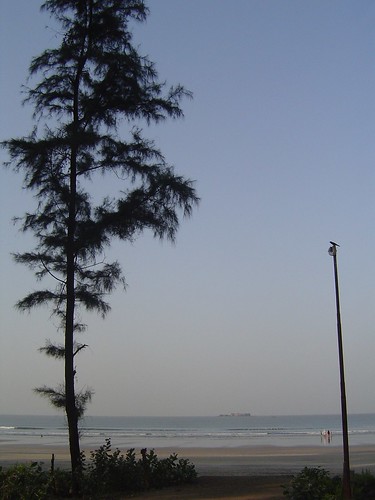
But as it turned out, there are TWO island forts in Murud. This one was called Kasa fort, it was built by Shivaji’s son Sambhaji after repeated Maratha attempts to conquer Janjira fort failed. By the way, that’s a Casuarina tree in the foreground of the photo. At night we saw a noisy fruit bat colony flying out of the Casuarina grove.

We had a great dinner, watched TV, and got up the next morning, refreshed and ready to see the Janjira Fort (well, I dunno about the others but mom was definitely ready).

We saw these deserted ruins on the drive to the fort, and later found out that they were the tombs of the Siddi kings, who built Janjira Fort.

The Siddis are black Africans who were originally sold as slaves in the Indian subcontinent. However, because of their success as fighters and seamen, they rose gradually to power. Small Siddi kingdoms were established in Western India in Janjira and Jaffrabad as early as the twelfth century. The Siddis played an important role in the history of Western India, particularly in the struggle between the Marathas and the Mughal empire; with the Siddis often aligning themselves with the Mughals.

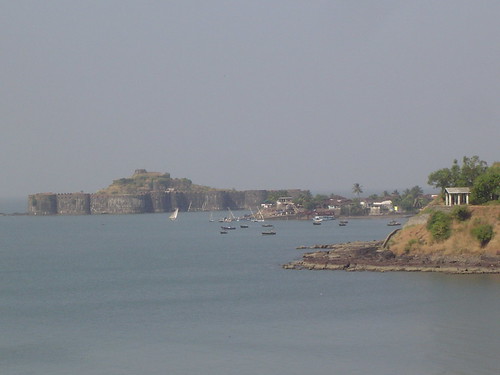
Here's a closer view of Janjira fort, accessible only by sailboat. I’d never been on a sailboat before. This was a novel way of traveling - no motors, no noise. Very Siddi.

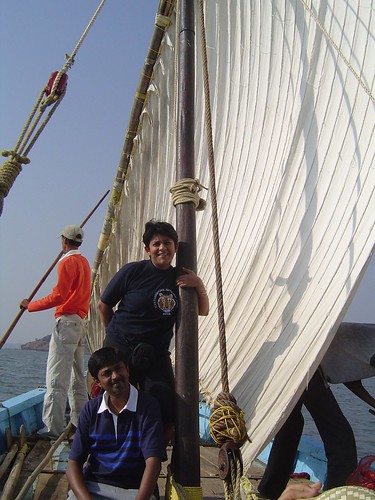
Mom and dad in the sailboat. The white sails are really nice, don’t you think?
The first thing we saw when we disembarked at the fort was the royal insignia of the Siddis , a lion climbing up on the backs of elephants. Does that signify Africa over India, I wonder??? The boatman told us that in order to gain access to the fort, outsiders had to first display a coin or ring with this seal.


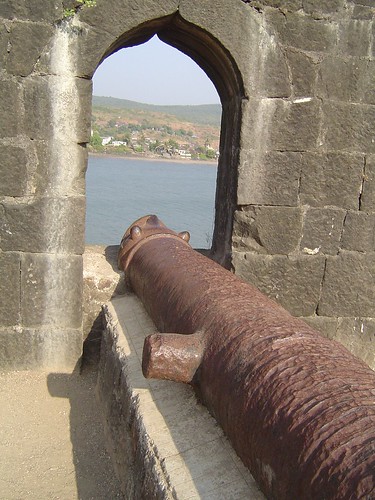
The fort is large, and there's lots to see. There are nineteen rounded bastions; each bastion houses a cannon, intimidating would-be attackers. Here is one of the smaller cannons. It is called ‘Go-Mukh’ meaning Cow-Face. (You can see why, right? Check out the ears!) The cannon is made of an alloy which keeps it from getting too hot in the summer sun.
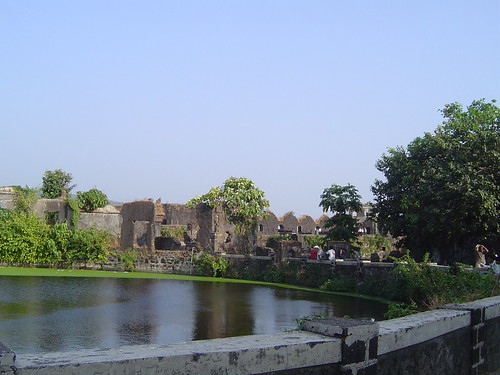
This is the water tank inside the fort, fed both by an underground spring, and rains.

Down below is a secret entrance into the fort, designed cleverly to look like just another window. During high tide it is completely hidden by water.
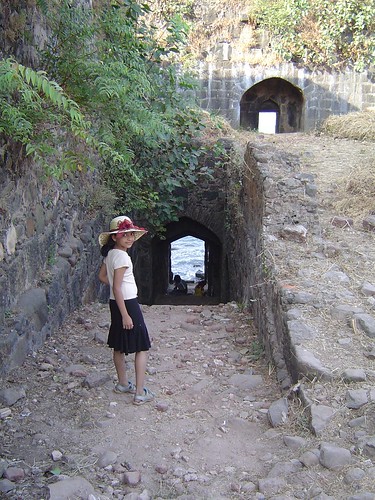
The guide also showed us an undersea escape passage from the fort, which is supposed to open out into the mainland (I didn't know whether to believe him!). The passage has now been boarded up, for safety, he said.

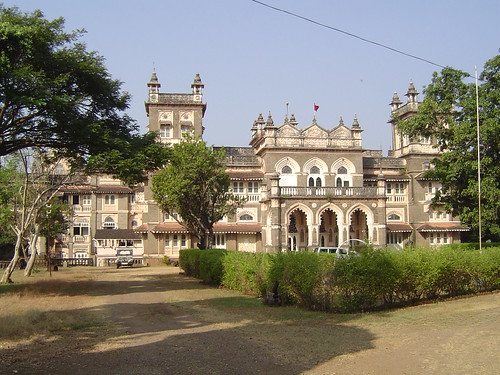
We left the fort and returned to the mainland, again by sailboat. On the drive back to the resort, we saw the palace of Sir Siddi Ahmed Khan, the Nawab of Janjira. Before this palace was built in 1885, the Nawab used to live in Janjira Fort. Now his descendants live here. The Nawab was a very farsighted man. One of his many projects was the Victoria Jubilee Water Works, which even today supplies water to Murud.

Later that night, we hired the same sailboat and we went for a one hour sail. We took snacks and drinks from the resort and ate them on the boat. The stillness, the moonlight, the gentle rocking of the boat, and the dark fort walls looming on one side, all made the sail a surreal experience. And the tikkas were great!

The next morning, after breakfast and a buggy ride on the beach, we drove back to Bombay. The route back is dotted with little farms and villages. We stopped and clicked lots of photos, but more about that some other time!

Thursday, December 20, 2007

Why the Dandi march is a big deal

If you walk into Mani Bhavan on Laburnum Road, you'll see this striking illustration by Nandlal Bose - it is a portrait of Mahatma Gandhi, at the 1930 Salt March in Gujarat.

"Here was the pilgrim on his quest of truth - quiet, peaceful, determined and fearless." - Jawaharlal Nehru

Why was the Salt March a "quest of truth"? And why did Gandhi decide to do it?

In 1780, the British Governor-General Warren Hastings brought salt manufacture and taxation under total government monopoly. By the 1800's salt had become a major source of revenue for the East India Company. Prices of salt were so high that the common man could no longer afford it. In fact, in 1836, at a Parliamentary Select Committee, Dr. John Crawfurd of the Bengal Medical Service gave the following evidence: "I estimate that the cost of salt for a family in Bengal as being equal to about two months’ wages, i.e., 1/6th of the whole annual earnings."

The Salt Tax seemed morally unjustifiable to Gandhi - here was a widely manufactured essential commodity that had been summarily appropriated by the Government. The objective was clearly the spreading of the widest possible dragnet for tax collection, with no concern for the hardship it imposed.

Already, a prosperous rural economy had been destroyed by ruthless land revenue and forest management acts. The British had seized and converted local farmland to foreign-owned plantations, restricted internal trade, destroyed the livelihood of nomads, taxed Indians heavily to support unsuccessful expeditions in Afghanistan, and set in motion inflationary measures that increased the price of food. (To get some perspective into this, just look at this statistic: Between the period 1875 to 1902, 26 million Indians died of famine).

Not surprisingly, Gandhi called the Salt Tax "the most inhuman tax the ingenuity of man can devise". He first protested against it in 1891, in an article in 'The Vegetarian'. In 1930, as part of his Civil Disobedience Movemenet, he decided to organise a mass protest against the tax.

The protest took the form of a long walk, through Gujarat, from Sabarmati to Dandi on the coast.

The Salt March: 241 miles in 24 days

The walk went through many villages in Gujarat, and grew in size and number as it moved on. Gandhi halted at several locations and delivered speeches. In the three-week period, it got widespread international and national press coverage. On the morning of April 6, Gandhi and his followers made their way to the seaside at Dandi, where after a ritual bath in the sea, he picked up a handful of muddy salt.

But was the Salt March a success? Did Gandhi's defiance of the law have any effect?

Immediately after Gandhi broke the salt laws, what began as a Salt March quickly changed into a nationwide movement. Mass civil disobedience spread throughout India as millions broke the salt laws by making salt or buying illegal salt. Salt was sold illegally all over the coast of India. A pinch of salt made by Gandhi himself sold for 1,600 rupees (equivalent to $750 dollars at the time). In reaction, the British government jailed over sixty thousand people by the end of the month. Gandhi was jailed for a year. However, the salt laws were not repealed in the Gandhi-Irwin pact of 1931, and freedom came to India only 17 years later.

All the same, in my eyes, the Salt March was a resounding success.

In the first place, it was the beginning of the common man's participation in a mass nation-wide struggle. "People of common clay felt the spark of life." said Jawaharlal Nehru, describing the phenomenon. Secondly, it was the first time Indian women played an active role in the freedom struggle. A government report at the time stated that "thousands of women emerged....from the seclusion of their homes...in order to join Congress demonstrations and assist in picketing: and their presence on these occasions made the work the police was required to perform particularly unpleasant."


The Salt March also brought for Gandhi, immense media attention from the West. In 1930, Gandhi became the Time magazine's Man of the Year. And much to Churchill's annoyance, the Government had to parley on equal terms with the leader of a subject nation.

While these things were important successes of the Salt March, to Gandhi the march was always about doing what was morally right. "I want world sympathy in this battle of Right against Might", he wrote from Dandi, in his endearing scrawl. You can see a copy of this letter at Mani Bhavan.

If you're planning to visit Mani Bhavan, then read the little paragraph below before you go. It is Rabindranath Tagore's description of Gandhi the Mahatma (Great Soul). The magic of Gandhi comes alive in Tagore's words.

"
He stopped at the th
reshold of the huts of the thousands of dispossessed, dressed like one of their own. He spoke to them in their own language. Here was living truth at last, and not just quotations from books. For this reason the Mahatma, the name given to him by the people of India, is his real name. Who else has felt like him that all Indians are his own flesh and blood?

At Gandhi’s call India blossomed forth to new greatness, just as once before, in earlier times, when the Buddha proclaimed the truth of fellow-feeling and compassion among all living creatures
".

Sunday, December 16, 2007

Popcorn, local style

Spotted on the Mumbai-Pune highway: Chaat Masala Popcorn. Now I've seen it all.

Thursday, December 06, 2007

The Great Indian Bargaining Game

Many overseas visitors to India are taken aback at the kind of street shopping that they experience.

The touristy parts of the country - Delhi, Agra, Rajasthan - are full of pushy vendors trying to sell them things at downright outrageous prices. In Bombay's Colaba district, I often see street vendors quoting tourists twice or thrice the normal price.

I met an American lady recently, it was her first visit to India. She said to me, "Deepa, when I shop here, I feel so much at a loss...I'm the outsider, and I feel like I have to constantly watch out so I'm not cheated." She was a smart, savvy woman, but she felt almost abused, emotionally as well as financially.

I thought about what she said - and realised that she was experiencing a kind of culture shock.

Any Indian woman will tell you that if you look prosperous, vendors will always quote you a higher price. All of us learn to handle this sort of situation - by watching other women, and of course, by learning from experience. I used to find bargaining very intimidating. But these days when someone quotes me a totally wacky price, I just grin widely and say the Hindi equivalent of "Yeah right, go pull the other one". Then we haggle back and forth a bit, and when the price gets to the point where I think the vendor is making a good margin, I give in. It's all part of the Great Indian Bargaining Game, and it has taken me a while to master it.

So I sat down to explain it to my American friend. I said, shopping in India is a state of mind, a game that you play. To treat this overcharging-bargaining game as a personal insult, or worse, to think of yourself as a victim because this doesn't happen in your country, is just totally missing the point.

I told her she needed to apply a different yardstick when in India. No one was singling her out for extra-harassment...this is how the shopping culture in this country works. Street vendors are not demons - they're just a bunch of fairly poor people trying to get a few extra dollars off anyone who looks like they can afford it. In my MBA school they called this "what the market will bear" pricing.

India is a both a destination and a journey. It has woven its magic for millenia now, on travellers from all parts of the world. It is a complex and rich culture, with so much to offer - but the rules are different. To explore this sort of complexity, you have to step out from the comfort zone of neatly labelled racks and polite checkout greeters. You have to embrace the street shopping and bargaining spirit.

It can be fun, actually. There's the crafty assessment of what something is really worth, the starting position, the bantering conversation and the give-and-take, the testing of each other's mettle, and the final agreement on how one particular shawl fits into the overall cosmic scene of things!

Travel wouldn't be half as interesting if the world was one big Walmart.

Tuesday, November 27, 2007

Gotta love Linking Road

If you're on a budget and still want to shop, head for the street stalls on Linking Road.

Nothing fancy about them, but they sell everything you can think of: bags, shoes, skirts, hairclips, belts, sun glasses, bras, undies...and all of it for prices that are amazingly low.

Last week I went to Linking Road looking for a challa - an ornament for the waist (don't ask me why I wanted it!).

I had to hunt long and hard to find it - apparently challas don't have any takers on Linking Road these days - so I ended up clicking a lot of photos of other shops instead.

Skirts with fancy beadwork at the waist. The gypsy look is obviously in.

Salwar kameezes and ghagra-cholis in several colours.

The kameezes are elegant when sleeveless, but for more modest women, there are matching little sleeves that can be attached by a tailor. Indian women traditionally prefer cuts that are loose and straight, that don't hug the body and outline every curve. But the shopkeeper wants to make the mannequin look sexier, so he bunches up the fabric and clips it at the back, like in the pink kameez in the photo above.

Bags to go with whatever clothes you buy.

Some bags can pass off for expensive stuff, but you need a fine eye to figure out which ones. The guys who own bag shops are armed with two things - one is a long stick with a sort of nail at the end - that's for picking bags off the "shelves" and putting them back. The other is a duster. This is the roadside, remember? Dust settles constantly on the bags. If you ask the shopkeeper to show you a bag, he uses the long stick to bring the bag down, gives it a few whacks with the cloth duster, and only then hands it to you.

Bags are all very well, but everyone knows shoes are serious business. Even if they're dead cheap.

There are lots and lots of shoe shops here. The shoes are perfect for college kids - colourful, funky, affordable. You can also buy party shoes here, but don't expect them to hold out long if you're planning to dance the night away.

Hair-clips and bands for little kids.

The price ranges from 5 rupees to 50. In the UK, I've seen similar things sell for at least twice or thrice the price.

Lawn-je-ray for the grown-ups!

I really must find out where these underthings are made. I used to think they came to Bombay from somewhere Far East (because the bras are all padded, you know?). But now I'm not so sure. Maybe we're making them here to *send* to the Far East, and these are factory rejects.

Anyway, it was surprisingly difficult, clicking photos on Linking Road. No matter how patient or clever I was, someone or the other would walk into the frame and ruin the whole thing.

After about 30 minutes of clicking away, I found one shop that sold what I wanted - oranmental challas. An air-conditioned shop, that too. I looked at several designs that the counter salesman showed me (I tell you Bombay shopkeepers are a really patient lot) - and finally walked home triumphant with something in gold and maroon.

Total damages for the day: Rupees 700. Not bad, not bad at all.

Thursday, November 15, 2007

Mystery Goddess

I found a poster of this goddess in Null Bazaar, right next to the vegetable section.

Anyone know who she is? I can't tell.

She was in a shop selling ceremonial stuff for weddings - incense sticks, little plastic coconuts, paper flowers and other tinselly stuff.

I think it is the Goddess Gauri, but I can't figure out what the parrots are all about.

The design on the forehead suggests she is Maharashtrian. So does the nose-ring. It is a strange poster, half drawing, half-tinsel, with a real nose-ring, and a real mangalsutra round the neck. Looks like something someone would place or gift during a wedding ceremony.

Null Bazaar has a big community of fisherwomen who have stalls in the fish-and-meat section. You think this is something to do with them?

Friday, November 02, 2007

I learn an old cooking technique

The walls of Mushtaq Bhai's kitchens are caked with soot, from years of cooking. Every time I go there, I get new lessons in cuisine.


This time was no different. I watched in fascination, as the mutton was first cooked with fried onions and masala, with a little water.

And then the cook showed me the crucial next step - Death by Onion! First, a thick layer of sliced onions was spread over the meat. Next, finely chopped green chillies were added. Then the handi was covered and the meat left to simmer in its juice for 30 minutes.

This of course, is the famous do-piyaza (literally, two-onion) technique, where onion is introduced into the dish at two stages.

The first stage is right at the beginning, when the meat is braised with onions, garlic, ginger and garam masala. Some yoghurt is added, to give the dish a little piquancy. When the meat is three-fourth cooked, then the second stage begins. The quantity of onion in the second stage is important - it is nearly twice as much as the meat.
I like this idea. The essence of the chilli and onion seeps into the mutton.

The do-piyaza was a favourite in the Mughal courts - Akbar's scribe Abul Fazl records that it was served as part of the royal repast, although Akbar himself preferred a simple diet of khichri-kadi (rice and yoghurt).

Akbar's son Jahangir, in the Tuzuk-e-Jahangiri, writes about a do-piyaza that he ate on a hunt:
"One day on the hunt, I shot a female nilgai, and two fully formed young ones were found inside. As I had heard that the flesh of the nilgai fawns is delicate and delicious, I ordered the royal cooks to prepare a do-piyaza."

And how did the do-piyaza taste?

"It was not without flavour", was Jahangir's royal pronouncement.

Sunday, October 28, 2007

Mythology in everyday language

- by Janaki Krishnan
Last week, I visited my friend Nirupama in Dadar. It was 10:00 in the morning. "Where is your son?", I asked her. "Oh, that Kumbhakarna? He's still asleep", she said in Marathi. We both laughed. She was referring to the demon Kumbhakarna who slept for 6 months in a year, and could only be woken up with loud drumbeats and trumpets.

As I walked home, I thought about how Indian languages, even in common usage, are rich in mythology, and how a single mythological reference easily conveys a wealth of meaning.

I remember my grandmother, who was laid down by cancer in her later years, referring to my mother as Bhoomadevi - Mother Earth, for all the burdens she shouldered so patiently.

A short-tempered neighbour, known for his loud outbursts, earned the name Narasimha - Man-Lion. As kids, we used to be very amused, imagining him as Narasimha, the fearsome form of Vishnu, half-man, half-lion. Just as Narasimha refused to calm down even after destroying the demon Hiranyakashipu, our neighbour refused to be quiet even when his entire household had beaten a thorough retreat.

With a mythology as rich as ours, there is no end to amusing metaphors. Take for example, my food-loving cousin. Whenever he visited someone, he would always check with the lady of the house whether anything good was being served that day. Naturally, the elders often said to him "Don't be such a Bakasura!".

Similarly, I have heard wily women being referred to as Manthara, and short men as Vamana or Agastya. And of course, scheming men are universally described as Shakuni.

In modern times, these rich metaphors have taken on interesting shapes. Indian languages have begun to reflect more recent personalities and characters.

My colleague Deshpande was known for his truthfulness. "Oh, that man? He is such a Gandhi!" is how people described him. The tone would be sarcastic or humorous, and usually hinted that although Deshpande's integrity was high, he was somewhat out of touch with reality.

I have also heard households where the woman's voice is supreme being described as under 'Indira Gandhi Raj'. I'm sure, in a few years, 'Sonia-ji' will come to mean a woman who wields the real power from behind the scene!

Perhaps I should compile a new dictionary with all these fascinating metaphors, old and new. What do you say?

Sunday, October 21, 2007

One year of dance lessons

- by Deepa Krishnan

Today is Vijayadashami, the tenth day of the Dassera festival. This is the day on which every dancer seeks the blessings of his or her guru.
It is also traditionally the day on which new dancers are initiated into the art.

I began dance lessons last Vijayadashami, so it has now been a year of learning. I learnt dance as a child; therefore this is not entirely new to me...but in some ways it is harder, because I have to unlearn some of the earlier habits.

In the past year, I'v
e struggled with getting back into the rhythms and postures of classical dance. But the body is an amazing thing - when you push it, it responds. I can see myself improving, day by day. Now if only I could practice more regularly!

Here are some photos from today's Vijayadashami celebratio
ns. When I got to the venue, one of the senior dancers was just beginning to draw kolam at the doorstep.

She looked like she needed help, so I sat down to assist.

The pattern we drew is a traditional Tamil kolam. You start with a square (see the central one with four connecting lines?) and then you draw the extensions.

These were the tools we used:
- powdered red clay, to create the base
- white Cherry Blossom shoe shine, instead of the traditional rice powder or paste
- chalk to try out designs
- paint brushes, instead of using our hands the traditional way

The final design was not just beautiful and welcoming, but also auspicious. (We were pretty pleased with our efforts, even if we did cheat). For all you purists out there, if you want to see this sort of kolam done the traditional way, then here is a good link.

After the kolam, we went inside and joined the rest of the audience. Eventually, the hall filled up, with students and their parents. Here is one section of the hall. The girls in the front row were new, just starting their lesson today. Older girls distributed flowers, for the ritual offering to Lord Shiva that would mark the beginning of the event.

Here is my guru, Jayashree Rajagopalan, in a beautiful orange and green sari. She spoke to the parents about the Natya Shastra, the world's oldest codified treatise on the performing arts. The Natya Shastra is the root source of India's classical and folk dance forms.

The first part of the program was, of course, a prayer to the Great God Shiva, in his form as Nataraja, the Lord of Dance. We offered flowers, bowed to him, and then began the performance.

I made several errors, Nataraja's grace notwithstanding. The guru was kind to me, offering encouraging words, and helping me get over the mortification.

(I still wince when I think about it. Aaaaaaarrrrrrrrrgh. I'll do better next year. I promise!)

Saturday, October 13, 2007

Starting a conversation

- By Janaki Krishnan
Perhaps it is the frequent weather changes in the UK that make the Englishman begin a conversation with remarks about the weather. Indians with their diverse customs and climate have different ways of starting conversations.

In fertile Kerala, the southernmost state, people tend to begin conversations with remarks about the activity involved at that moment. For example, if you're bathing in the river, and someone stops to chat with you, the conversation begins with 'Kulikyya?' (Bathing, eh?). Or if you're resting, then it's 'Kidukkua?' (Resting, are you?).

In North India, even before starting a conversation, people touch the feet of their elders saying 'Pai laagoo' (Hindi) or 'Pairi pauna' (Punjabi). This greeting literally means 'I fall at your feet', and is a way of showing respect to older people. The usual response is an affectionate blessing - 'Jeete Raho, beta' - may you live long, child.

India has many ways of saying even the common 'How are you?'. In Gujarat it is 'Kem chho'. The Maharashtrians say 'Kasa kai', the Bengalis 'Kaimon aache' and the Tamilians 'Eppudi irrukenga'. It is impossible to list greetings of all communities. With 22 official scheduled languages, and 415 other living languages, India has among the most diverse spoken cultures in the world.

Often, greetings involve the names of Gods. In Maharashtra, the standard greeting in villages is 'Ram Ram' - referring to the God Rama, hero of the epic Ramayana. If you meet someone of a higher status, you add 'Saheb' to it, to acknowledge the difference in status - Ram Ram Saheb.

Muslims in India, in general, use 'Salaam aaleikum' - Peace be upon you. Many Hindu religious organisations have evolved greetings of their own. If you call the ISKON temple, you'll be greeted on the phone not with a 'Hello' but with a 'Hare Krishna'. The Chinmaya Trust uses 'Hari Om', and devotees of Sai Baba say 'Sairam' as a form of greeting.

And so it goes on. The manner in which a person starts a conversation provides clues to the identity of the person. In a diverse country like India, this can be quite useful!

Mumbai, of course, has it's own style. The busy Mumbaite, rushing to catch a local train, has learnt how to begin and end the conversation at the same time - 'Hi yaar, how are you, chal, see you!'