Saturday, January 13, 2007

One-stop mini mall

As I walk along the streets of Matunga, I marvel at how South Indian culture has been transported to this small stretch in central Mumbai.

This tiny pavement shop is a perfect example.

It sells all the little things that Brahmins need to live life as prescribed by the Vedas. The Vedas contain rites and rituals for important events such as birth, marriage and death. The central element in the rituals is the sacred sacrificial fire.

The long Kusa grass you see stacked on the left is laid on the floor around the sacred fire for purifying the area. Shorter Kusa grass is twisted around the ring finger while offering oblations into the fire. Small twigs of the banyan tree are used to feed the flames. The fire itself is built using dried cowdung cakes as fuel (see if you can spot it in the picture!).

On the shelves at the top of the shop, you can see little containers with sandal powder, camphor, sacred ash and turmeric. A little plastic has crept into the packaging, but in all other ways, the rituals remain the same as they were four thousand years ago.

We looked around for the shop owner, and spotted him taking an afternoon nap.

Obviously, Bombay's modern-day rush
hasn't yet reached this corner of Matunga!

- JK

Saturday, January 06, 2007

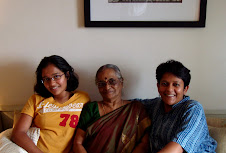
Saree as Pants

Some things are just plain cool.
Can you hear the swish of cotton as she walks?

Wednesday, January 03, 2007

Climbing the Sahyadris

Just a hundred kilometers from Mumbai, the Sahyadri hills begin.

This New Year weekend, we decided to go climb one of the hills to see the ruins of Korigad, a fort built on top of the hill.

There are nearly 350 forts in Maharashtra, evidence of a martial past, when the Marathas fought long and hard to shake off Mughal rule. Some of Maharashtra's forts are large strong cunning affairs, built on islands in the sea, or on the shore - but many like Korigad are small clever mountain hide-outs in the Sahyadris.

What makes the Sahyadri forts interesting is the way the very mountain lends itself to warfare.

You see, unlike the Himalayas, which were formed by two tectonic plates colliding, the Sahyadris are a relict of an ancient table-land, whose sides have been scooped out by massive erosion. (Check out the Deccan Uplift map, very cool pics)

How does that help in warfare?

In two ways - first, the sides of the mountains are steep. The
climb is so steep in places that invading armies can't come up except in ones and twos.

And second -
the top is flat! In fact, it's so flat that Korigad actually has a lake on top, inside the fort. What a clever place to hole up! There's probably water enough to last for a few months in troubled times.

There's a Marathi saying -
Jyanche kille, tyanche rajye. He who owns the forts, rules the land. When I went to Korigad, I could see the sense in it.

Here's a photo of husband and me at the top, inside the fort. You can see how flat it is. Behind us is a small part of the lake (full pic here). At the far end is the fort wall.

Why is the wall only 8 feet tall? Because the other side of the wall is a sheer drop, of course! Barring the one route by which we came up, the other sides of this hill are steep and difficult to climb. They knew what they were doing when they picked this place for a hide-out!

The coolest thing about Korigad is actually the fact that it is so close to Bombay - just two hours away - and yet so charming and unspoilt. We sat on the fort wall, in the shade of a leafy bush. We ate salted peanuts, drank cold water, played desultory word games and watched the birds. The afternoon was quiet and still, we had the entire fort to ourselves. I could hear bees buzzing. The breeze and the sun were doing their bit as well, making me drowsy.

I tell you, I've become a Sahyadri fan.

Saturday, December 30, 2006

Birds Ahoy!

Isn’t he handsome? Meet Aquila heliaca, the Eastern Imperial Eagle. He comes from Europe and the Middle East, and visits India every winter - clearly, this guy likes to travel.

If you’re lucky, you can spot him in Mumbai -
Sewri Bay is one of the best birding sites along India’s West Coast. Around 150 species of birds winter here, including Mr. GoodLooking above.

Unfortunately for him though, he isn’t the star of Sewri.


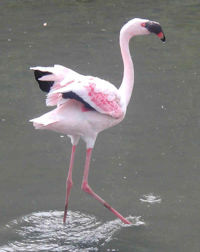
What people flock to see in Sewri is Phoenicopterus minor -
the Lesser Flamingo. Pink and petite, flamingoes come to Mumbai in huge numbers in November, and stay until March. Why do they like this place so much? It's because of the sheltered nature of the bay, the gentle tides, and the organic richness of the food.

Sewri is also a winter refuge for nearly half a million waterbirds, including sandpipers, plovers, gulls, stints, terns and several globally threatened species such as the Nordmann’s Greenshank, Greater Spotted Eagle, Oriental White-backed Vulture, Long-billed Vulture and of course, the Eastern Imperial Eagle.

If you’d like to visit Sewri, join the BNHS walk on Jan 7.

- Aishwarya

Love stories from the Raj

The pavement bookstalls of Matunga fascinate me.

It's not that I cannot afford to buy from regular bookstores - but how much more fun it is to stand and browse the higgedly-piggedly stacks, to search among the many second-hand titles and stumble upon some hidden treasure!


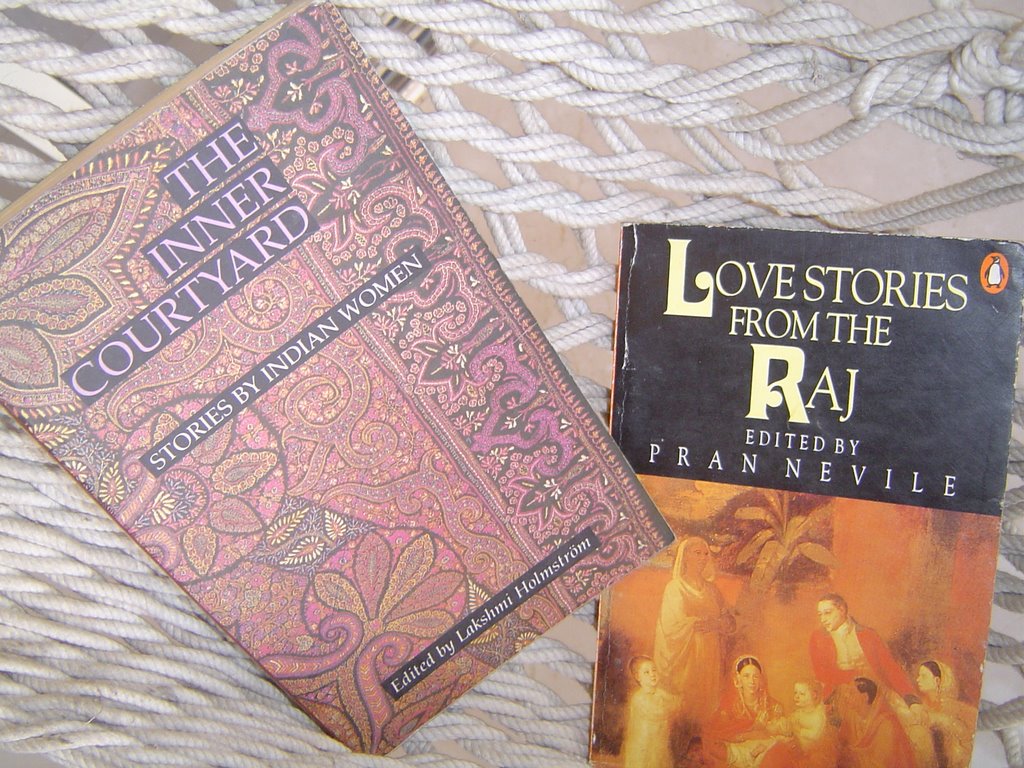
Yesterday, I stopped in Matunga to run some silly errand - and ended up at the bookstalls as usual. Here is what I bought, after a 20 minute search:

The Inner Courtyard is exactly what its preface says - "a constellation of some of the most dazzling stories" from the writings of short fiction by Indian women. How could I resist it?

Love Stories from the Raj is Pran Nevile's interesting account of money, lust and longing in British India. There are 21 stories, each based on fact, but written as fiction. The painting on the cover is of William Palmer, confidential secretary to Warren Hastings, and his Indian wife Fais Baksh, a descendant of the Moghul emperor Shah Jahan.

I paid INR 120 (less than 3 US$) for the two books together.

I also bought 3 old Tarzan comics and 2 Batmans (INR 25 per book). And regretfully declined two shoddy prints of Laxman's "You Said It".

A very satisfactory morning, all in all.

- Deepa

Sunday, December 24, 2006

Incredible ikat

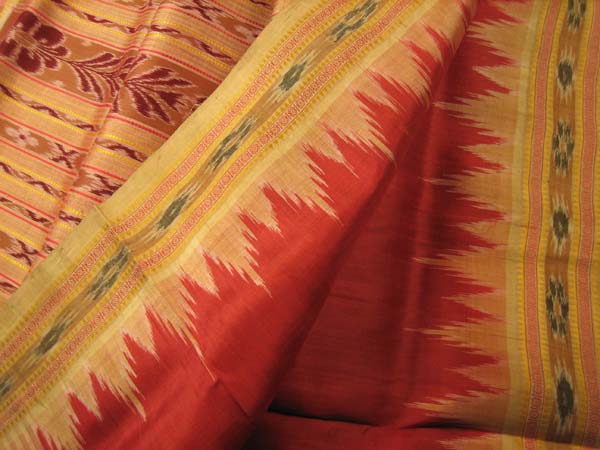
This morning, my mom and I took stock of our Orissa ikats. We have several in our collection already, but the sale at Chetana Craft Centre was still tempting.

Have you seen an Indian ikat?

It is such an amazing piece of work!
Amazing, not because of the gorgeous geometry, or the bold colours. Or how softly it drapes the body. What makes ikat incredible is all the creative imagination that goes into it even before the cloth is woven.

You see, when an ikat weaver creates a saree, he lines up the raw yarn, imagines the final design, and then colours the yarn differently in different places. And that's what creates the pattern of the saree - the sequence of colours on the thread itself.

Here is how it works:

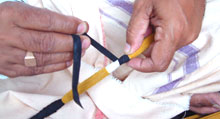
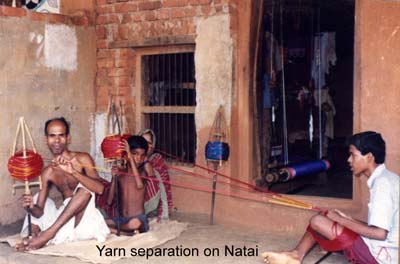
Step 1: Line up the yarn and measure it

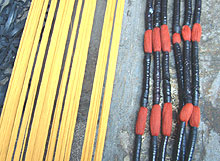
Step 2: Cover up the portions you don't want coloured (he's using a simple black rubberband)

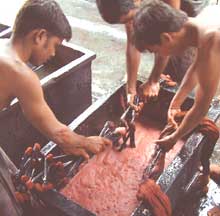
Step 3: Dye the uncovered portions

Step 4: So here's how it looks after dyeing - the red parts are the coloured bits, the black is uncoloured.

The colouring process is repeated, until you've coloured the entire thread with the precise colours you want.

Step 5: Unwind the thread!


Step 6: Now arrange it carefully on the loom, and weave it...the result is magic!

See why we're crazy about ikat?

- Deepa
Acknowledgements: The photos for this post came from sarisafari.com, onevillage.com, orissa.net and the animalrescuesite.com

Monday, December 18, 2006

On a more personal note

Come Monday morning, I am a mass of aching muscles.

It's the weekend dance lessons, taking their toll.

I am learning a mix of vyayama (excercise), sthanas and charis (stances and leg movements) and adavus (steps).


A lethal mix. And one that I should not attempt at 38, perhaps.

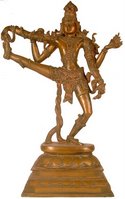
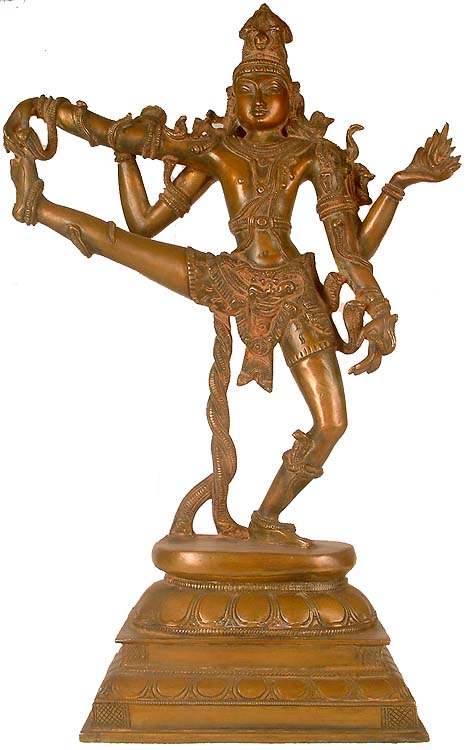
At some point in the future, I will, I hope, become flexible, poised, graceful...until then, I can only look at Him, the Lord of Dance, and marvel.

Post Script: If you can straighten your leg out like that statue, let me know. You'll have my warm admiration.

Sunday, December 17, 2006

A Chinese Connection

If you walk past Kala Ghoda, spend a minute or two to peek into the doorway of the David Sassoon Library.

This is what you'll see inside - a beautiful carved doorway, wooden panelling on the walls, a corridor paved with Minton tiles, and at the end of it, a marble statue of David Sassoon.

The Sassoons were wealthy Jews who migrated to India in 1833 from Baghdad. They were clever businessmen, establishing themselves quickly in Bombay under the British (this inspite of the fact that David Sassoon didn't speak a word of English). I wiki-ed the family, and found lots of interesting stuff.

It appears that our Mr. Sassoon was quite the wheeler-dealer. He was in fact, one of the key players in Britan's Opium War with China. Check out the full story here.

Clearly, money talks. And when it does, it is heard.

Sunday, December 10, 2006

Complex complex

Guess what this is!
This is a map of the Buddhist caves at Kanheri. A bit like a rabbit warren, don't you think? Kanheri grew over a period of eight centuries to become one of Western India's largest Buddhist monk settlements. As it grew, the monks carved out more and more caves, until the entire hill was dotted with prayer halls, sleeping quarters and water tanks.

H
ere's the key to the map. As you can see there are over a hundred caves - with lots of tanks and cisterns to store water.

If you ever get to Kanheri, use the map to figure out how to get from cave to cave. The starting point is the Booking Office, which you can see illustrated at the bottom of the map.

It can be interesting. One overseas couple who tried it had this to say: "The map in the guide book looked bizarre. It was simply a series of dots and numbers that resembled a child's connect-the-dots puzzle. However, like so many other systems in India that seem totally illogical or unintelligible on the surface, those amazing little numbers helped us find all the caves we wanted to see in that honeycombed ravine. That was just as well, because there was no one to ask for directions!".

Kanheri is set well inside Sanjay Gandhi National Park, so it is calm and quiet and green, very different from Bombay's usual bustle and noise. See for yourself.

Sunday, December 03, 2006

Not just another tree

If you stand at the Police Headquarters on Regal Circle and look towards the Prince of Wales Museum, you'll spot a large pipal tree.

How do I recognise the pipal, you ask? By the leaf, of course! What other Indian leaf has such a perfectly pointed end?

And what other tree has inspired so much devotion? This is the tree under which the Buddha attained enlightenment.

At Bodhgaya, the place of his enlightenment, people still worship this tree. And everywhere in India, Hindus, Sikhs and Buddhists treat this tree as sacred. Women pray to the pipal to be blessed with children. (By the way, the Latin name for this tree is Ficus Religiosa).


In the early years, the Buddha forbade images of himself - so his followers looked to other symbols for inspiration. The pipal tree, the wheel of dharma, the deer recalling the sermon at Sarnath, Buddha's footprints, all symbolized him till about the 1st century AD. This austere form of Buddhism is called the Hinayana tradition.

It was only later, when Mahayana Buddhism transformed the Buddha into a God, that carven images of Buddha came to be made. Legends of Buddha's previous births, the Jataka tales, and episodes from his life, all formed sources of inspiration for Mahayana painters and sculptors. You can still see the austere legacy of Hinayana Buddhist monks at Kanheri Caves in Mumbai.

And because Kanheri was a thriving settlement for many centuries, you can also see how more and more ornamentation crept into this beautiful simple religion as Mahayana became popular. Check out the add-on Buddhas carved into niches in the first four photos on this page. They're so clearly an after-thought! And on the other hand, in the more recent caves, there are large figures of the Buddha hollowed out of stone, very much a part of the planned design.