Saturday, July 30, 2011

An ode to Misal Pav

- by Deepa Krishnan

I don't understand why more people don't write or talk about misal-pav. It is, in my view, the city's tastiest Maharashtrian breakfast dish, spicy, tangy, low on oil and fantastic value for money.
Misal at Prakash in Dadar
Misal-pav opposite the Municipal Building at VT
Last Sunday, I photographed a plate of misal-pav (with my new camera!) at VT. It was being sold at a little nondescript hole-in-the-wall place that also sells pen refills and chocolates and aspirin. It was nine thirty on a Sunday morning, and the shop had a steady stream of people asking for misal pav.

Pav of course, is the bread. So what's misal?

The word misal means mixture, similar to the word mishran in Hindi. A lot of things go into the misal, and there is quite a bit of flexibility in how you put it together. Indeed, many Maharashtrians will tell you that nothing can beat a Kolhapuri misal, one of the spicier versions of this dish. There is the less spicy Puneri misal, the Nashikchi misal, and so on, with each local shop offering it's own personalised jhatka :) :) to the taste.

No matter what the variant, in general, a misal will have something called "usal" as its base, this is a dish cooked with safed vatana (dried white peas), matki (sprouted 'moth' bean) and chawli (black-eyed beans). Matki is the most popular, but all three are used, sometimes all together. The generic Marathi term for these ingredients is kad-dhaanya, an all-inclusive sort of word that encompasses sprouts and grains. A large variety of kad-dhanya are sold in every Maharashtrian locality in Mumbai.
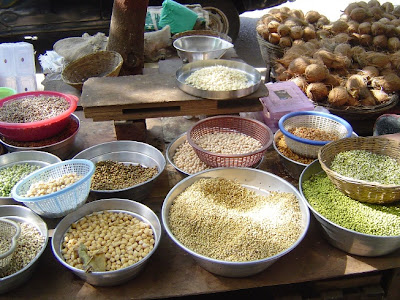
Kad-dhanya shop on Ranade Road in Dadar West, outside the Pethe jewellery shop. Everything is pre-sprouted and ready to cook, a blessing for the Mumbaikar

The key to a good usal is an eye-watering mouth-tingling spiciness, which is set off wonderfully by the pav. The spiciness comes from the unique masala.

A lot of people haven't heard of "Goda Masala", the Maharashtrian version of garam masala that goes into a traditional usal. It is a complex masala, totally unique, and packs quite a few surprises. For example, who would have thought a masala could have dried lichen (you know, the mossy stuff that grows on tree bark)? Amazing, no? The Western Ghats of Maharashtra are very bio-diverse, and they have a rich collection of lichens. So that probably explains how lichen ended up in this dish! I wonder who collects it - do they just scrape it off?!! :) :) I would highly recommend reading this wonderful account of Goda Masala by A Mad Tea Party. Great photos!

In my grandmother's home, we had masala-women, tribal migrants who came from the villages each year and pounded masalas in stone or iron mortars with huge wooden pestles. These days, the masala-women are no longer to be seen. Fortunately, you can buy goda masala in shops, like this one near Dadar station:

Walking into Family Stores in Dadar is an education in Maharashtrian specialty cuisine. Especially around festival days.

If you want to try making usal at home, you could skip the complicated stuff and just buy ready-made usal-misal masala, like this one from Kapol. There are lots of other brands as well.


The Kapol site also offers a simple recipe for how to use this masala

Once the usal is ready, you serve it piping hot with garnish. The garnish is usually a layer of shev (farsan), topped by onions, a wedge of lemon, and fresh coriander (as you can see from the Kapol photo above).

I've seen several different recipes for usal; some that only involve a tomato based gravy, but also some that involve tamarind. If you search online, you'll find lots of variants. If you understand Marathi, you'll thoroughly enjoy this cooking demo on Zee Marathi. The hosts of the show are TV stars; they are themselves having a whole lot of fun. The conversation is zesty and the recipe is easy. It substitutes garam masala for goda masala, so purists will wince :) but it is total dhamaal as we say here in Mumbai!!

Wednesday, July 27, 2011

We are like this only

In a Mumbai living room, doting grandparents, grand-aunts, grand-uncles, aunts and uncles gather around a little laptop screen. Everyone is smiling and saying incomprehensible things.

What's on the screen? Two tiny twins sitting at a laptop in Cinncinnati, lisping nonsense and winning hearts with every lisp. Welcome to the world of Skype in India.

"We are like this only".

Saturday, July 16, 2011

Advantage, Omni!

- By Deepa Krishnan

The black-and-yellow Fiat Premier Padmini has long been the iconic taxicab of Mumbai.

But of late, many new taxi models have started to show up, smartly turned out in the mandatory black-and-yellow.

Among all the new models, though, it appears the Omni has one special advantage...

Superior leg room, made possible by sliding doors!!

Advantage, Omni! :) :) Move over, Fiat!

Saturday, June 25, 2011

Of beads and happiness !

- By Deepa Krishnan

One of the nicest things about living in India is how you can get something custom-made so easily. Today I set out to repair a broken green necklace, and to create a new piece of red coral jewellery for myself.

This green necklace is one of my old favourites...but has been sitting inside my jewellery box for a while now because it broke while we were on a TV shoot.

Mercifully, I didn't lose too many of the beads. So I put all the broken bits away in a little box, waiting for the day when I would have some spare time.

Today, I finally found the time, and took the box to my local street-side jeweller, Mr. Raju Patwa.

The Patwas are a traditional group of craftsmen who work with beads. Although this man had not seen the original necklace - all I gave him were loose beads - he took one look at it and created something just as attractive as my old one. I sat on a little stool next to him, and watched him deftly put it together. At the end of 15 minutes, I had my necklace back, and a big smile on my face! The cost? Thirty rupees. I was very pleased because I used to wear this necklace very often, and I missed not having it.

My next project was more ambitious. I have this really lovely coral pendant set in silver. It used to be strung on a single red leather thong, but the thong broke. So I was stuck with the pendant, not knowing what to do with it.

This time, I wanted to string it on something slightly chunky looking. So Mr. Patwa and I spent 15 minutes looking at different beads and arranging / setting them in different combinations. After examining red, green, and silver beads, and tsking and tut-tutting our way through many wrong combinations :) we finally hit upon the idea of using tiny black beads, interspersed with asymmetric long coral beads.

Once we had agreed upon the basic idea, I left Mr. Patwa to think up the actual creative bit of how to make the idea come alive. I was to come back after an hour, to see what he had done, and then we'd figure out any further changes.

With an hour to kill, I wandered through the market with my mom and sis. We went to a specialty food store, stocked up on some favourite treats, bought fruits and vegetables, ate rawa dosa and had mosambi juice...and by the time I came back, there was a half-finished necklace waiting to be tried.

So then we went to the final stage: I tried it, we added some beads, removed some others, modified the length so it would be just right for me...and finally, I took it home. It had taken totally 1.5 hrs to get this necklace done. I paid Rs 300 for the coral, black beads, design and labour and thought it was well worth it to have something so personalised.

And then...(sigh)...the pleasure of wearing it (and knowing no one else has one just like it!).

My sis saw the necklace and said, I want to design one too! She has just today bought a silver pendant and ear-rings from SIA (where there is a massive sale going on), and we're going to make an expedition to Bhuleshwar to buy beads. Then we'll come back to Mr. Patwa to figure something out for her. I'm looking forward to the next creative session!

Friday, June 17, 2011

Dastangoi in Mumbai - wow!

- By Deepa Krishnan

Wow. It's not often you get to see a live performance that is this fantastic. To think I almost didn't go!

This is Dastangoi, the art of story-telling, that used to be popular among the Mughals. I went for a show a couple of weeks ago, at M C Ghia Hall in Kala Ghoda.

The Mughal Emperor Akbar loved Dastangoi performances, and encouraged them in his court. The art died later; so this is a revival of a lost form. But the show that I saw was different in some aspects.

For one thing, the original Dastans (tales) were usually told by a single guy. The Dastan I heard had two narrators; Danish and Mahmood. They took turns to tell the story to the audience; skillfully passing the baton back and forth. They also conversed with each other as part of the story, often enacting conversations between two different characters. Their timing was perfect. They were witty and the script was incredibly funny, so all through the performance, we were rolling with laughter. If you ask me, it was much better than having a single narrator. Here's a photo of Danish and Mahmood with mock-serious faces, saying the most satirical things. The audience was literally in splits. We were forbidden by the duo from clapping in appreciation, so all we could do was say wah-wah, wah-wah in traditional style, and collapse laughing.

The original Dastans were about djinns and magic and adventure and what not. Here's a scene from the most popular Dastan, the Epic of Amir Hamza. Amir Hamza is a larger-than-life hero who travels to strange places, fights demons, trades witty remarks and generally saves the day. No wonder Akbar loved him! I can imagine the entire Mughal court going ha-ha-ha, wah-wah, wah-wah, just as we did! Under Akbar's patronage, Dastangoi evolved into a popular form. This illustration was commissioned by Akbar, as part of the Hamzanama, a huge series of 1400 such drawings, illustrating all the adventures of Hamza. Look carefully and you will see a giant called Arghan Deo rising from the water bearing a gift for Hamza. I wonder what this particular fairytale was!
The tale that Danish and Mahmood told us was not of Amir Hamza. It had a very modern theme - it was about civil rights and sedition, inspired by the imprisonment of Dr. Binayak Sen, a health care worker and human rights activist. For those who don't know this story, it would be good to look up the Free Binayak Sen website. Dr. Sen and his wife Ilina Sen were among the audience (I was sitting at their feet; hence the unusual angle!)

Because the Dastangoi format requires a magical setting in a strange land, Danish and Mahmood invented a strange country, peopled by strange characters. But it was easy to recognize comparisons - there were the poor landless, there was an oppressive state and police, and a shoddy legal system. The story was told in satire form; the humour saved it from being a one hour moral sermon. It was powerful and appealing, and the audience responded with many wah-wahs both for the content as well as the presentation!

Earlier in the evening, both Dr. Sen and Illina addressed the audience on the issue of sedition laws and how they can be misused by the state. Dr. Sen is Vice President of PUCL (The Peoples Union for Civil Liberties), a 25-year old organisation formed primarily as a platform for the protection of civil liberties and human rights.

The audience for the speech represented Mumbai's educated elite (no surprises there) - social workers, writers, activists, lawyers, film makers and college students. People listened carefully when the Sens spoke, and clearly there was a sense of real concern among the audience about the issues that were discussed.

I went with my friend Pooja. Before the speeches, we made a little foray into Jehangir Art Gallery, where I bought a couple of paintings. This is me with the artist, Somnath Roy, who teaches at the Government College of Art and Craft, Calcutta. The paintings are now hanging on my wall at home.

Later that night, Pooja and I went to dinner at Chetana, where we had a Rajasthani and Gujarati thali and discussed the performance (we both loved it). I dropped her at Churchgate Station for her train, and returned home happy. All in all, a good evening, even if I did return significantly lighter in the pocket!

Sunday, May 29, 2011

Gandhi Market

- By Janaki Krishnan

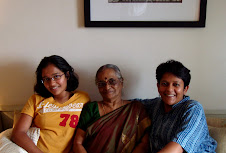
I welcome Saturday - a day I get to spend time with my two working daughters. We discuss children and maids, go out shopping, eat and unwind. Yesterday, we went to Gandhi Market in King's Circle - a market set up soon after India's independence to rehabilitate refugees from Sind and Punjab.

There are about 200 shops in the market. Initially it was just a cloth market catering to the lower middle class, but today the market offers everything - vegetables, leather goods, artificial jewellery, decorative hair clips and many other household items. It's definitely a woman-centered market!

Though the market is housed inside a single-storied concrete structure, the real fun and excitement begins long before you reach the gate. The entire footpath surrounding the market is a shopper's paradise. Small sellers selling readymade garments for kids, innerwear for ladies, napkins, towels, imitation jewellery, churidar sets, etc. line up on either side. Pushing through the crowd enjoying the multi-coloured dresses for children is itself a happy experience.

It is an open secret that bargaining starts at 50% of the price quoted by seller. In olden times this market catered mainly to the lower middle class. However, today Gandhi Market has grown in size and variety and also offers quality stuff. Very intricately embriodered designer sarees suitable for bridal wear are sold.


However, the majority of people enjoy an evening buying stuff from the small stalls outside the market, at throwaway prices.

As we approached the gate, I stopped near a pavement shop selling colourful embroidered salwar suits. Just when my daughter tried to click a photo, the owner, a young man of thirty, came and stood near me saying, "Maji ke saath mera bhi photo nikalo" (Please click my photo along with your mother!). He touched my feet for blessings. We all smiled and for a moment he felt like one of us. 'That is Mumbai' I thought. There is a free spirit where all are equal irrespective of one's station in life.


We stepped into a shop selling sandals at fixed rates. I just sat on a stool watching people going in and out. A young lady (she appeared to be educated and modern with short hair and a trendy look) came in and picked up a black and white sandal, tried it and put it back. The shop owner (who was also the salesman) gave her three more sandals, of different patterns, colours and price. She tried all three and quietly walked away without buying - probably satisfied with the very act of wearing them for a short while at no cost! The shopkeeper, cool and calm, unmindful of his wasted labour, turned his attention to his next customer. She was a saree-clad woman, very different from the first one, and looked like someone from a lower income group. But within a couple of seconds, she made her choice, bought an expensive shoe, and walked off.


As every good salesman knows, it's all a matter of chance, and even people who step in casually may go home with a bagful of purchases. The Mumbai salesman's patience is legendary (especially in saree shops!). In the major saree markets, you will find salesmen always encouraging you to see more and more of their goods. "Dekhne ka paisa to nahin lagta behen", they say with a smile. "Costs no money to see". They will do their best to present all their goods, tempting you with one offer after another, until you find that one saree you absolutely cannot resist! Mumbai is a shopper's haven, yes, but is also the the marketing capital of India. I'm quite sure no other city in India can match the sales and service levels that Mumbai shops offer.

Finally we came to the jewellery section. Glittering stones of all hues set in traditional as well as modern designs, to match every outfit and every occasion, were displayed with the board 'SALE 50% REDUCTION'.


We were almost tempted to buy some ear-rings, but we were running out of time, so we returned home. We had spent nearly two hours in and around Gandhi Market, and the faces of smiling, hardworking sellers continued to linger in my mind.

---------------------------------------------------------
This article appeared in DNA Newspaper on Jun 6, 2011
---------------------------------------------------------

Friday, April 15, 2011

Bombay Sandwich

by Aishwarya Pramod

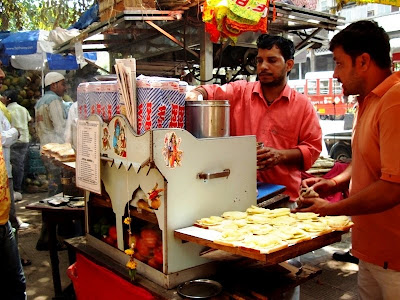
Bhelpuri and vada pao may rule the world of Mumbai street food; but I think the Bombay Sandwich manages to hold its own quite well :)

Everyone I know likes them – hot, toasted, full of sliced vegetables, melted cheese and spicy green chutney.


I’m not really sure why it’s called a Bombay Sandwich (I googled it and found no explanations), but I think it’s probably because the sandwich as a major staple of street cuisine is only found here in Mumbai. I’ve eaten these sandwiches at Elco Arcade in Bandra, at a little stall outside my college building, at a stall in Matunga Market, in Gurukripa Restaurant in Sion, and near Podar College... And they’ve all been deliciously filling. :)

I’ve noticed that these sandwiches tend to be almost exclusively vegetarian. I suppose that’s part of the definition of a Bombay Sandwich. And there’s usually a fixed set of veggies that go into it – cucumber, tomato, potato (very important), onion, beetroot, capsicum. And the bread is always soft and white, no fancy healthy alternatives like brown or multigrain.


Some sandwich-walas add their own special twists to the sandwich. The one near my college, for example, tops his sandwiches with crunchy sev; really nice! The one near Podar College offers chocolate and cheese sandwiches, which seemed popular among the students.


The Making of a Bombay Sandwich


Spread the slices with butter, green chilly-coriander chutney, and red garlic chutney. Add fresh crunchy cucumber slices....

...thick wedges of boiled potato, and sprinkle generously with sandwich masala (a KEY ingredient). This sandwich-wala perhaps makes his own masala. When asked, "Bhaiya ismein kya hai?" he said "Ismein toh jahaan hai" :). But one could recreate this sandwich at home using sandwich masala from Kapol or Tid-bit.


Add onion, beetroot (ooh, colourful) and a ton of grated cheese...


Tomato, more masala, and finally it's ready to be toasted...


... using this contraption-thing (we have one just like it at home).

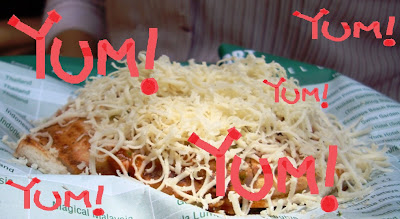
It comes out hot and golden-brown. Cut into pieces, top with more chutney, more grated cheese, or both.


Delicioso!


Oh, but I cringe to think how calorific (AND unhygienic) it probably is. Kidding, actually I don't care, I’d eat it anyway, anyday :)

------------------------------------------------------------------------
This article also appeared in Chorus+Echo, a UK-based website that
curates and publishes interesting cultural stories from around the world
------------------------------------------------------------------------

Sunday, March 27, 2011

With Caroline Quentin in 'A Passage Through India'

- By Deepa Krishnan

This week I'm feeling like a TV star :)

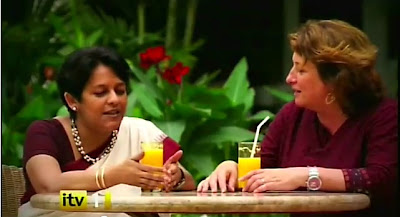
I was on iTV in the UK, in a show called A Passage Through India. The show had a celebrity hostess, Caroline Quentin, and she travelled through many cities, including Mumbai.

Episode 2 of A Passage Through India, iTV UK
I took Caroline around Mumbai in a taxicab that had been specially arranged for the shoot. We were both wearing maroon, and the red upholstery of the cab gave it a "this is India" look.

How do you like my "Sonia Gandhi" saree? :) :)
The saree is actually a khadi cotton, that I bought from Sundari Silks in Madras. And aren't the pearls gorgeous? They're from Cochin, a gift from my husband on our last Kerala holiday. The ear-rings are from Delhi. So the only thing "Mumbai" about this is my saree blouse and my lipstick!

In the initial part of the programme, we drove around the city must-see's and I gave her an introduction to the origins of the city and how the East India Company finally arrived here.

After the initial driving around, we went to see the city's bazaars. This is Caroline and me at Chor Bazaar where I was talking about two of my pet themes, recycling and the never-say-die spirit of Mumbai's migrants.

Car parts and metal recycling near Chor Bazaar

Sharing a laugh over hair colour and male vanity
Caroline is absolutely lovely; she is warm, outspoken, funny and intelligent. A total delight to be with. We had loads of laughs; some of which made it to the show, and some of which didn't (thank god). In this part of the programme, we were discussing what colour hair we preferred in men :)

We also went to Mangaldas Market, where we found this family shopping for a wedding.

Caroline Quentin at Mangaldas Market, doing her thing - making everyone laugh!
There were two cousins, both getting married the same day, and both girls were at the market looking for their trousseau. Everyone was very friendly and they all had a good laugh at Caroline explaining how she did the dandiya-raas at Navratri.

We found a lot of stray dogs in Bhuleshwar and Chor Bazaar. Caroline loves dogs; she has 4 dogs at home; so we talked a bit about the problems of having such a huge stray population, and about local non-profits that work in the area of stray dog welfare. Later in the show, she went off with a vet to see Welfare of Stray Dogs in action. She also went to see Mallakhamb being practiced; and she went shopping with a Bollywood starlet and learnt some dance moves.

Towards the end of the show, we went to the Taj for drinks. It was a hot day, and this was a welcome break from the bazaars.

"Mumbai's heart lies in its bazaars", I'm saying.
All in all, a fun day spent with a lovely lady; and a chance to showcase my city, minus the usual cliches. I quite enjoyed myself!

Sunday, March 13, 2011

Welcome summer

By Janaki Krishnan

Mumbaikars welcome summer for many reasons - happy holidays for children, travel plans for the family, and of course, Alphonso mangoes for everyone.

For me, summer is not just these things, it is also the season of the Jackfruit, Queen of Fruits, with its lovely yellowish soft flesh and unparalleled sweet taste.

Jackfruit extracted and ready to eat (Matunga Market)

My earliest memories of this fruit go back to the 1960's when I was in the seventh standard at SIES School, Matunga. As soon as the school closed for summer, we would start packing to go to our native village in Kerala, where my grandparents lived.

A month before our arrival, my grandfather would begin preparations for our visit. He would select the jackfruit tree that bore the sweetest fruits, and earmark the best fruit for us. "Don't cut this", he would tell the servants. "It is for my grandchildren from Bombay."

The day we reached Kerala, he would make preparations to pluck and bring down the ripest fruit. Jackfruits can be huge; and we children found it fascinating to watch a big fruit weighing 20-25 kilos being brought down carefully from the tree. A rope was tied around the fruit, and it was lowered down slowly to avoid damage.

Jackfruits at Vashi market. There are some giant ones at the bottom left.

Once the fruit was lowered, it was then brought into the house with all of us 8 children trailing behind it. First the big fruit was cut into two. Then, as we watched in anticipation, it was cut into smaller, more manageable pieces. Finally, the "nose" of each piece was cut to loosen the fibres that bound the fruit together; and each child was given a piece.

Before we could dig into the fruit, my grandmother would emerge from the kitchen with coconut oil to protect our hands from the sticky "chakkini" (thin long fibres holding the hidden fruit inside). Once the oil was applied, we were then finally free to handle the fruit. The pleasure of removing the chakkini, finding the delicious fruit, removing the seed, and then finally popping the soft sweet fruit in your mouth is a heavenly experience! Today's children may perhaps consider it a laborious procedure, since they are products of the fast-food age. But in those days, even my youngest brother (who was just 4 years old) would not allow our grandmother to do it for him.

Delicious fruit hidden inside the fibrous chakkini

By the time we finished gorging ourselves on the fruit, servants and other poor people of the village would come to buy the seeds for making vegetable curry. They would pay 2 annas for a big measure of seeds; but there would still be many seeds for our own use in cooking.

The thick, thorny outer skin would be cut into smaller pieces. We children would take the pieces and feed the cows and buffaloes. Thus every part of the fruit would be used.

Our adventures with the jackfruit didn't end with this. The next day, an unripe jackfruit would be selected; and deep-fried to make jackfruit chips. The day after that, another fruit would be used to make jackfruit papadam, and another for jackfruit jam, both of these for us to take to Bombay.

Almost every day that we stayed in Kerala, the menu would include jackfruit (chakka). Most often, it went hand in hand with mango (manga). Chakka kootan and manga pachadi. Manga sambar and chakka poduthual. Chakka pradaman. Chakka Erisheri. Chakka Neyappam.....an endless list of inventive dishes would include the jackfruit.

Idichakkai poduthual, made from jackfruit seeds (from Moorthy mami's kitchen)

All these summer joys came to an end when my grandparents moved to Bombay, for my grandmother's treatment at Tata Memorial Hospital. But the jackfruit continued to make its presence felt. My mother would buy jackfruit every year on Vishu, and she would make these dishes afterwards.

Most of these dishes are just a fond memory now. I do not have the skill (or the enthusiasm!) of my mother, to try my hand at various jackfruit recipes. If I do buy jackfruit, the easiest thing, I have discovered, is to make chakka poornam. Cut jackfruit into small pieces, add fresh coconut and jaggery, cook it for 15 minutes, and add ghee at the end. The taste is lovely; it can be eaten plain; or as a sort of spread with white bread; or even an accompaniment to a dosa. Try it!

Posted by Deepa on behalf of Janaki Krishnan