Saturday, October 18, 2014

Samosas to swear by

- By Aishwarya Pramod

If you live in Mumbai, and like watching movies, chances are you’ll have eaten an A-1 samosa. They’re among the most famous samosa-makers in Mumbai. They make about 15,000 samosas a day, and supply more than 30 movie halls in the city. Whether it’s a posh multiplex or a small single screen, you’ll find them wherever you go.
Those crunchy, spicy, potato-filled triangles of happiness can make a bad movie tolerable and a good movie awesome! But to get an A-1 samosa, you don’t have to go to the  cinema, where they’re priced quite high. At their main shop in Sion, near my house, it’s 10 rupees a samosa.

The shop’s nothing fancy, and it’s often hidden from view behind a row of parked vehicles. But it's always bustling with customers. Also, A-1 doesn't sell just samosas. They have kachoris and "aloo-pops" too.

The Punjabi samosa is their classic offering – it’s the potato-filled one you get in all the theatres. My other favourites are the Cheese-Corn Samosa and the Chinese Samosa. The Chinese ones are stuffed with bright red, schezwan-flavoured noodles – but they’re really not as strange as they sound. I’ve never tried the Sweet Mawa Samosas myself, I don’t know how I feel about a sweet samosa :/

Here’s their menu (since you can't tell the samosa varieties from the previous picture):

My mother recently brought home some of A-1's paalak-paneer samosas (not on this menu). They were filled with paalak and paneer (spinach and cottage cheese). They were pretty good, but not as much paneer as I'd have liked. I think I'll stick with the Punjabi anyway.  
There are two locations where the samosas are made: the first is at Champaklal Estate, Sion East. Here, the masala / stuffing is made, and the samosas are rolled into their typical triangular shape. From Champaklal, it is taken to the A-1 outlet in Sion West, where the samosas are first 'half-fried' and kept ready. Then they are deep fried in batches and brought out front. From here, they're distributed to retail shops, cinemas, school and office canteens, caterers and party organisers. As each batch gets sold or distributed, new batches are deep fried.

The distribution process is interesting: there is an army of freelance entreprenuers on cycles, who buy samosas from A-1 daily, and sell them to various buyers across the city. Typically they have a 1 rupee margin per samosa. Sales are made in lots of 150 or 250 samosas (there is a weighing machine, so the samosas are placed on trays and weighed, not counted). Each freelance entrepreuner has his own set of contacts/buyers across the city to whom he sells.

So if you go to A-1 at any time of the day, you can see hot samosas, coming right out of giant iron woks, being piled into trays, then loaded on cycles and being taken away. The large trays you see in this photo above can hold 250.

A-1 was established more than 40 years ago by Kishanchand Nevendram, a Sindhi who came to Mumbai from Karachi, after the Partition. He is said to have left everything he had behind in Karachi. His grandson now owns the business. Anyway, here's a testament to this little shop's fame: not only do many Sion-dwellers swear by their samosas, but a friend of mine from Andheri (so far from Sion it might as well be Mars!) once came to hang out in Sion and said, "Do you know where I can try an A-1 samosa? I've heard a lot." 

So if you're ever walking around in Sion, don't forget to stop by A-1 samosa :)

Note: While A-1 has great variety, for something a bit more filling you can cross the road to the equally well known Gurukripa Hotel (Gurukripa and A-1 think of each other as simply two parts of the same business. A-1's owner is the nephew of Gurukripa's - it's all within the family). In Gurukripa you can get A-1's Punjabi samosas with some chhole (white chickpeas), garnished with some onion – delicioso!

Sunday, October 12, 2014

Ek Hazaarachi Note at the NCPA's Marathi Film Festival

By Deepa Krishnan

For the last 6 years, NCPA has been organizing a Marathi Film Festival to showcase critically acclaimed and national award winning films. This year, I went with my friend Kiran to attend the screening of Shrihari Sathe's "Ek Hazaarachi Note". 

The films screened at the festival are sub-titled in English. Although I can follow spoken Marathi well, it helped to have sub-titles, especially since Ek Hazaarachi Note is set in Vidarbha, and there were many nuances of the rural dialect that I could not otherwise follow.

NCPA's Marathi Film Festival is called 'Nave Valan', meaning, New Directions. Valan actually means "turning"; and the festival's name aptly reflects the new-wave of Marathi films that we have been seeing recently. There has been a new-found interest in Marathi cinema since 2004, when Shwaas was selected as India's official entry for the Oscars. Budgets for Marathi cinema have increased; and we are also seeing an increase in the number of films produced. But more importantly, we are seeing talented people come forward.

I enjoyed Ek Hazaarachi Note very much - it is the tale of life in a small village, told sensitively and simply. 
The festival screening included face-time with the cast and crew; and I loved meeting the script writer, Shrikant Bojewar, who did such a great job of bringing the culture of Vidharba district to life. Shekhar Sathe, who produced the film, is also a friend, so we all went to dinner later and discussed the making of the film. 

I thoroughly enjoyed the evening and have decided that I simply must put Nave Valan on my annual calendar! Thank you, NCPA.

Wednesday, October 08, 2014

Film Shooting for Swachh Bharat Mission

- By Deepa Krishnan

One of the nice things about living in the media capital of India is that you're always coming across all kinds of outdoor shoots. Yesterday I saw this advertising shoot in progress:
In a couple of minutes we figured out that it was a shoot for the new cleanliness campaign launched by the government of India.

How did we guess? Because of the "Gandhi Chashma" that the actor with the broom was wearing. The Gandhi spectacles are the logo for the Swachh Bharat Abhiyan, The Clean India Mission:
https://www.facebook.com/SwachhBharatMissionGrameen
Here's a closeup of the spectacles :)
Lots of local people had gathered to watch the shoot; and I think everyone in the crowd realised what was going on. Of course, it had no impact on the actual mess of paper and plastic that was lying around the market area. I think along with positive messages we also need stiff fines. It will work better if we educate people, but also have Cleanliness Inspectors that follow through with monitoring measures. 

We need major re-thinking on urban waste management - so I am not really saying keeping the streets clean is going to solve our real garbage problems. But it's a start.

Sunday, October 05, 2014

The picturesque Bandra Station

- By Deepa Krishnan

I've been wanting to photograph Bandra Station ever since its restoration some 5-6 years ago. I finally got a chance to go there last week. It is by far, the city's prettiest railway station.  No, it is not grand, like the Victoria Terminus, but in my eyes it is very beautiful. The woodwork and tiles add enormous charm, don't they?
Plans for this station were finalised in the UK, and the building was erected by BBC&I in 1864. Finally in 1869, the train service (which ran only upto Mahim) was extended upto Bandra, paving the way for more people to settle in this suburb. By 1881, Bandra had 15,000 residents, of which half were Hindu, 30% were Christian and 15% Muslim. There were also Parsis, Jews and Armenians.

Apart from the attractive Mangalore tile roofing and carved wooden eaves, this station has cast-iron pillars (you can see them in this photo). Remember my previous article about Watsons Hotel? The Watsons were shipping their cast-iron pillars to India at roughly the same time as Bandra station. I wonder if the pillars all came from the same source and on the same ship :)
As part of the 1925 Heritage Regulations, Bandra Station was listed as a Grade 1 Heritage Structure (prime landmark in the city; no interventions permitted on exteriors or interiors). A conservation project was undertaken in 2008-2009 by Abha Narain Lambah Associates. The wooden eaves were restored, the roofing tiles repaired, some ticket counters and other temporary partitions demolished, the walls were strengthened. Extensive termite treatment  was done. There are more phases of restoration planned for the interiors, but I don't know what's happening to that.

Sunday, September 28, 2014

The Beer Can at BKC

- By Deepa Krishnan

London may have the Gherkin, but Mumbai has the Beer Can :) Or maybe it's a Wine Barrel? Check out the photo below and decide:
In case you didn't already know, this is the ONGC Green Building being built in Bandra Kurla Complex. I have been watching this building come up, little by little, for the last 2 years (I can see it from my 14th floor balcony in Sion). I even talked about this building in my interview for Mint.

Finally last week I went to BKC and clicked a close-up photo; then I decided to read up about the building. Apparently, the Beer Can is designed to be "Green, Energy-efficient and Intelligent". This is a CDM Project - meaning that the energy conservation measures in this project will help ONGC generate Certified Emission Reduction units which may be traded in emissions trading schemes. This kind of project needs to be independently audited. A Japanese company called JACO CDM did the audit, and I managed to get the audit report copy. The original project plan filed with United Nations Framework Convention for Climate Change (UNFCCC) is also online.

ONGC has several other similar projects in India. 
ONGC Green Building, Dehradun, Hafeez Contractor
There's another one coming up in Kolkata:
ONGC Green Building, Kolkata, Hafeez Contractor
The one in Dehradun was completed last year, although I have not seen any real-life photos except this one. Construction on Kolkata has begun.

Tuesday, September 23, 2014

A fun day in Bollywood

- By Deepa Krishnan

I had a Bollywood day today. Saw a movie-shoot with Nana Patekar who (gasp) took off his shirt. OK, OK, there was a vest underneath but still, it was very much a case of dhakdhakheart. I am *not* old enough to be impervious to such stuff! Mercifully, I decided not to make a fool of myself and ask for a photograph. 
Also, there were Anil Kapoor and Paresh Rawal. And a whole host of younger actors whose names I *am* too old to be familiar with.

It was fun seeing the sets and the wardrobe guys and all the hard work that goes into the shoot. The scene they were filming was a party, into which Anil Kapoor swaggers in. Then he has a face-off with Nana Patekar. I loved all the glam girls and guys and how they sweated under the sun, but all smartened up miraculously when the director yelled Aaaaaction!! I especially loved how they made fake alcohol and filled it into cocktail and wine glasses.

I also saw lots of sets. Like this one, of a courtroom, with a lawyer arguing a case. Excuse the blurry pic. But it was too melodramatic not to post. What do you do when cliches come alive? :) :)

A super day!!

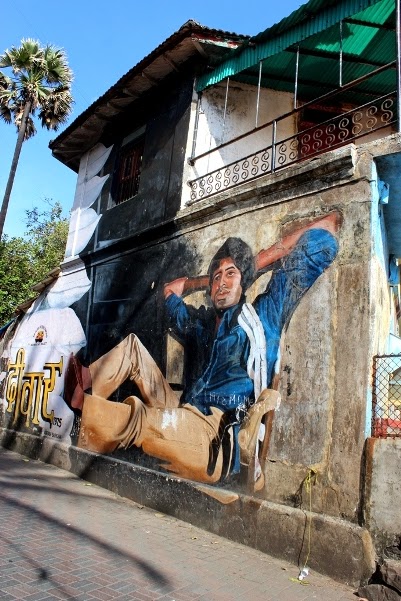
Oh also, I photographed Ranjit Dahiya's Amitabh Bachchan in Bandra. Awesome, no?

Tuesday, September 09, 2014

Ganesh Visarjan 2014 - a great experience at Girgaum Chowpatty

- By Deepa Krishnan

I had a fabulous time at the Girgaum Chowpatty Visarjan this year. Actually it took me completely by surprise, because they have enforced a STRICT ban on drums and noise.

I went there expecting to be deafened by the noise. In fact, I even bought ear-plugs! But in spite of the thousands and thousands of people, there was no crazy noise. There were no big drums and no clang-clang-clang to burst the eardrums. The processions were colourful and full of tamasha, there were people singing with small cymbals and chanting "Ganpati Bappa Morya! Pudhchya Varshi Laukar Ya!". But we did not go deaf with the noise!
At a couple of places there were horrible loudspeakers, where sponsors were distributing free drinks and food, and they thought that gave them the right to shout over the speakers. But overall, it was not an assault on the ears. The police have a very major presence and are very helpful to direct people and maintain crowd control. 

This is our group, at Chowpatty Beach. Here also, at the beach, there was good 'bandobast' by the police, with CCTV cameras and several policemen on the ground. There was a separate entry area, a separate exit, and separate lanes for big and small Ganesh idols. The police were directing the flow of people and trucks.
I also went to Lalbaug, where unfortunately the noise levels were incredible and it was impossible to stay for any amount of time. But I saw Lalbaug cha Raja and many others going in big processions here, lots of singing, dancing, gulal and band-baaja.
There are lots more photos here on my facebook page: Ganesh Visarjan 2014 Mumbai Magic

Monday, September 01, 2014

The old BEST bus ticket

- by Deepa Krishnan

Did you know? These punched BEST tickets are now history. These days you get a modern version, like a credit card slip. I got this photo of the old-style tickets 5 years ago, when I went on a bus ride from Sion to VT. The conductor punched them for me. Against the green colour of the seat, the tickets made for a great photo.
I don't know if these old tickets are completely phased out, but it sure looks like they're on their way out :-( What a pity. They were so interesting! And they've been around for ages, with so many codes and markings on them! Here are all the things on the old ticket and what they meant:

1) On top in black, you can see the Serial number of the ticket

2) Below that, there is the BEST logo and it says: Parivahan Upakram - which means Transport Undertaking

3) In the centre is the fare plus 'adhibhar' (surcharge); in this ticket its Rs 9.85 + 15p surcharge. The surcharge has been around for 3 decades now and BEST donates this money to the state government. In response to a Public Interest Litigation, the state clarified in 2007 that the money is being spent on nutrition schemes for children, pregnant women, and new mothers. From April 1975 to July 2006, this has amounted to Rs 321.8 crores of donations.

4) In the centre there is a vertical line, and it is used to mark special or concessionary classes of ticket - Baalak (child), Khaas (special), Saamaan (luggage), Jod (valid with something else, additional ticket)

5) Punching system - On the left there is a series of numbers, from 1 to 26, this shows the stops on the route (onward). There is a similar set of numbers on the right, those are the stops on the return route. The conductor will punch the stop that you are going to get down at.

6) Right at the bottom we have 'Bruhmumbai Vidyut Purvatha Ani Parivahan Upakram' - Bombay Electric Supply and Transport Undertaking.

7) And below that it says something like "Niyamanusar something something ticket" I can't read that bit clearly.

Anyone who knows more, please correct me!

The new ticket is here, in case you want to have a look.

Saturday, August 30, 2014

"Half the Sky" - University of Washington Foster School of Business

- By Deepa Krishnan

Yesterday I addressed a group of 25 girls from the University of Washington's Foster School of Business. They were here on a Women’s Lead­er­ship and Entre­pre­neur­ship program. It's called "Half the Sky", and it inspires students to make a dif­fer­ence through meet­ings with lead­ers and role mod­els all over India. Most of them are from the MBA program, but there are also a couple of students from other streams.
The students are going to be in India for a month, studying women’s leadership, and learning about "social enterprises" that create business solutions to poverty and environmental issues. Apart from meeting lots of women in India, the group is also spending time with non-profits, learning about specific issues first-hand, and working with the non-profits on problem-solving recommendations.
We spent an hour together, and I spoke about my life, my beliefs, decisions that I made along the way, and why I am happy with what I am doing. We discussed the Mumbai Local tour, and how it is designed to be socially relevant and at the same time, financially viable. I spoke also about creating a tour company that was inherently 'responsible', where social good is in the DNA of the company, and CSR is not just an afterthought or a cash handout at the end of the year. It was informal and fun, I enjoyed it enormously, mainly because I connected with the girls, and didn't have to watch my mouth :) 
The 'Half the Sky' program is the baby of Cate Goethals, consultant and professor, and wearer of many interesting hats. She has been coming to India since 2010 with this program, and it's always a pleasure meeting her. We posed for photos after the speech.
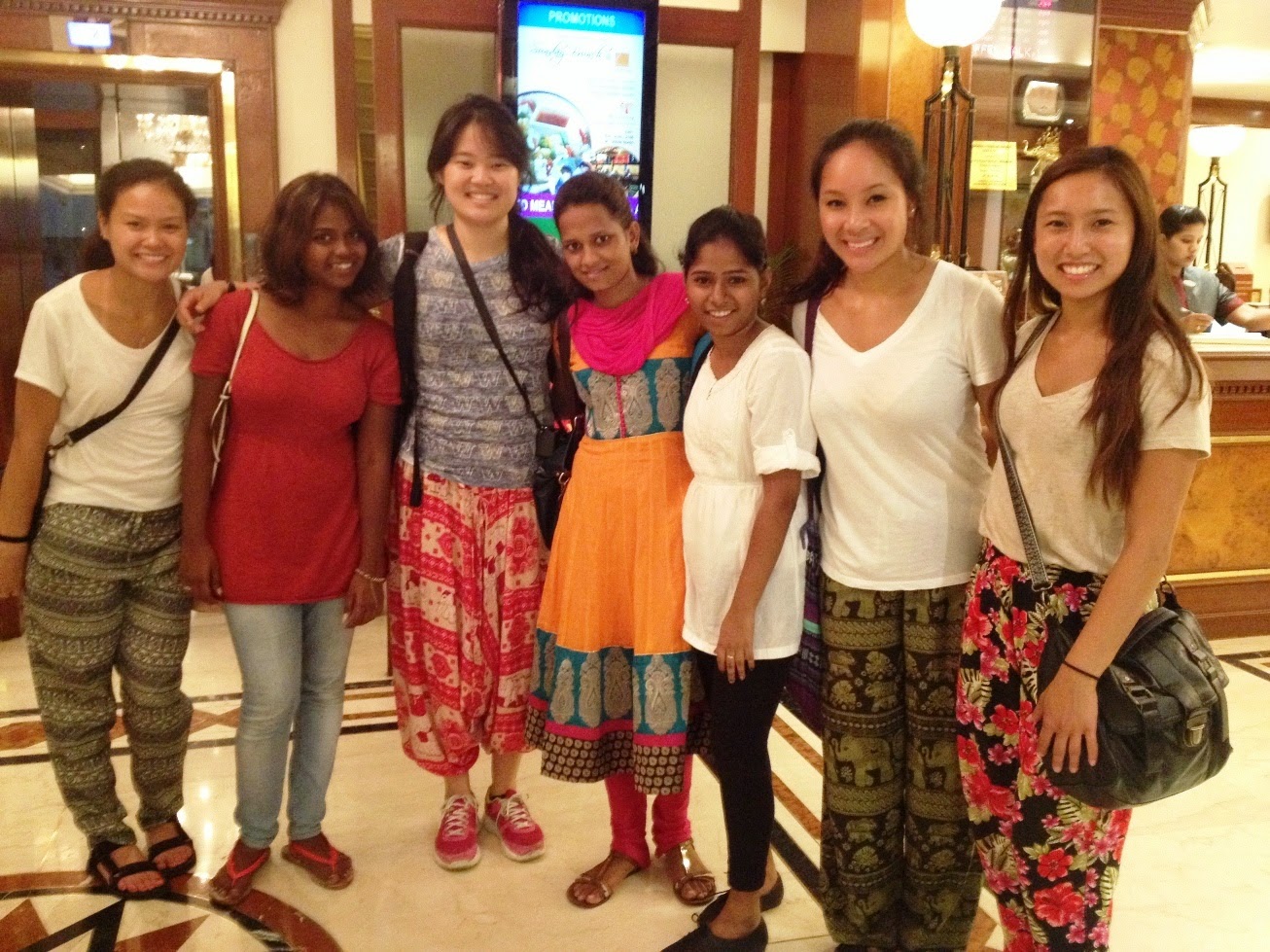
After this, I said goodbye, and the group went on a tour of the city, with the guides from the Mumbai Local program. I spoke to Cate today, and she said they all enjoyed the tour very much. Here are a couple of photos from the tour: one of the group at VT, and the other in the lobby of the hotel, with the Mumbai Local guides.
We've been doing this sort of thing for the last couple of years. Here's a collage of images from Cate's visit last year:
And here's one from their visit the year before that!
This is a great program, with bright and motivated groups of students visiting India each year. I wish them all the best and hope they go on to become inspiring leaders and role models for the women of the future. Some of the girls this year came up to me and asked if I could be their mentor. Mentorship is a big word - but I think working women everywhere need to share our lives and our stories. Especially, we need to share the difficulties. Speaking the truth, admitting the mistakes you've made, and being confident in stating what you've achieved - this is the most valuable form of mentorship. Too many women - especially in India - tend to be self-deprecating. We need to come out and celebrate our achievements too.

Thursday, August 14, 2014

Finding Watson's Hotel in a sleepy Cumbrian village

- By Deepa Krishnan

Anyone who has been to Kala Ghoda knows the decrepit Esplanade Mansions, popularly called Watsons Hotel.

But not many know what the architects originally envisaged, or how the hotel looked in its heyday. Fewer still know the story of how the hotel was built - a story that begins in a small village in the north-west of England.

Here's the building today: you can easily spot the famous cast iron frame structure, still standing strong. But the building itself is in ruins. This is the side-view of the building:
Here is what this building was originally meant to be. See how gorgeous it looks in this painting! (If you click on the picture, you'll get a bigger view). 
Photo credit: Castle Carrock
If you want to see this painting for real, you have to travel to Cumbria, to a little green village called Castle Carrock. The painting of Esplanade Mansions is hanging in their town hall. Here's what the village of Castle Carrock looks like; it has less than 500 people living in it.
Photo credit: Castle Carrock
The story of Esplanade Mansions actually begins in this little village. Like many good stories, this one also begins with a farmer :) His name was Watson.

The farmer had three sons, but two of them, John and William Watson, left Castle Carrock in the 1840's to start a drapery business in London, dealing in silks and other textiles.

From London, the two brothers migrated to Bombay in 1853. Bombay had developed into a major trading centre by that time; shipping was thriving, land had been reclaimed to expand the city, and links to the Deccan hinterland had been opened to facilitate trade. Perhaps the Watsons thought it made excellent business sense to relocate. I also have another pet theory about this migration to Bombay. Perhaps the Watson brothers attended the Great Exhibition of 1851 in London, at the Crystal Palace? Perhaps they were enchanted with the Indian textiles they saw? Surely the Indian Pavillion was a vision to delight any silk mercer and draper!
Whatever the reason for migration - the two brothers arrived in Bombay in 1853, and set up shop here. They must have struck gold in Bombay - because they soon had three shops here, at Churchgate Street, Hamam Street and Meadow Street. Apparently it still wasn't enough. Within just ten years of arriving in Bombay, the Watson brothers made a grand bid for yet another building site. The original plans submitted for the building included a shop front on the ground floor, offices on the first and second floors, and residences (for themselves, I presume) on the third floor. 

The plans the Watsons submitted conceived of a bold new design - a cast iron frame that was modelled on the Crystal Palace, where the London exhibion was held. Nothing like it had been seen in India before. By 1865, the initial plans for a shop changed; and the Watsons decided to build a grand new hotel instead. But the cast iron girders remained in the plan. Although there were problems with having the designs approved, the Watsons persevered, and pushed through with their plan.

The design involved the import of hundreds of cast iron girders. Arranged from top to bottom, these girders formed a sort of grand metal bird-cage. This sort of design actually exposed bare metal. It was in fact, the first multi-storey habitable building in the world in which all loads, including those of the brick walls, were carried on an iron frame. In that sense, it is the earliest pre-cursor to the modern-day skyscraper.
The crowning glory of the building design was a mansard - a type of roof that actually doubles up as a floor. The architects apparently wanted to cover the top with glass. It would have made a fantastic salon, eh? Or a really fancy penthouse suite for the who's who of Bombay's visitors.
The Watson brothers began to ship materials for the new building into Mumbai. By 1867, many of the materials had arrived; and assembly of the iron framework began on site. By 1869, the hotel was complete - BUT - that beautiful (and impractical) mansard was abandoned along the way. Maybe they ran out of money - or time.

Still, just look at this hotel below! What views of Bombay harbour! This photo is from the 1880s; the only other building at that time in the area was the Sailors' Home in the distance. The wide road you see is the Esplanade; and hence the name of the hotel.
http://www.oldindianphotos.in/2012/11/watsons-hotel-bombay-mumbai-c1880s.html
The patch of land on the right of the photo, by the sea, is where the Taj Mahal Palace and Towers eventually came up - but that was not until 1903. Before that, for more than 30 years, Watsons Hotel was the numero uno establishment in the city. Mark Twain stayed here; Kipling wrote about it, and the earliest screening of the Cinematographe in India by the Lumiere Brothers was in this hotel (just one week after it was first screened in Paris).
Of the two brothers, John and William Watson, we know this: William quit the drapery business to become a shipping agent. John Watson remained in the drapery and hotel business; but he returned to the village of Castle Carrock in 1869, just after Watsons Hotel was built. His sons, James Proctor and John Jr, inherited and ran the hotel successfully, until they too returned to Cumbria in 1896 (at the time of Bombay's bubonic plague).

With the owners gone, and with competition from new hotels such as Green's, Majestic, and the Taj, the birdcage hotel went into decline. In 2006, the World Monument Fund placed the hotel under the list of World Endangered Monuments.

Here's a recent photo I clicked; can you see the beautiful Minton floor tiling? The iron girders are still standing strong. The inside of the hotel has been divided up and sub-let to lots of small businesses. Next time you're in the area, pop into the building and take a quick look. And if you want a little challenge, then try to spot the Watsons logo on the outside of the building!