Sunday, December 20, 2009

At the Post Office

- by Deepa Krishnan
.
I have not been to the Post Office in the last 12 years. But last week, I went with mom and dad . They had invested a little money a while ago, in some postal savings scheme, and my signature was needed in order to redeem it.

My first impression of the interior.

At first I thought nothing had changed at the Post Office - but then I realised the red colour was new. The place was brighter than I remembered. And there were now chairs that you could sit on, while you waited for the files to move. That's Dad, seated, waiting for his cheque.

Mom in the rust colour saree. She's helping the lady in green fill a form in English.

A Tamil-speaking lady in green was having trouble with forms. Mom as usual, volunteered to help. I wandered off with the camera, clicking photos. The first thing I noticed was this couple.

They were at the Monthly Income Scheme counter.

This is a scheme where you deposit a certain amount, and then you withdraw on a monthly basis. It is popular with retired people - perhaps there was a family elder on whose behalf they were withdrawing.

I sneaked a peek at the man behind another counter. I wondered what his job was. I found out easily enough. His job was to write things in big fat ledgers.

The babu and his numbered ledgers

It seemed to me like the dullest job in the world, scribbling little numbers on page after page, book after book. And yet, this is a sought-after job, bringing with it a certain social standing. A man with a steady "go-ment job" has no trouble finding a bride.

I saw the usual board, asking people not to bribe officials.

A little further away was the mail dropbox. If memory serves me right, the red slot below is where I used to drop letters to my German pen-pal. I wonder if anyone has-penpals these days!

The green is for inside the country, and the red is for international.

I wandered outside the post office gate, and found a little blue office. The board on the office said, "Harris Michael Koli, Investment Consultant. Please phone on mobile before comming" (His spelling, not mine!).

Exterior of Sion Post Office.

On the building you can see the new logo of the Indian Post Office, launched in 2008. It is meant to represent a new dynamic and modern postal system, in tune with the twenty first century. Frankly, in a country this size, that is not an easy achievement. I looked up the India Post website and found that we have a staggering 155,035 post offices in the country, of which 90% are in rural areas.

By the way, I found some other interesting tidbits as well:
  • The average distance you have to walk anywhere in India, to find the nearest Post Office is 2.59 kms.
  • In Maharashtra, a typical rural post office serves 5,127 people and an urban post office 35,324 people
  • Of the 155,035 post offices, 2,500 have completed what the India Post calls "Modernisation (Improving Ergonomics)". I wonder what they did as part of this exercise!
  • An impressive 10,000 post offices have been computerised (my post office is one of them, so there are fewer babus writing in files in Sion, he he.)
  • There are 30,000 female employees of India Post. This is 10% of the total staff.
Another interesting thing about the Indian Post is that it provides employment for more than just it's staff. Like Michael Harris Koli above, or this gentleman with the moustache below.

Mr. Moustache - the grand old man outside Post Office!

Mr. Moustache has been a fixture outside the Sion Post Office for the last 20 years. What does he do? He is a typist, and he types out legal agreements on stamped paper. It has nothing to do with India Post, this is just a very good place to set up shop.

The Parcel Service Guy

Next to Mr. Moustache is another counter - this is a Registered Parcel service. You tell the man the address, and give him your parcel. He wraps it in the right sized envelope or packet, seals the package with wax, and fills in the post office Registered Parcel form. All you have to do is take it inside the Post Office and send it off. It's a handy service if you can't read or write, or don't have the right packing material at home.

When I wandered back inside, I found that our cheque was ready. Dad was pleased as punch. We didn't have to wait too long, or fill lengthy forms. The records were computerised, it was easy to check the file and see what was due. It was all very pleasant. And while it isn't as fast or easy as say, a private sector bank, I suppose things *have* changed, after all, at the Post Office.

(Article quoted on CNN Go Jan 7 http://www.cnngo.com/mumbai/none/post-about-mumbai-post-office-006787)

Tuesday, December 08, 2009

The flamingos are here!

- By Deepa Krishnan

My uncle, A. Krishnan, sent in these photos from his visit to the Sewri mudflats last week. Our pink visitors are here again!

Flamingos are very interesting birds. You know they're not born pink, right? Baby flamingos are a whitish-grey. They turn pink over time because of algae in the food they eat. So this kiddo on the right has some years to go (and lots of eating to do!) before he looks as pretty as that other guy on the left.

They have a funny way of feeding - they eat by holding their bills upside down in the water. See that deep curve on the bill? There's a specially adapted tongue inside the bill that filters tiny food items. In lesser flamingoes, the bill pumps water 20 times a second, while the tongue filters away like crazy!! They need about 60 grams of food a day, so no wonder they feed all the time.

Just in case you were wondering, the flamingo tongue tucked away inside that bill is large, fleshy and has little bristly projections. Yeew? The early Romans thought it quite a delicacy, anyway, and pickled flamingo tongue was on the menu at their parties! I kid you not.

Here are some more birds that have not yet turned fully pink. You can really see the curve of the bill beautifully in this photo. Babies are born without the curved bill, by the way. Strange huh? It takes some weeks for the bills to start curving. Until then, parents feed the chick. Both dad and mom produce a sort of "milk" - well, let's call it milk, even though it is red in colour. Babies store the pigment in their liver, which then gets deposited in their adult feathers as they grow.

You know another interesting thing about flamingo babies? They grow up in creches. Flamingos lay a single egg, on mounds of mud. When the eggs hatch, the chicks join a creche, a sort of group child-care facility which is marshalled by some adults. The adults lead them on foot to fresh water sources, because the chicks can't fly. Mom and Dad come to the creche, find their kid, and do the milk feeding thing. Hah! If only we had that sort of child-care to help Mumbai's stressed out working parents!

Here's a longer range view. These are mature adults, since they're all pink. Flamingos live for 40-50 years, did you know? I found that very surprising, because I always thought birds were short-lived. Goes to show how much I *really* know about birds!

Here's a still longer range photo. Look at the number of birds in the distance! How pretty they must look when they're flying!

There are lots of flamingos at Sewri right now, but there are also many waders and kites and other interesting birds. The best time to see birds is between high tide and low tide, so look up the newspaper and see when the high tide is. If you go 3-4 hours before that, you should have a pretty good shot at spotting them. Or else, you can go just after high tide. If you take the train to Sewri, then the big main road that comes out to the east of the station goes to the Sewri jetty. You can drive there as well, via P D'Mello Road, or the inner docks road. Ashbirder has a pretty good map, if you want one.

So what are you waiting for? Grab a pair of binoculars and head out! It's right in the middle of the city, you don't even have to go outside the urban jungle!!


- Deepa

Saturday, November 28, 2009

Sacrifice

- by Deepa Krishnan

The old man was kind to me as usual.

Salaam-alekum, I said, as we walked into his soap-recycling workshop in Dharavi.
He smiled and waved us in. Behind us, his workers sliced the soap neatly into little bars.

Hurry, hurry, the old man said to them. I must go say my prayers.


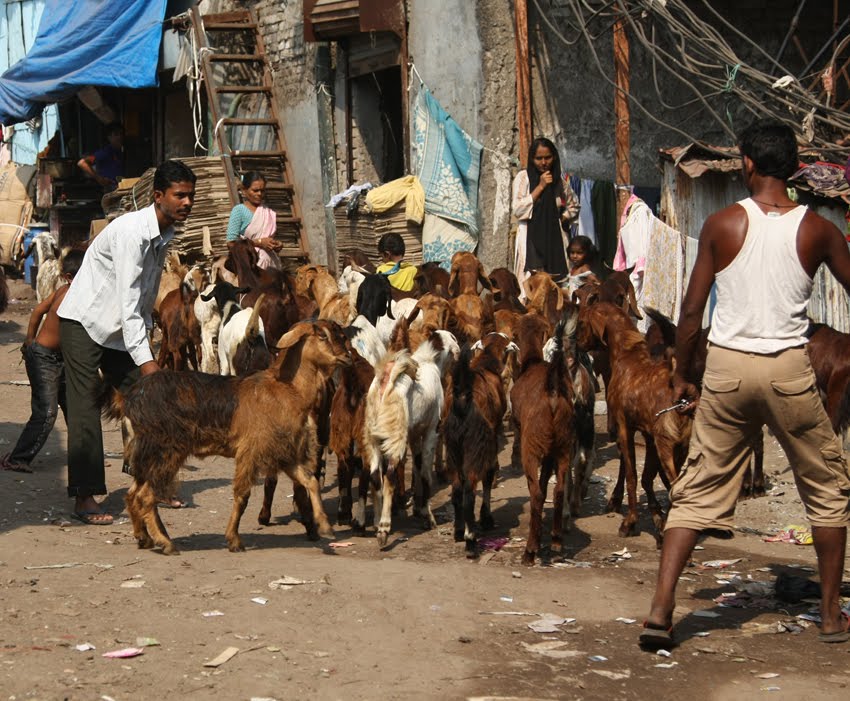
There were two goats in the workshop - a big brown one, and a smaller cream coloured one. They followed him around.

First, I must feed these two, he said to me. And he brought out his store of wheat grain.


Wheat?, I asked. I thought it would be grass or leaves.


Ah, these are hand-fed goats, he said. No grass for them!

The goats ate greedily. I looked at their shiny pelts and felt sorry for them.


So, I said to him, tomorrow you will slit their necks, huh?


He nodded and said, yes, it is qurbani.


Qurbani, sacrifice, is the theme of Bakr-Id (in memory of the time when Ibrahim sacrificed his son at God's command, only to discover that instead of the son, a dead ram lay at the altar).


The ideal qurbani is therefore, when one selects the animal oneself, nourishes it and becomes familiar or even attached to it. Without that attachment, there is no real sacrifice, is there?

I knew this, but it didn't stop me from feeling sorry for the poor goats. Vegetarians like me can afford to feel this sort of sympathy. But as long as I don't get holier-than-thou about it, as long as I can understand someone else's point of view, it's ok, I guess.


I don't eat meat, I said to the old man. It was the perfect opening for him to ask me about myself. Who was I? What part of the country did I come from? Where did I live? We found ourselves settling into the well-understood rituals that govern social interaction.

I talked about my grandfather, and how he migrated to Bombay and found a job here. As I told my grandfather's story, the old man stood up and cleared a chair for me. Come, sit, he said, why are you standing? And thus, over a migrant's story, we made a connection.

Next time, I go there, I'll ask the old man about *his* story. I am looking forward to it.

The photos below are by the very talented Meena Kadri, who came with me on my Dharavi jaunt. Check out her flickr album if you have the time. What an amazing eye she has for form and colour.

Aerial view of recycling sheds (on the left). Trucks bring in raw material and take away finished goods.

Inside the soap factory: Worker slicing and packing soap. The raw material includes waste from large soap manufacturing factories. The final product is a small green slab.

More goats outside the workshop compound. No one will go hungry on Id.

Thursday, November 26, 2009

There is an answer

- Posted by Deepa, a poem by Girish Sangameswaran

My cousin Girish wrote something about last November's attacks on Mumbai, and I thought I'd post it here on the anniversary of the attacks.

- Deepa

Violence in Mumbai, 26 Nov 08 onwards.
More than 100 killed, 300 injured.


The horrendous acts of violence
Laced with sweetness of religion
Garnished with mindsets of division
Are these acts of chaotic blindness or
Colossal stupor ?

Armed organizations with black heads
Black scarfs, black weapons
Blackness looming large
Black minds, black shouts of freedom, victory

Who are they, where do they come from,
Individual or collective consciousness ?
Remnants of the undesired or
Splinters of past hurts ?

There may be no quick answers to violence,
but surely a long term one,

When a child is told -
That the skin colour differs but when pinched hard,
one sees red blood

That the long hair is the one that’s rolled,
to be covered with a turban

That to kneel down or to join palms,
are both acts of surrender and prostration

That Pani, Neeru, Thani and Jal mean the same
That the Spirit is to be embraced and not the façade
That the visage changes but the expression is one,
And this expression is the language of the heart spoken through the eyes
Which is universal and belongs to the ONE who is common to all

There is an answer……………if we believe in one.

Friday, November 13, 2009

Mango-ginger? What's that?

by Janaki Krishnan

Yesterday, my daughter's maid rang me up.

"Amma" she said, "Deepa tayi has bought something that looks like ginger. But she has asked me to turn into a pickle. What
shall I do? It's a little like ginger, a little like tumeric."

"Ah, it must be Manga inji (mango-ginger)," I said.

Pale coloured mango-ginger in the foreground. To its left is raw turmeric, yellow-orange in colour. To the right is regular ginger.

Mango-ginger, a member of the ginger family, is closely related to turmeric. It looks like ginger - knobbly on the outside, pale yellow on the inside. It combines the zing of ginger and the coolness of sweet, sour, raw mango. Aside from this, the mango-ginger's got nothing much to do with an actual mango.

So I told the maid, "To make the pickle, cut it into small pieces, add salt, red chilli powder. You can also add a little bit of lemon juice if you like. It's delicious, and can be had with curd rice. Wait and see, Deepa will eat twice the amount of curd rice that she usually does!"

The pickle after it was made. Unlike other pickles which require to be stored or put away for a while, this one can be eaten immediately after preparation.

Mango ginger can also be used to make a chutney along with urad dal (black gram or black lentil), red chillies, hing (asafoetida), grated coconut and a bit of jaggery. This chutney is eaten with dosas, idlies and even rice.
.
The Gujarati word for mango-ginger is "amba harad". My Gujarati neighbour cuts it into small bits, adds salt and lemon to make a simple pickle to be eaten with chapatti. Sometimes, she also adds slices of raw turmeric to this pickle. A Parsi friend cuts it into thin strips and uses it in salad. Another lady we know dices it into little cubes, along with similarly diced cubes of carrot and cucumber. She adds coriander, lemon and a little salt to make a fresh and delicious salad.
.
Mango-ginger has excellent medicinal properties and finds extensive use in the indigenous system of medicine. It is an appetizer, aphrodisiac, laxative and an antipyretic as it cools down the body in case of a fever. It is effecive against bronchitis, asthma, hiccough and inflammation due to injures.
.
It's too bad that this spice is relatively unheard of. When you get a chance, please try some of the pickle... there's hardly anyone I know who doesn't like it!

With inputs and edits by Aishwarya

Friday, September 18, 2009

The Oldest Synagogue in Mumbai

- By Deepa Krishnan

I went to Bhendi Bazaar recently with Freni, walking through the areas surrounding Minara Masjid. We were looking for Shaar Harahamim, the oldest Jewish synagogue in the city.

It was Ramzan, and everywhere there were interesting stalls selling all sorts of things.

This is seviyan, right? Is it for kheer?

I was starving, and it was lunch time...then I realised everyone around me was fasting! Normally, I can't stand being hungry, it gives me a migraine...but when I thought about everyone else I saw, and realised they would all not eat until the evening iftar, it gave me the backbone to walk further.

In all my 40 years, I have never been to this side of the city, so everything was new and interesting to me. I photographed an old building, Dawoodbhoy Fazalbhoy School (the Trust provides scholarships for Muslims to study abroad). I wondered who the Fazalbhoy family was, and what their history is...perhaps they are one of the early trading families that came to the city of Bombay under the British. Or maybe someone in shipping? Are they Memons? This is the sort of history I'm always curious about, so if any of you know, then do post a comment!

Dawoodbhoy Fazalbhoy School

Eventually, we found ourselves on Samuel Street. I spotted a bhelwala, and gave up on starving myself. So munching sukha-bhel, Freni and I strolled on, chatting, peering through side lanes, looking at old homes, small trading shops, enjoying the bazaar buzz that is very typical of old Bombay. I'm addicted to this sort of thing, and Freni is so wonderful to walk with...sigh...everyone should have a friend like that!

After about 30 minutes, we finally came to a little door, painted blue, with the sign we were looking for - the Star of David!

Shaar Harahamin, The Gate of Mercy. In Marathi, it is Dayeche Dwar.

Entry to the synagogue is through a still smaller side door, the sort that you have to bend to enter.

Exterior view of synagogue with smaller side-door. On the higher floor is the ladies gallery.

We went inside, and found the old caretaker, who gave us a wonderful tour of the place in Marathi. This is a Bene-Israeli synagogue.

Freni chatting with the caretaker.

The Bene Israel are the oldest Jewish community in India. Their ancestors were shipwrecked and washed ashore the Konkan coast, south of Bombay. The survivors - seven men and seven women - buried their dead in a site near the village Nawgaon, which later became the Bene Israel cemetery.

The survivors were offered shelter by the local inhabitants and decided to settle permanently in the Konkan villages. They adopted Hindu names similar to their Biblical first names, but became known by their “-kar” surnames, which indicated the village in which they lived in, or sometimes, their occupation. So for me, the most fascinating thing about the synagogue were the name boards!!

What an interesting collection of first names and surnames! Moses Talegawkar, from Talegaon of course!

The synagogue itself is very quaint. I loved the old mezzuzah that was affixed to the doorway, and the beautifully carved door that housed the Torah. The furniture is all old wood, and the benches are solid, with no nails. I tried to move a bench, but it was too heavy. The gallery for women is separate, on the first floor, and there are steps on the outside that you can use to go upstairs. The caretaker told us some interesting tales, and explained his daily routine. I found it very interesting that the lamps in this synagogue are lit with coconut oil. And he showed us how he makes the lamps and places the wicks.

If you are anywhere near Bhendi Bazaar, I would recommend going to this synagogue, for a glimpse of an interesting community that has played an important role in Bombay's history. On the Mumbai Magic Jewish Heritage Tour, my guides have been taking people to this synagogue. But I wanted to see it for myself, and I'm glad I did!

Tuesday, September 01, 2009

A feast, a feast!! (and a glorious saree)

Last week, Mom and I went to Matunga to buy a saree.
.
Not any old saree, but an ombudu-gajam, that Queen of Sarees, all of nine yards long, the ultimate, definitive, TamBram garment.
.
We got there a little early, and the saree shop hadn't opened yet. So in keeping with our TamBram roots, we decided to have coffee at Manis Lunch Home. As we went in, both Mom and I stopped in our tracks - there was this giant 10 foot poster outside:

Mani's Lunch Home - Invitation to the Onam Feast on Sep 2
.
Talk about authentic food! This is about as good as it gets!
.
I wanted to go eat there today, but the morning was manic, so I was stuck at my desk. I have to be content instead, with posting a picture of *another* feast I went to yesterday.
.
Palakkad Wedding Meal - and this is only the first course!!

My cousin Ravi got married at Bangalore, and this is the photo of the main muhurtham meal. Very similar to the Onam sadya, in fact, most of the items listed in the menu above were served. We all ate until we burst.
.
As for the ombodu-gajam saree, here is mom, looking resplendent in it! I don't know how to drape this saree, so I have promised myself I am going to learn it. I want to look like this some day!
.
Mom and Dad with Aishwarya.

The ombudu-gajam is from Lakshmi Silks, another venerable Matunga institution. My grandmother used to buy there, and so does my mom. My sister and I have been sensibly following in their footsteps. The South Cottons at Lakshmi Silks are fantastic.

By the way, if you overhear a conversation between two TamBram women in Matunga, it will likely go something like this:

"Nalla irrukey! Enga vaanginai podavai?". This saree looks good! Where did you buy it?

"Iyengaaru-kadai daan, vera engai!" (this said with a smile). At Iyengaar's shop, where else!

If you are part of the inner coterie, then you'll know that 'Iyengaar' refers to the owner of Lakshmi Silks, a man responsible for much female happiness in the Matunga area.
.
Lakshmi Silks is a tiny shop near the kabutarkhana in Matunga Market. Business is done the old fashioned way. You leave footwear outside, step into a small airconditioned area. You sit on the floor, on mats. You explain what you are looking for. Soon, the sarees emerge, silk and cotton, exquisite Kancheevarams, beautiful Mangalagiris, checked Chettinaads...your head reels with pleasure. You take your time. You examine everything.
.
Perhaps it is that arresting maroon that calls out to you, the one with the temple motif and the glorious golden pallu. Or perhaps it is that beautfiful mango yellow, the one with the green and gold border.
Eventually, you make a selection. You fork out money, watch as the precious saree is wrapped...and then you walk out, clutching your bundle of silken happiness, plotting when to wear it.

Ah, Matunga, Matunga! Long may your shops thrive!

Saturday, August 15, 2009

An emotional Independence Day

I watched a re-run of the movie Gandhi last night on TV. There were many emotional moments during the movie, as I watched the story of India's struggle for independence. I could not stay unmoved as I watched the brutal lathi charges, the bravery and countless sacrifices. I rejoiced at the smallest victories, I cried at the losses, I despaired at the Partition.
.
When the movie was over, I went to bed thinking - This story is my legacy. This is what I have inherited. These are my heroes, ordinary men and women, born of the same soil as I am.
.
Right now, outside my house, they are playing the usual Independence day songs...ae mere pyaare vatan...saare jahan se acchha...apni azaadi ko hum...It should be cliched and cheesy, but instead, today, it gives me goosebumps.
.
I remember the movie I watched, and the zeal of the men and women who died to give us India.
.
But I believe you don't die, unless every memory of you is erased from the hearts and minds of your countrymen.
.
Let's remember then, the heroes and the leaders, the ordinary men and women, who gave me the right to stand up and say, "I am Indian, and I am free!"

Saturday, July 04, 2009

You know it's the monsoon when...(3)

...everything's covered in blue!

Motorbike parked in Sion - it was covered last evening to protect it from rain at night.
.Goods Tempo with blue tarpaulin lashed down.


Slum colony in Bandra
.
Make-shift blue roof at cinema complex

Verandah cover to protect the daily washing

This morning I saw a pav-wallah on a cycle, his bread was covered with a blue sheet. The temples have blue coverings. Shop awnings are blue. I saw an apartment block where the whole terrace was covered in blue. In Dharavi, there is a street where 4-5 shops do nothing but sell these blue sheets.

Keep your eyes open and you'll see bright blue just about everywhere!

Wednesday, July 01, 2009

You know it's the monsoon when... (2)

... the horses are suddenly excited because of the cool weather.

Dawn riding at the Mahalakshmi Race Course

Riding in the summer was hot and sweaty even at 6:30 am.

After the first showers, during the riding class, our instructor said "Aaj ghode fresh hain... mausam thanda hai na."

Indeed they were up to more tricks than usual... (prancing around, tossing their heads.. and the more badmaash ones bucking and almost throwing off their riders).

As for me, I enjoyed the cool, almost cold breeze at dawn.