Friday, July 27, 2012

Bollywood dreams

- By Deepa Krishnan

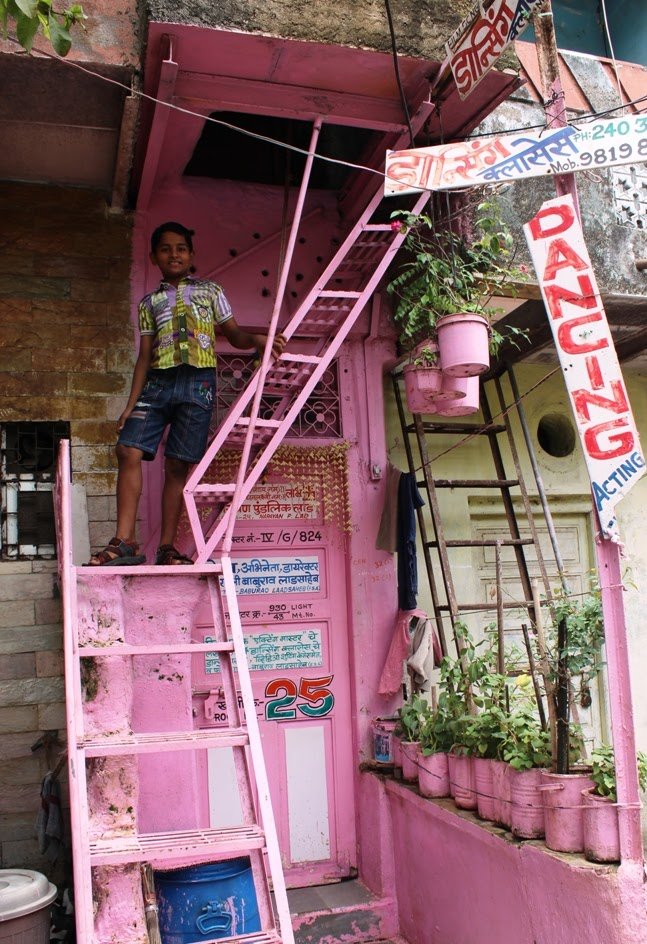
There's a little pink house in Dharavi, where dreams are made.
When you look at it, it doesn't seem very different from many others in the area. What sets it apart is kids like this one below, who come here with stars in their eyes.
This little kid is Gulam Mustafa Khan. He is 11 years old, and he wants to be a movie star. Every Sunday, his mother brings him to this little pink house, to learn acting and dancing. 
Sitting next to Gulam and his mother is Ikram. He is Gulam's "mamu" - his mother's brother. Irfan wants to become a dancer.

And here is the man who they hope will make these dreams come true: Baburao Lad. Producter, actor, teacher, dancer, painter, photographer - Baburao is a multi-talented guy who polishes and converts Dharavi's many hopefuls into star material.
Baburao has even published a book: it's called Acting Master, and it has all the do's and don'ts for success in Bollywood. The loft of the pink house is Baburao's studio, where the magic happens.
I watched as a Bollywood number was taught.
The moves are just what every fledgeling Bollywood aspirant needs - straight out of popular films. I asked Gulam what he was learning. "Rowdy Rathore", he said to me. "I'm learning acche acche steps from Rowdy Rathore."
But dancing is not enough if you have to be a star. So Baburao teaches acting, fighting and modelling.
And all manner of other skills:
The classes cost Rs 500 per month, with a Rs 2000 joining fee. This is far less expensive than similar classes in non-slum areas. But going by the number of eager folks coming to the class, it looks like in this pink house at least, the City of Dreams is alive and kicking. Enjoy the show :)

Friday, July 13, 2012

One rainy evening at Bandra Fort

- By Deepa Krishnan

The old Portuguese fort in Bandra is one of Mumbai's favourite hangouts in the rain.  

There's a fantastic breeze, with great views of the Arabian sea and the Worli Sea-link. Families, college kids, lovers, everyone comes here to hang out in the evenings. Naturally, the bhelwalla does brisk business.
Seen from the top of the fort, the tad palms and the sea remind you of Mumbai's original landscape, as it existed before Bandra developed and grew into what it is today.
In the 1640s, the Portuguese built a fort here, called Castella de Aguada - the Castle of Water.
The fort is still there, and it has unbroken views of the Sea Link which is behind it.
Further down the road, you can see folks hanging out near Shah Rukh Khan's Mannat. There's a little garden here, nice for spending time with friends, plus the added bonus of a possible star sighting. The cafe nearby has windows with sea views.
Along the Bandstand promenade, there are lots of people walking, sitting, talking, kootchy-kooing...I decided not to click photos of the many romances - didn't want to get any of them into trouble! There are lots of pretty girls around, adding to the glamour quotient of the place. Check it out sometime!

Sunday, July 08, 2012

Flora Fountain, Mumbai

- By Deepa Krishnan

Sometimes you walk past something without realising just how beautiful it is. And then you pause. 

Here she is, the Goddess Flora, on the top of the fountain. Beautiful, no?


She's right in the middle of the busy financial district. Rather incongruous, really, when you think that Flora is the Roman goddess of spring, of flowers and fertility. What on earth is she doing so close to all these banks and the stock market? :) :) 
Actually, there's a very simple reason why this fountain has Flora as the theme - it's because the guys who built it were the Agri-Horticultural Society of Western India (AHSWI). But why would an obscure-sounding society like that build a fountain in a city? Where would they get the money in the first place? I did some digging around, and as it turns out, the Society was anything but obscure. 


Originally founded in 1820 in Calcutta by William Carey, the Agri-Horticultural Society of India was responsible for introducing a wide range of crops in India. From all over the world, they brought varieties of maize, cotton, sugarcane, potatoes, and ginger for cultivation and hybridization in India. They introduced cinchona (from which quinine is derived). They established beautiful gardens, they documented the flora of the country, published journals, and held competitions and shows. In effect, they were the Agriculture Ministry in India well until the 1900's. 
The photo above  is of their garden in Alipore, Calcutta. It is spread over 21 acres, and contains many rare plants. The British were a nation of garden lovers and their legacy lives on in the various regional versions of the Agri Horticultural Society of India.

Anything Calcutta did, Mumbai had to do better :) The Agri-Horticulture Society of Western India was founded in 1830. The first garden was set up in Sewri, and was soon appropriated as a cemetery for Europeans (see photo below from CNN-Go). 
In Mumbai, the Society had some interesting people as members - a mix of great intellect and great wealth. 

Among the intellectuals was Dr. George Birdwood (Anglo-Indian, born in Belgaum, educated in England), who was Principal of Grant Medical College Mumbai. He wrote several books, including a "Catalogue Of The Economic Products Of The Presidency Of Bombay",  "Practical Bazaar Medicines: With Over 200 Useful Prescriptions", and a treatise on incense. In short - a man who knew his plants. 

The other intellectual in the Society was Dr. Bhau Daji Laud (see photo alongside), who rose from humble beginnings in Mandrem (Goa) to twice become Sheriff of Mumbai. He shared Birdwood's interest in botany, studied the Sanskrit literature of medicine, and tested traditional drugs to which Hindu texts ascribed marvellous powers. These two then, were the brains of the Society. Among the wealthy notables in the AHSWI were ace businessman Jagannath Shankar Seth, David Sassoon (the Jewish merchant-prince) and Jamsetjee Jeejibhoy (1st Baronet).


It was David Sassoon who donated his land in Byculla to create the loveliest garden Mumbai had ever seen - the Victoria Gardens. Spread over 48 hectares, the garden was established under the direction of Dr. Birdwood and Dr. Laud. It had beautiful architecture, and was planted with rare trees and shrubs. It  continues to be a green solace to the people of Mumbai.
So as you can see, gardens and flowers and plants and crops were quite the fashionable thing in Mumbai in the mid 1800's. The idea of celebrating Goddess Flora was perhaps just a sign of the times. The money for Flora Fountain came from a Parsi gentleman: Mr Cursetjee Furdomjee Parekh. He was a partner at Jamsetjee Jeejibhoy's firm, owned many ships, and like many merchant-princes of the time, made a significant fortune in trade with China and Europe. 

The sculptor was James Forsyth, who had earlier worked on a beautiful Flora  Fountain in Witley Court, Worcestershire, England (that original fountain was damaged and is now being restored). 

The Flora Fountain in Mumbai was carved of Portland stone in 1864, and installed in the place where Church Gate stood. Here  are a couple of more photos; this is the base of the fountain, and you can see how these carvings represent the bounty of nature.
The anklets on her feet are interesting, she looks almost Indian, doesn't she? Is that a sheaf of wheat at her feet? I tried to look it up, but couldn't find more information about the design of the female figures. If you know where I can find information online, do let me know.  

Sunday, June 24, 2012

The Wholesale Flower Market at Dadar

- By Deepa Krishnan

On a rainy day, the wholesale flower market in Dadar is a great place for photography enthusiasts. 

It is an indoor market, so you can walk around without worrying about getting your camera wet. Of course, you have to slosh through a messy floor, but the colours are so fantastic that it is well worth it.
The business is wholesale, and flowers are sold in bulk to wedding decorators and event managers. A lot of business is transacted over the phone (repeat customers, established relationships). But many people come to haggle and buy, especially when they need a lot of flowers. Also, small local flower-sellers in the city  come here in person to buy their daily stocks. They buy not only flowers, but also the leaves that are used as wrapping, and thread as well, to tie it all together.


From the wholesale market, these flowers then make their way to local street stalls, to be fashioned into garlands or "veni" for the hair. I clicked this photo of one flower-seller at our local market, she was stringing a garland in the traditional way using her toes to hold the thread.
Isn't this veni gorgeous?!! Makes me wish I had longer hair, just so that I could wear this!
The best time of day to go to the Dadar flower market is early in the morning, when the flowers arrive. The stocks are freshly stacked, phones are buzzing, buyers are haggling and business is brisk. By about 9:00 a.m. the day's major business almost comes to a close, although there are many shops still open until 10:00 a.m.

Sunday, June 10, 2012

Chai, chai, chai...

- By Deepa Krishnan

It's raining outside, and in this kind of weather, I can't stop thinking about chai!

Hot, sweet, milky, chai. Especially from the chai-shop outside our office. This shop goes by the uninspired name of Prince Milk Center, but their chai is to die for. Maybe it's the huge amounts of sugar they add to it, or the way they keep boiling it until the milk acquires the rich, condensed smell of kheer. Who knows? All I know is, I absolutely crave it everyday. (Yaaaaaaaaargh. It's Sunday today! I have to wait until tomorrow to drink it!)

Meanwhile, as a consolation of sorts, I found a cool chai-inspired T-shirt at the Tantra website. It has a chai-wallah doing his usual rounds with a dented aluminum kettle and half a dozen cheap tea-glasses (you can click on it to see a larger image, I love the quirky illustration).
The Tantra T-shirt says:
Chai - India's National Drink
Stronger than Vodka, Healthier than Rum, Cheaper than Scotch. 

The T-shirt is prompted of course, by the Planning Commission's announcement that tea will officially be declared the national drink of India from April 2013. If the Russians and Scots and everyone else can have a national drink, so can we!  
Chaiwalla at Mangaldas Market

According to an ORG-India Tea Consumption Study, 83% of homes in India drink tea. I find this a bit hard to believe, considering how many people can't afford even food. And there is a substantial South Indian population who drink coffee. 

Anyway, according to this same study, tea is also the cheapest beverage in the world after water. Perhaps, perhaps... But not in Mumbai, where our office tea guy charges Rs 14 for a "special masala chai" and Rs 10 for a "regular" chai.  Fortunately, he offers "cutting chai" (tea served in half-glass portions), which makes his regular chai a very affordable 5-rupee addiction. 

One of the nicest things about being in the travel business is that you get to travel all over the country. This also means endless opportunities to try tea in all sorts of places. I've had fantastic chai in remote little villages, highway dhabas, mid-size towns and big cities. 

This year, the best tea I've had was at a small non-descript tea-stall in the Old City of Ahmedabad. It was early morning, and we were on a "pol" walk through several heritage neighbourhoods. Mid-way through the walk, we stopped for chai. The entire neighbourhood was quiet, and just this one stall had its burner going and tea on the boil. The owner was a glum sort of fellow, not the chatty smiling variety. But he quickly served us chai in a simple white cup-and-saucer, and in the cool morning hours, the taste was simply divine.

Post Script: After I finished writing this story, I spotted yet another chai T-shirt, this one from Tribal Route. 
 And they have a funky Bollywood-theme chai kettle, very cool, no?
If you spot any more chai-collectibles, let me know!

Saturday, May 26, 2012

The students who make me proud! - Photos from the Mumbai Local tour

- By Deepa Krishnan

We launched the Mumbai Local tour about 4 years ago - you know, the one that uses local trains, buses and black-and-yellow taxis to see the city? It's been a very successful partnership with The Akanksha Foundation. Akanksha helped us find students who were looking for additional income to put themselves through college, and also to support their families. We trained these students to work as guides for this tour.

Here's one of the early press shoot photos - from a training session, for an article that appeared in the Indian Express. Behind us is the Taj Mahal Palace and Towers. It was our first photo-shoot and neither I nor the kids could stop laughing at how fake it felt. I've got a copy of Sharda Dwivedi's "Fort Walks" in my hand, and I'm pointing like a school teacher! I want to grin every time I see it! 
Later that day I clicked a more 'real' photo, of Priyanka with a tourist. The tour starts at the Gateway of India, and in this colour photo you can see how the area in front of the Gateway is all dug up. They were opening up the whole area then, making it easier for tourists to stand and photograph the Gateway. It is now very nice, they laid cobbled stones and it looks good. 
This is the first batch of students who went through the training.
This is Freni, who shared her knowledge of the city with them, and became Freni "didi" in the process :)
Some of our initial experiments with the route, using buses and trains!

The kids did amazingly well. Thanks to the fun nature of the tour, and its genuine Mumbai flavour, before we knew it, we had more bookings than we expected. And of course, we then had more students training! 
Here are some recent photos taken this year during the tour, with two Australian families:
Looks like such a fun tour, no? Try it sometime! A part of the tour proceeds goes to Akanksha Foundation,  to support the excellent work they do in the education of children. The girls who work as guides for this tour have all benefited from Akanksha programs, and they are a credit to their community and to their parents. Through the tour I am glad we are able to provide them with some additional income. More important,  I think the tour provides them with opportunities to interact with people from different countries, to gain confidence and skills, and to learn and be proud of their own city. Three of the girls now work in my office as well, so they have taken their first steps towards a career in tourism.

Here's another recent photo from an article in the Times of India - this time with a family from New York:
Because of our success in Mumbai, I thought I would do a similar tour in Delhi, and not surprisingly, that tour is doing well too! Head over to Delhi Magic and take a look! I hope these tours go from strength to strength, and that more and more students benefit from them. 

Sunday, April 15, 2012

Khichiya papad chaat in Bhuleshwar

For fantastic khichiya papad chaat, head to the Khau Galli in Bhuleshwar!
The papads are roasted over a coal sigdi, and then coated with two kinds of chutney, red and green. Then it is topped with potatoes, tomatoes, onions, and of course, finally garnished liberally with sev and coriander.
It's seriously tasty, folks. As you can see from the first photo, the papads are nice and thick, so they make a great base. Unlike the usual urad dal papads, khichiya papdi is made of rice and the taste is very different. If you live in Mumbai but haven't yet tried this, you're missing something!

I've only ever seen this in Bhuleshwar, but if you live in a Gujju neighbourhood, let me know if you've spotted this. I'm told Borivali West is another good place to find masala khichiya papad? 

Wednesday, March 07, 2012

Visiting the Nehru Centre, Mumbai

- by Deepa Krishnan

A couple of days ago, I went to the 'Discovery of India' exhibit at the Nehru Centre. I came away loving the feel of the place! 

The Nehru Centre was conceived in 1979. So everything, from the exterior architecture to the exhibit design, has a very 80's feel to it - neither too modern, nor too old-fashioned (er, just like me?). Anyway, it took me back to my school days; and reminded me of a quieter Mumbai, with lesser traffic, fewer people, and more open spaces. 
Exterior of Nehru Centre, Worli, Mumbai 
The first thing I noticed when I went through the gate was this sculpture, nicely positioned between two trees.
"Attraction" by Paresh Maity 
“My interaction with art began in Bengal when I would stand and watch idols being prepared for the Puja,” said Paresh Maity in a recent interview with Business Standard. “That was the beginning of my inspiration.”. Inspired or otherwise, I rather enjoyed the quiet conversation of these two stone creations, focused entirely on each other :) There were several other installations nearby, but I did not have the time to go look at them.

We walked inside into a cool area, and found the cleaning staff signing off for the day.
Lazy afternoon; the cleaning staff in their blue sarees
When you enter the building, you see a large open space, with a staircase leading up (on the right). The Discovery of India exhibit is on the first floor.

Immediately to the right, before the staircase, is a model of the HMS Trincomalee, built at the Mumbai docks by the Wadia shipping family. The Trincomalee is Britain's oldest warship still afloat (after nearly 200 years)! Master shipbuilder Jamsetjee Bomanjee Wadia supervised its construction in the early 1800's. It was one of 14 ships built for the Royal navy during Wadia's life. An engraved silver nail was hammered into the keel to ensure the vessel's well-being (ha! maybe that's why it's still afloat!).
Model of the Trincomalee in the lobby 
Actually - the real reason it hasn't fallen apart is probably that unlike most ships of that time, which were built using oakwood, the Trincomalee was built using Malabar teak. It is a particularly hardy wood. And a lot of money has gone into restoring the ship, which is currently a museum exhibit in the UK. Here's a photo from the real ship, from Hartlepool (North East of England).
Beautiful teak-wood, restored lovingly. There is a Maratha figure on the busthead, acknowledging the ship's origins in Bombay. Photo from website of HMS Trincomalee

The Wadia family continued to build over a 100 ships for Britain, becoming the leading family in the development of Bombay's shipbuilding industry. I'm glad the Nehru Centre offers this tribute to them. 

Passing the ship, we walked upstairs to the Discovery of India exhibit. It is a summary of 5000 years of Indian history. And although the story is complicated, it is told exceedingly well. If you have a child, and you're just introducing him or her to India, I can't think of a better way to do it. 

The exhibit is divided into sections, starting with the prehistoric, and then going on to the Harappan civilisation, the Golden Age of the first millennium, right up to Indian independence. It is really too much to do in one day, especially if you have a child with you, but you can spread it over 2 or 3 visits, as a story-telling session. The displays are interesting and interactive, visually pleasing, stimulating all the senses. Yes, it is from the 1980's, so you don't have touch-screens and what not, but it's still very interesting. For example, at the very beginning - the very first exhibit they have is a dome covered with stars and you stand under it, and you can hear from the Rig Veda, the hymn to the Creation of the Universe. Nice, no? I certainly loved it. If you want to hear what I heard, here is a link to the Sanskrit chant and the translation as well.

Here's a photo from the last display section, during British rule, it depicts the city of Calcutta, its bazaars, people and buildings. It is a 3-dimensional exhibit with cut-outs and props: see how nicely it is done?
Calcutta's "White Town" and "Black Town", both beautifully depicted
Seriously, the most appealing thing about the Discovery of India is that someone with intelligence, creativity and a great deal of knowledge has put it together. I don't who it was, but here's a little salute to them! I went with three guests from the USA; they were going on a long trip all over India, and for them, this was a great introduction to all the things they could expect ahead of them. 
Here's wishing you happy discoveries ahead, Roger, Alan and Richard!


This article was featured in the DNA Newspaper, April 24, 2012