Sunday, February 27, 2011

A Sunny Morning at Sewri Fort

- By Deepa Krishnan

I have been going often to Sewri these days, now that flamingo season is here.

But today, I also took the opportunity to climb up to Sewri Fort with my friend Sancia. I had forgotten my camera, so these photos are from my cell phone.

It was 8:30 a.m., and the sun was just starting to warm up the fort walls.

The fort interested me, because it is very much part of the city's history. It belongs to the heady "pirate" days on the Bombay coast, when wars were fought for control of Mumbai as a trading post.

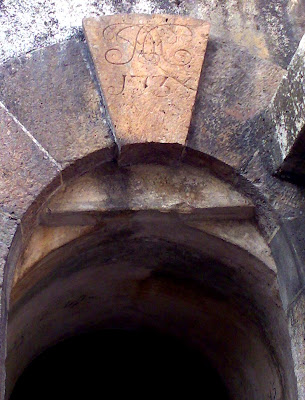
Sewri Fort was built by the English, to protect their interests in Bombay. A carved stone over a doorway says 1736; but battles were fought here even before that.

The Siddis attacked and conquered Sewri in 1689. The also overran Mazgaon, and raided Worli. Check out the much tougher looking Siddi fort here; my daughter wrote about it when we visited. Safe in their invincible fortress, the Siddis, known for their naval prowess, were a force to reckon with.

Spurred by defeat at the hands of the Siddis, and threatened by the Marathas and other European powers, the East India Company went into a building flurry in the second half of the 1600's, raising fortifications all over Bombay.

Sewri Fort was one of them. It wasn't a useless investment. When the Portuguese attacked in 1772, the attack was repelled from Sewri Fort.

Here is a pictorial timeline of Mumbai's forts
(those that are still standing today):

As you can see, lots of forts were built in the second half of the 1600's. Most had fallen into disrepair in the last 300 years. In the last 5 years or so, the government has begun to "restore" these forts. The ones that I have coloured in blue have been "restored", but it is so insensitively done that it makes me wince.

In the photo below, you can see the original stone steps going up to a look out point. Concrete has been poured over the curved decoration of the steps, to create a cement "banister" for these steps. A concrete wall partly covers the original stone arched door (where I found the carving of the year). What were they thinking??

50 sepoys manned this fort; and it had 8-10 cannons, looking out toward the sea. There were living quarters, and ammunition stores. Today, all the bunkers are concrete, although some attempt has been made to keep the shape in line with the original construction.

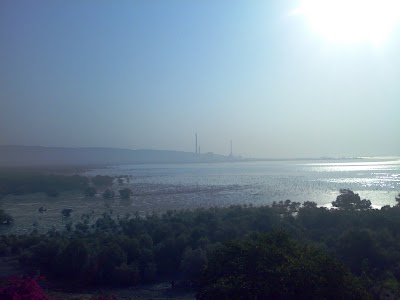
We climbed up to one of the view points to look at the harbour. The tide was retreating; beneath us we could see mangroves; and amidst the retreating water, there were flamingoes feeding.

We went down and got some close up sightings of the birds. Today the sighting was really fantastic; we spotted what must have been at least two or three thousand flamingoes. The juveniles stood in little brown and white groups, and the adults stood in much larger groups of pink. Apart from that, I saw gulls, stints, kingfishers, egrets, herons and what not. But without my camera, I couldn't get any decent photos :( sorry!!

Eventually I got hungry; and Sancia also needed to go to church. So she dropped me at my mom's house, where an excellent breakfast was waiting. Dosa, chutney, sambar and molagapodi. And filter coffee to top it all. Bliss! I wish all Sundays were like this :)

Thursday, February 10, 2011

Flat tyre on the Vashi highway

By Deepa Krishnan

We were returning from a wedding in Pune, when the car began to veer and drag a bit to the left. The front tyre had gone bust. We asked a truck driver where we could get it fixed, and he pointed to a repair shop about 500 metres away.

Vashi highway on a glorious sunny afternoon

The 'Puncher' Shop with its rubber tyre advertising

I was surprised at how long it had been since I had last visited a puncture shop. Ten years, I think! You know, this is what happens when you employ drivers, and stop taking the car out yourself. You kinda stop doing these little things, and before you know it, boom! you're sitting in a little ivory tower, and you don't know what's happening out there any more.

I discovered, for example, that there were now these new-fangled things called tubeless tyres. Don't laugh, dammit. I didn't know!! When I last looked, tyres were filled with thin rubber tubes, the tubes were full of air, and that's how cars worked. Now apparently, these tubes have disappeared. No longer can you turn a tyre inside out and wrest a skinny tube from its innards. No longer can you fill these tubes again with air; and send the car merrily along it's way.

Instead, you fix a flat tyre with an entirely different set of tools.

The first thing you need, is a strip of this deceptively simple looking stuff.

This is a tough, chewy rubbery-leathery thing that sticks to your fingers if you let it. It's basically a plug.

The next thing you need is this T-shaped tool, with a needle. And you need a tube of vulcanising fluid.

Now for the repair itself. Snip a small strip of the rubber plug, shove the needle through it; and then put this vulcanising fluid on it. Then you grab the handle with both hands, take a deep breath, and shove the strip it into the problem spot. See the guy in the photo below?

Our repair guy was around 16 years old.
There was an assistant as well, a little kid with a bandana.

So what happens - chemically speaking - is that the vulcanising fluid works on the strip, and converts it into a permanent hardened plug. (Or at least, that's what I think!). The little kid's job was to keep the air-pressure in the tube constant, so the plug would set well.

The Apprentice.
He took his job seriously.
There were other neighbourhood kids as well, watching.

Mom and Dad waited outside.
The neighbouring shop-owner kindly gave them space to sit.

Inside of our repair shop. I have *no* idea what most of these things are.

What I do know, though, is that these things are there for a reason. *Some* car, *some* day, will be rescued by some weird contraption that can only be found in this mess!

Seriously, why do cars have to be so complicated? :)

For example, what on EARTH are these belt-thingys?

More mysterious gizmos.

What is that U-shaped thing hanging from the ceiling? Or is it not U-shaped? Should I announce a prize for anyone who can actually name all these things?!!

Anyway - the whole repair thingy took about 15-20 minutes. I tried chatting to the 16-year old; but he was cagey. I'm from Calcutta, was all he would say. I let him be; there are a lot of illegal migrants from Bangladesh near the Vashi area, and I did not want to probe further. He was making a living in a tough world...I wished him well, and went on my way.

Saturday, January 22, 2011

Girls unite! Nothing to lose but your chains!

by Janaki Krishnan

I am a regular reader of the Tamil magazine Mangayar Malar (you can find it in the bookstands at Matunga, but most Tamil people in Mumbai have it home-delivered).

Mangayar Malar is a women's magazine that covers various topics - real life anecdotes, interviews of successful people, religion, recipes, etc. Among the most popular sections is a monthly forecast (using rashis). There is also a matrimonial column.

Mangayar Malar - Dec 2010 issue

Among the many real-life stories in the magazine, there was one story about a Brahmin priest from a small village. This priest has four sons, ages 45, 42, 39 and 32 respectively. All four sons are unmarried, and the priest has been having a hard time finding a match for any of them.

The priest bemoans the fact that no one is willing to marry his sons, although they are good men. Girls want money and status, according to the priest, whereas his sons can only offer a simple village life.

Kanyiar Manam Maruma - will girls change their minds?

The writer of the article has invited comments from readers, asking whether we are now living in an India where girls want material pleasures more than anything else. Why are today's Indian girls chasing money, asks the writer. Do they not know that a happy marriage is not about material things? Or is it that today's girls are educated, have jobs of their own, and are therefore increasingly unwilling to get married?

Thirumana Malar - the "marriage special" section of Mangayar Malar

The writer's questions set me thinking about my recent experiences in the "marriage market". In my spare time these days, I help my friends in matching the horoscopes of their sons or daughters with prospective brides or bridegrooms.

Once the horoscopes are matched, the girl and the boy talk to each other. Here are some of the questions that girls are asking before accepting the boy:

1) After marriage, are we going to live with your parents? (a good question in space-starved Mumbai!)

2) Will you look after my parents in their old age? (especially when she is the only daughter)

3) Shall I give a part of my salary to my parents after marriage (probably for repayment of a PF Loan that the father has taken for meeting wedding expenses!)

At the end of the day, I feel this is a positive trend in our society. All these years it was a man's world. A young man, whether educated or illiterate, healthy or disabled, handsome or ugly, asks for a "fair", beautiful, smart, homely, educated girl, along with dowry. After marriage, the girl is the property of the husband and the in-laws, often exploited physically, mentally, emotionally and financially.

I am happy that the situation is changing; that girls are losing some of the traditional chains that bound them in the past. These changes have touched only a fraction of Indian society. It is high time we wake up and discard these harmful attitudes towards women.

Sunday, January 16, 2011

Cosmopolitan Mumbai

I was telling someone about how cosmopolitan Mumbai is; but other than anecdotal stuff, I found it very hard to prove! I mean, how does one convince anyone of something like that?

Then we came across this dentist shop in Dharavi:

The signboard was written in four languages - English, Hindi, Tamil and Urdu. I didn't have to say anything more! :) :)

Sunday, December 19, 2010

Why Mittal Patel is one heck of a lady

Some days ago, I met Mittal Patel, a very determined young lady from Ahmedabad.

Mittal is a journalist by profession. But for the past 5 years, she has been working with the nomadic and de-notified communities of Gujarat, trying to get them access to basic rights. In doing so, she's taken on two of the biggest challenges in India - the bureaucratic system, and the caste mindset.

Mittal Patel

It was my neighbour Rashminbhai who introduced me to Mittal (or Mittal-ben, as she is called by most Gujaratis).

At Rashminbhai's invitation, I spent an evening at Amulakh Amichand School in King's Circle, watching Mittal tell her story to an audience of 100 people.

Mittal talking about nomads. The speech was in Gujarati.

I was so fascinated that the very next morning, I went over to Rashminbhai's house, and spent three hours chatting with Mittal. Over many cups of chai (and Rashminbhai's delicious farsaan), I listened to more details of her work.

It was quite an education.

The nomadic tribes of India are spread over multiple states, primarily Maharashtra, Rajasthan and Gujarat. In Gujarat, they number around 4 million, and this is the target group that Mittal has sworn to support (that's roughly the population of Singapore or Ireland, by the way).

One nomadic family with their cart. All their belongings will typically fit into the cart.

Gujarat's nomads are not one single community (there are over 300 communities listed in the government list). They follow different religions, practice different occupations, and have different customs and beliefs. The Dafer people, for instance, are typically employed to guard ripening crops. The Saraniyas are knife sharpeners. The Kangsia are bangle sellers and traders. The Nat and Nataniyas are performers - bards, musicians, acrobats, dancers, fire-eaters and so on. The Vansfoda work with bamboo and sell bamboo products. The Vadis are snake charmers; the Madaris work with monkeys.

As Mittal rattled off one community name after another, I was struck by the one thing that all these communities have in common - their traditional way of life is either dying, or dead already.

Television and cinema have largely killed the demand for traditional entertainment. Legislation has killed the livelihood of those nomads that work with animals. Plastic has replaced bamboo and other materials. And so on. In the past, people in a village waited for the nomads to show up on their annual routes, trading goods, services and entertainment. Now, there is no demand. So the nomads are quite literally, out on the streets, reduced to begging and theft for their livelihood.

No takers for acrobatics.

As if the loss of livelihood was not enough, the nomads have another big problem: As far as the government is concerned, they don't exist. I'm not kidding. The nomads have nothing, no birth certificate, no ration card, no land deeds, no school admission record, nothing. Not a single piece of paper, to prove they're part of the Indian population.

What this means is that they are completely left out of all government schemes. Take NREGA, for example, which promises work and an honest day's wage to anyone who wants it. Even if a nomad woman says she wants work, she can't get it. Why? To be eligible for NREGA you need to be a resident of a village. But village panchayats routinely refuse to let nomads be registered as part of the village population. They're nomads, right? They don't belong! So what if they've lived on the outskirts of a particular village for 20 years. They still don't belong! In fact, Mittal tells me that when she goes looking for a nomadic settlement, villagers typically do not even acknowledge that it exists.

Saraniya settlement on outskirts of village. This is no man's land, typically on the boundary of two villages. So neither village owns up to the settlement.

Apart from this, old prejudices and caste issues also kick in. Some nomadic communities have traditionally been labelled thieves. Most are from the lowest rungs of the caste hierarchy, with zero respect from other, higher castes. There is also the fear that if they are formally acknowledged, they will stake claim to government benefits.

Net net - the nomads are left out there in the cold - with neither the government nor the village recognising their existence. Not surprisingly, Mittal's biggest effort is firstly, to get every nomad a piece of paper that says, Hey! Look at me! I'm here! I am Indian! I'm Gujarati! I live in this village!

This ought to be simple, but as anyone who has worked with government machinery in India will tell you, it's staggeringly difficult in practice. In the first place, the whole thing requires forms to be filled and submitted - and how does an uneducated nomad do that? Mittal told us a quirky story about how she tried to help a middle-aged nomad with filling a form:

Mittal: Janunath, where were you born?
Janunath: I'm not sure. You write what you think is right, Mittal-ben.
Mittal: But how can I just cook this up? At least tell me something more about the areas where you roam, so I can write something sensible.
Janunath: I don't know, Mittal-ben. Ask my mother.
Janunath's Mother: We go to many places, Mittal-ben. I don't know where we went that year when he was born.
Mittal: Fine, I'll write something or the other. OK, Janunath, tell me what your age is.
Janunath: 18
Mittal: 18? Are you sure? You look older to me.
Janunath: I don't know, Mittal-ben.
Mittal: Do you have children?
Janunath: Yes, four children, here they are.
Mittal: Ah, so this one is the oldest? He looks like he is 14!!

So Mittal gives up asking questions, and she estimates everyone's age by looking at the age of their oldest child! And thus the form is filled for the whole clan, with approximate age, approximate place of birth, and so on :)

But form filling is only the beginning. The next problem is that the form verification process requires the village panchayat to certify that the details are correct. This is, of course, next to impossible. So Mittal and her team have to keep shuttling endlessly between the government and the panchayat office, patiently coaxing people to do what is right.

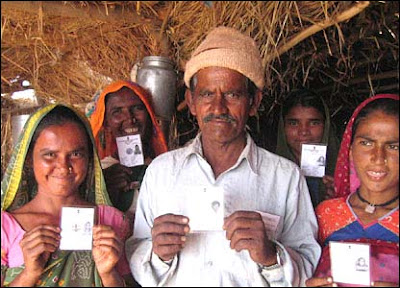
Without going into all the painful stories, let me just say that it is STUPENDOUS achievement, that Mittal Patel has finally got voter id cards issued to 20,000 nomadic people.

Way to go, Mittal-ben!!

That's not all. She has lobbied and got the Gujarat Government to pass a new State Resolution, which gives nomadic/de-notified people land rights. In the first year of allotment, 502 plots of land have been alloted to people who previously had no piece of earth to call their own. Mittal has started "tent-schools" for nomadic children, conducted "group marriages" to help reduce the burden of wedding expenses on nomad families, rescued nomadic girls from prostitution, and taken on many other social issues.

Honestly, I can't think of a more difficult challenge than trying to change the way "society" thinks. And I can't think of a more frustrating task than to get the big slow blundering bureaucracy to do something different. But Mittal has taken both these challenges head-on, and proved that it can be done.

When you meet people like Mittal, you end up feeling like you simply have to do something to help. You can't just sit there and let someone struggle against huge odds. I've started by contributing from my company's profits to Mittal's NGO; and next April, I'm planning to work on training and providing employment to some of her nomadic women. I'm looking to make a trip to Ahmedabad soon. Anyone who wants to contribute is welcome.
Sunday, December 12, 2010

Discovering carrom at Chor Bazaar

- By Deepa Krishnan

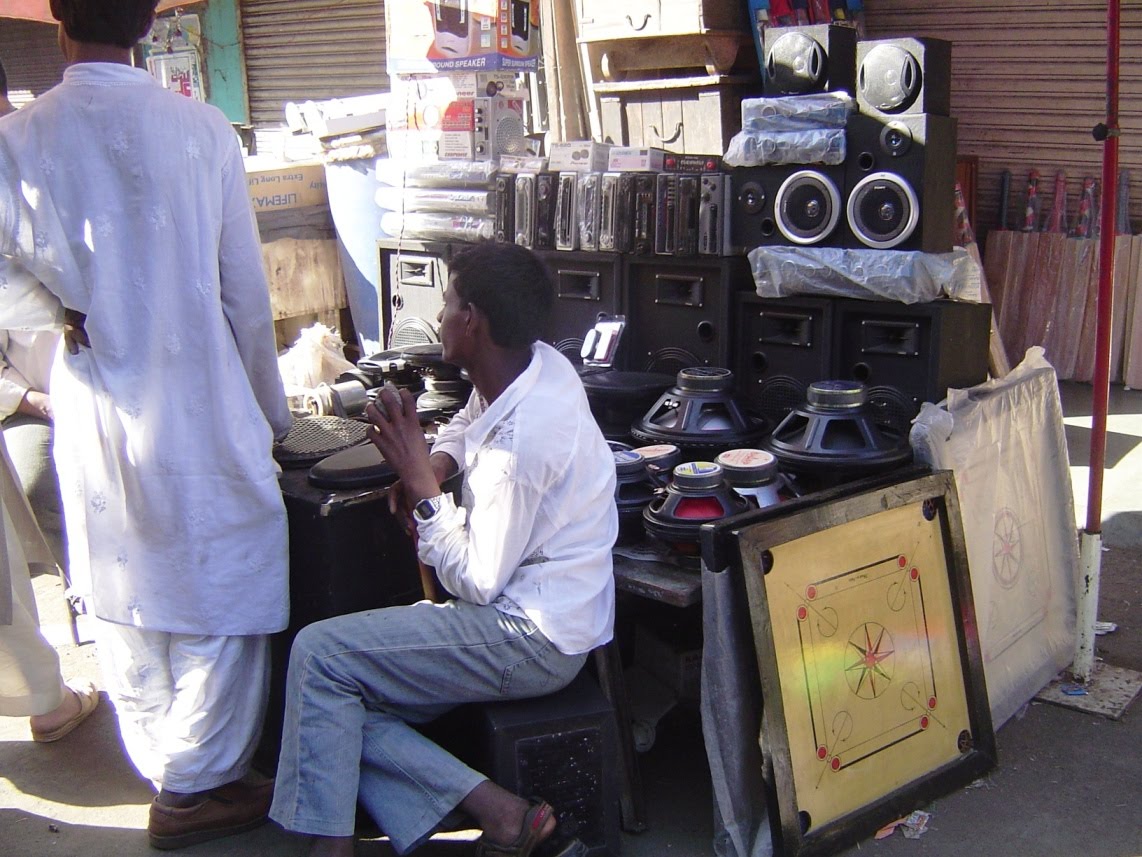
I was walking along Chor Bazaar when I spotted these carrom coins. Nostalgia grabbed me, and I stopped in my tracks.

I played a lot of carrom as a child. Summer holidays were usually filled with competitive carrom games, and I suddenly remembered how we'd emerge from the games with white and powdery fingers.

I looked around, to see if I could find the carrom board. Ah yes, there it was, stacked up casually against another stall.

I was tempted to take the board home. God, but I used to love this game!

When I was growing up, there was a carrom club in the building where we lived (although "club" is probably too grand a word for it). The game was played in a small garage in our building, mostly by guys, but there were a few women and girls as well.

Each evening, we'd wait for grown ups to push up the garage door, so that we could troop in and set up the heavy carrom board. Four of us would sit at each game, one on each side of the table. Other kids (the poor latecomers!) would gather around, watching the game, waiting for their turn.

There was not much conversation, really, beyond the game itself. In fact, the game was everything. The only things you heard were small little expletives, or frustrated groans. We lived for the pleasure of the perfect shot, and praise from a keen audience. "Great shot!"..."Too good, yaar!" and so on.

As the evening progressed, the older folks, back from the office commute, would come and join the game. Younger kids would get shooed off the game, to make way for the older "dadas". The younger ones wouldn't leave though, they'd just stand around watching the older gang at the game. A single yellow bulb would come on, lighting the board as it grew darker. At seven thirty, the kids would go home, while the older ones played on.

The game was played intensely. Players had reputations to live up to. Mr. X was good at straight shots. This other guy, Mr. Y, his backshot was perfect. Z was a 'thumbing' champ. And so on. Every year, we'd have competitions, and reputations would be made and broken.

When I left Bombay for Calcutta (to get my MBA degree), I discovered to my delight that there was a carrom board at IIM Calcutta. So carrom continued to be part of my life for another two years.

Then I got married, and discovered that carrom was played in my husband's family as well. I remember some long ago afternoons, playing carrom with his cousins. Of late though, there have not been any games, as most of the cousins have dispersed.

I've stopped playing now, more's the pity. The last time I played was five years ago, when we moved into a new apartment in Bombay. There was a carom competition here, and on an impulse, I enrolled my name for it. It was fun, and I even won the darn competition.

I should really start playing again. Game anyone?

Monday, November 01, 2010

Hair can be so annoying!

- By Aishwarya Pramod

I've always wanted long hair - long, lustrous, wavy/straight black hair. But my hair's never been very long - a short bob or a boy cut when I was tiny, and just past my shoulders in high school and college.

It's not for lack of trying to grow it, though. You see, my hair goes through an annoying cycle, which seems to force me to keep it permanently short.

The cycle has four stages:

STAGE 1: OPTIMISM

I have short hair in this stage. I get my mom to massage oil into my scalp every time before I shampoo it, which is twice a week. It's really shiny, healthy, glossy. No hairfall or anything. At this stage, I'm convinced that my hair will be able to grow long and strong.

I have great hopes for you, hair :D

STAGE 2: COMPLACENCY

My hair's grown a little longer, so it needs more care. I really should oil and shampoo as regularly as I did when it was short, BUT I've grown lazy :(

Plus, somehow in this stage, there's usually some kind of distraction like an upcoming exam, for which I need to study furiously 3 weeks in advance, or a trip outside Mumbai to a place that doesn't have hot water or enough time for mum to sit and massage oil into my scalp. So I skip the coconut oil and shampoo directly. Sometimes I don't even use conditioner. :O

This happens a few times, but I tell myself "You've been very regular with the oil upto now, it's ok if you miss it this time." (Big mistake, btw.)

I can't really focus on my hair HERE, can I?

STAGE 3: DESPERATION

My hair decides it's payback time and revolts. Hairfall, split ends, general destruction. I desperately get my mum to massage coconut oil into it every 3 days, but it's too late.

Oil Massage

STAGE 4: GIVING UP (OR A NEW BEGINNING)

I hate my hair. I'ts thin and shapeless. I have to get it cut.

I give up! Time to head for the salon.

I get it cut short, and then I'm back at Stage 1!

This four stage cycle thing has happened to me thrice. :| Wow.

This time I swear I will take care of you, hair. I would have been at Stage 3 (desperation) right now, but thankfully, stage 2 (complacency + lack of time/energy to oil stage) wasn't as bad as the previous times. So I'm going to get it cut, but only to shape it a bit so I can grow it long. This is a whole new Stage for me B-)

Anyway, a bit about hair oil:

I use Parachute coconut oil sometimes, and sometimes I use a special ayurvedic oil prescribed by a Vaidyan (ayurvedic doc). No idea what's in it - medicinal plants I guess.

Every time before I shampoo, I sit down on the floor with a book while my mom (or if my mom's busy, the maid) sits on a chair behind me and massages the oil into my scalp for 15 - 20 minutes. I sit with the oil in my hair for an icky hour, then I shampoo and condition. The cleanliness feels good after the oil.

I'm convinced that the secret to good hair is regular use of coconut oil. It's supposed to be very good for hair (and skin). I really think that if I ever have healthy long hair, it will be thanks to coconut oil. And lots of it, regularly.

My weapon of choice!

Sunday, October 24, 2010

Weekend with Ranjana

I've been working too hard, frankly, and so has my husband Pramod. This weekend, though, our friend Ranjana (bless her!) came to spend Friday night with us; and we finally made time for a long overdue night out in the city.

Friday night, at our apartment complex, waiting for the car.
I'm wearing a halter-neck top that I bought eight years ago. That's how dated my wardrobe is. As I was dressing up, I decided enough was enough. I would definitely go shopping on Saturday. Being a workaholic is ok. But wearing the same darn thing over and over again? Sheesh. I'm not *that* ossified.
.
When the car came, we set out for Bandra, to pickup an old school friend of Ranjana, and then headed to Aer, the rooftop bar at the Four Seasons.

Ranjana and Pramod at the Four Seasons rooftop bar
If you want my honest opinion, this is truly the most outstanding piece of real estate for a bar/restaurant in all of Mumbai. The cover charge at Rs 3000 per couple is stiff by the city's standards, but the incredible view of the city glittering below is very worth it. We hung around at the bar for a few minutes, until our table was available.
.
City glittering below
Honestly, this photo does no justice to the view. The full moon was out overhead, and the city lay beneath us. The walls are of sheer glass, making the most of the view. The seating is a sophisticated white, and the dim lighting is perfect. It lifts the spirits, this place.

All seats taken
On a Friday night, all seats were taken. The crowd is a mix of all age groups; but this is not a teeny-bopper place; it is significantly older. There were many people here catching a drink after work; I saw a lot of business suits and formal office wear. The Four Seasons is very conveniently located for people with offices in Worli and Lower Parel. For those working in Nariman Point or Fort, it is a logical mid-way stop on the way home. I rather liked the feeling of being part of the "office crowd". Tables are large, so even for bigger office groups of 8-15 people, there's lots of space.

We ordered nachos and chicken satay; the nachos were not as crisp as they should have been. The satay was pronounced excellent. I didn't even look at the menu; so I don't know what else was on offer.

The worst part of Aer is really the music. The night we were there, it was some electronica/techno type of thing; totally ugh. After an hour of listening to it, I was ready to give up and die. Pramod - who is more sensitive to music than I am - walked up to the DJ and said, hey, check out the people here, do you think this is the kind of music this age group is looking for? As it turns out, the DJ had nothing else to play; or maybe he had been instructed to play nothing but this nonsense. Pramod and the DJ chatted amicably for a long time; while the rest of us looked on and wondered what they were talking about - maybe they were earnestly discussing the city music scene :)

It was a relatively cool October night, but I think November-February would be perfect. I'm definitely going back again, to see if the music changes at all. Fortunately, the music isn't loud.

After Aer, we went back to Bandra and dropped off Ranjana's friend.
.
It was midnight by then; and on an impulse we decided to check out more places. I dragged Pramod and Ranjana to Pali Village Cafe for pasta and dessert and coffee. But we got there too late; they could only offer wine and dessert. So off we went to that old favourite, Olive.

Chilling out at Olive
For a place that is so much part of the city party scene, Olive is quite unpretentious. The food is good, the service is decent, and the crowd is a merry mix of all sorts. We found a nice corner at the bar to hang out; and then Pramod wrangled us a table to take a late order for pasta and pizza and tiramisu. Quite a lovely end to the day.

Oh - and one more thing - if you're wondering whether I kept my shopping resolution - here's the proof :)

A productive Saturday afternoon at Zara
We went shopping at Palladium on Saturday. Ranjana and I were joined by my sister, and we spent a happy afternoon trying on all sorts of things.

Zara is such a delight - I could kiss every single designer that works for them. By some miraculous magic, the clothes at Zara make you feel feminine and beautiful, in a way that other stores don't quite manage. Ranjana bought up half the store; and my sister bought winter clothes for her upcoming trip to Istanbul.
.
I was content with three simple additions to my wardrobe. But I'm already looking for another weekend out now, so I can wear them. Pramod, are you reading this? :)

Sunday, October 10, 2010

Of grand hotels and other things

No, I'm not writing about the Taj Mahal Palace Hotel!
.
The Taj is undoubtedly a city icon, but Bombay has been home to several other fancy hotels; some older than the Taj, and some its contemporaries. It's time someone wrote about them! By some quirk of history, none of these grand hotels now survive as working hotels, except the Taj. But several buildings remain, reminders of past days when these were grand hotels where the elite of the city hob-nobbed and conducted business.


The Majestic Hotel, Colaba, 1909 (built just 6 years after the Taj Mahal Hotel).

The Majestic used to be one of the city's premier luxury hotels; it was built by an Italian firm that ran the super-snobbish Savoy at Mussoorie and Carlton in Lucknow. Nothing but the best would do for the Majestic! These days though, it houses a hostel for members of the legislative assembly, a basic canteen, and a department store on the ground floor. Quite a come-down from its glory days!

The Majestic is not the only old grand hotel; there were others too. Where did these hotels come from? Who built them? For whom?

To look for answers, we must go back 150 years, to a glorious era of prosperity when Bombay became an important global centre of trade and commerce.

In the 1860's, Bombay saw unprecedented growth because of two key events. First, the American Civil War (1861-1865) led to a global shortage of cotton, because exports from the cotton fields of America were blockaded. The demand for cotton from Bombay shot up; prices rose to astronomical levels, and dizzy fortunes were made overnight by the city's cotton traders and shipping merchants. The second momentous event was the opening of the Suez Canal in 1864, which dramatically improved shipping.

As trade grew, traders and merchants from overseas started coming to Bombay for business; and naturally the demand for hotels went up. Hotels were certainly a more attractive option than the "chummeries" or clubs that gentlemen could stay in. What's more, travellers by sea had become used to the high hospitality standards offered by well run steamships, and looked for similar comforts in the ports.

Among the earliest grand hotels was Watson's Hotel; which reflected the owner's enthusiasm for ironwork (considered cheap to build).


Watson's Esplanade Hotel, 1867-69

It was a 'Whites Only' hotel; and was built by John Watson, who ran a drapery business in the city. The building's unique cast-iron frame was imported from England, and reassembled here. In its heyday, the hotel boasted  well-appointed rooms, and a grand ballroom. It's most attractive feature was an atrium. The waitresses, I am told, were imported from England as well :) After John Watsons died, the hotel closed down. Today it is a warren of small offices. I took a photographer on a walk into this building, and she clicked this very interesting photo of the nameboards inside Watsons.

After Watsons came The Bycullah Hotel built in 1871; and the Green's Hotel built in 1890. Both these buildings were earlier mansion flats; they were converted to hotels.

Green's Hotel was bought by the Tatas, and demolished in 1973, and in its place, the Tower wing of the Taj came up.

The Bycullah Hotel, 1871.

I'm not sure what happened to the Bycullah Hotel - but it's not there any more. The pillar in the photo is still there, it's locally called "Khada Parsi" or The Standing Parsee. It is now squashed between two flyovers; see this photo. So Bycullah Hotel has disappeared, then. Does anyone know when or how?

The next hotel to come up was The Great Western, converted to a hotel in 1890 or so. In the late 1700's, this building was the residence of the Governor of Bombay; then subsequently it was the home of the Commander-in-Chief of the Indian fleet. In the 1800's it was the Recorder's Court House. Today, the building houses small businesses, an art gallery, and a designer garments store.


The Great Western Hotel, 1890, originally home of Governor Hornby (who bunded the breach at Mahalakshmi)
The road on which Great Western is located is Dockyard Road, now called Shahid Bhagat Singh Marg. The facade of this street remains the same today as it was all those years ago. The Doric porte-cochere of the hotel was demolished to widen the street, so the Great Western is like a face without a nose :) but other than that, walking on this street is a great way to experience the old Bombay.

Saturday, September 25, 2010

Hungry kya? Take a walk! (Article in Times of India today)

The Times of India featured our Matunga Food Walk in this article today in the Wine and Dine section of Crest. OK, so they got the prices wrong, but all publicity is good, right? :)

There's also a photo of me in a red saree, looking like a little blimp. I swear I am not this fat! It's the *others* who were tall and slim, dammit!

Hungry Kya? Take a Walk!
by Mahafreed Irani
Sep 25, 2010
Times of India

For tourists who want to skip the clichêd tours of Mumbai, culinary walks are an interesting alternative. "Food is one of the most interesting ways of understanding a culture, " says Deepa Krishnan of Mumbai Magic, a tour company that organises food walks in the city. "Tourists are increasingly looking for more insightful and interesting experiences than merely visiting monuments.

Bazaar walks and cuisine trails help to showcase some very rich aspects of Indian society. " The Mumbai Magic food walk starts with a guided tour around Matunga market and ends with a cooking demo and tasting of traditional food at an Indian home. While at the market, a culinary expert guides tourists around various food-speciality shops. Even though Matunga isn't a tourist area, Krishnan chose the market as it has a number of eateries and stores that sell regional ingredients. "Most foreigners have limited knowledge about Indian cuisine and may have only tasted Punjabi fare like butter chicken, " she says pointing out how they are surprised that Indian food is not as spicy as they have been led to believe. "Regional food is a pleasant discovery for them."

The package which costs Rs 1, 000 per person for a guided tour for six includes a visit to a Gujarati, Parsi, Goan or South Indian home. During the visit, tourists can choose to participate in the cooking process of a traditional meal or sip on some Indian wine and observe the cooking. The demonstrators have been flooded with queries like, "Can we peep into your fridge?" and "Please explain the use of these unfamiliar cooking gadgets", says Krishnan referring to tourists who were curious about metal tongs.

Krishnan also organises food trails in Delhi, Agra, Jaipur, Chennai and Kottayam. In Kerala, the walk includes visits to a private spice plantation, paddy fields and toddy shops and in Jaipur, tourists learn how Rajasthani cuisine has been influenced by the hot climate and scarcity of water.