Tuesday, May 27, 2008

Summer games

The summer holidays are here, and my daughter and niece are bored. School is closed but it is too hot and humid to play outside. There's only so much television they can watch. So the girls are holed up inside the room, with nothing to do. The airconditioner is going at full blast.
.
"Let's play Monopoly", says my niece suddenly. All at once, the mood in the room changes, and the afternoon seems filled with new promise.
.
In a few minutes, the board is set up, and "money" allocated. Within the first thirty minutes, the girls are transformed into real estate barons. Ha! I got Park Street, says one, as she pays for the property. Tchah, says the other, I have Bond Street!
.
When the rivalry gets sharp, I announce lunch. They give up the board reluctantly. "We're going to continue after lunch", they tell me.
.
After lunch, the game quickens. By now, both sides own sizeable chunks of London. There is gleeful gloating, as rents are levied. The girls keep a sharp eye on each other's wealth. Fortunes are made and lost, and the fate of London's real estate swings wildly in the hands of two girls competing for giddy sums of money.
.
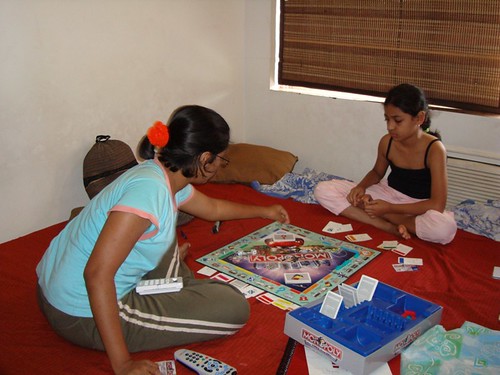
As I watch the game, I am transported to a scene from my own childhood - my sis and I playing Monopoly in the summer holidays. We compete fiercely, but I always seem to lose, while she makes infuriating amounts of money. It is the same with any game of chance - Ludo, Snakes and Ladders, cards - I always try hard, but she always wins.
.
My daughter interrupts my train of thought.
.
"Do you want to play with us?" she asks. I smile and refuse.
.
"But why? It's fun!", says my niece.
.
I decide to confess. "Because I'll lose", I say to my niece. "I'm no good at this game! Your mom and I used to play this game, and I always lost!"

The girls look at each other and grin. "I'm going to win this one", says my niece. "No way!" says my daughter, and they go back to the game.
.
I watch them competing, hunched over the board, and I smile to myself. I remember my sister, and the intense concentration of our summer games. I'm glad some things just don't change.

Friday, May 23, 2008

Masala Central

- by Deepa Krishnan
.
I was walking through Crawford Market looking for pasta, when I saw a little shop with a row of bottles. The neat blue labels and red caps arrested my attention. .
.
"What a great collection of Mughlai masalas", I said to myself as my camera went click. There were over 50 different spices, ranging from simple popular dishes like Chicken Tikka, to regional specialities like Yakhni Pulao.
.
As I read the neat labels, I thought of Mumbai's many small "Punjabi" and Mughlai restaurants, with their faded menus and their standard but popular offerings. Did they all buy masalas from places like this? Maybe that's why Chicken 65 tastes similar, whether you eat in Bhayander or in Masjid!
.
Alongside traditional Mughlai masalas, I also spotted coastal cuisine - Konkani Malvani Masala, Goan Fish Curry Masala, Vindaloo Masala, Prawns Masala Fry and so on. A bottle of Sambar Masala was the sole vegetarian representative from South India, but to add a dash of international flavour to the offerings, there was a bottle of "Pizza Masala".
..
There are other shops in Crawford Market that sell masalas, but none of them had the neat packaging and display of this one. I complimented the owner on his marketing savvy. "It's not just bottled masalas", he said to me. "If you buy the masala, we also give you the perfect recipe for how to make the dish at home. Try it - your home food will taste just as chatkeela as the restaurants!"
.
Home cooking, as tasty as restaurant food? A tempting thought, indeed, for harried mothers of finicky children! Mumbai loves to eat out, so often it is restaurant food that defines the standards for what is tasty and what is not. A masala that promises to transform home cooking into something interesting and extraordinary is quite a draw.
.

So if your family is addicted to restaurant food, go to Crawford Market and take a look at Tasty Spices on Lane 1. Maybe you'll re-create that strange restaurant magic at home, and have everyone asking for more!

Sunday, May 11, 2008

Vedic astrology goes global

- By Deepa Krishnan
.
"My colleague Anne is flying to Mumbai this week", said my friend Pradeep. "And she wants to have her horoscope read. Can you help?"
.
Anne, it turned out, was British. "My company works in consulting", said Anne. "We advise people on how to manage vendor-client relationships. And I'm curious about this science that predicts whether a relationship will work." Anne figured the best way to understand Vedic astrology was to try checking her horoscope compatibility with her husband.
.
"It's all computerised these days," I told her. "If you give me the date, time and place of birth for your husband and yourself, I should be able to get you a reading."
.
So she mailed me the data - they were both born in little towns - and off I went on a Saturday morning, looking for a computerised horoscope service. I found one in Churchgate, but I wasn't quite sure how they would manage astrology for people from different time zones.
.

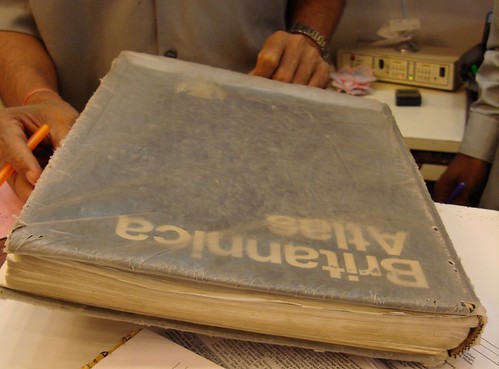
As it turned out, they were quite capable of producing charts for the British. Or for Mexicans. Or Polynesians. Or really, anyone from anywhere. The secret? The Britannica Atlas! To figure out the exact time of birth, the guy at the shop spent 15 minutes finding the towns I gave him, and then found out the latitude/longitude co-ordinates and time zone.

Once the dates and places were keyed into the computer, here's what it produced - an analysis of the two charts, and a recommendation. The report starts with a little disclaimer:

"It should be understood", says the disclaimer, "that marriage is pre-ordained by Almighty Providence, and actually one has no control at all over the selection of one's partner in life". Some other very sensible advice on the disclaimer: "Astrology is only capable of indicating tendencies and potentials. The user of this service should treat these predictions with due discretion".

Vedic Astrology is a practical sort of thing - it determines the compatibility of horoscopes by checking whether the couple is mentally and sexually compatible, whether the marriage will bring luck or prosperity, whether the attraction in the relationship will last, whether the bride and groom will live long, and of course, whether they will have children. A reasonable recipe, actually, for a successful marriage.

The methodology is complex, but primarily includes an analysis of the major gunas (characteristics) of a person. The assumption is, of course, that the position of the stars and planets at the time of your birth influences your gunas.

There's a scoring system to see how well the gunas of the man and woman match. If you don't make the minimum cut-off (18 points), then the match is not considered very good. An average "acceptable" level is 18 - 24 matching gunas, but the higher the score, the better the marriage. Scores of 32 or above indicate that the marriage will do really well.

I don't know if Anne's horoscope matching was correct, or whether she figured out new secrets for great client-vendor relationships. But I'm hoping it will give her a couple of anecdotes at least, for her next presentation!

Apart from horoscope matching, you can also get a glimpse into the future - a 20-year prediction costs 700 rupees and tells you everything you want to know about yourself, year by year. What's more, this is a multi-lingual service. You can order the prediction in Gujarati, Hindi or English. While I waited at the shop, several prosperous looking people came in for future predictions, and remedies for current problems. They got neatly stapled printouts, with advice on what lucky stones to wear, what mantras to chant, what prayers to offer, and what colours to wear.

Me, I prefer not knowing the future. My grandmom had a simple philosophy - do what you have to do, don't harm others, don't think bad thoughts, and let the future take care of itself. If my future is meant to be good, then it will happen anyway. And if the future's bad, I don't want to ruin the present worrying about it.

Saturday, May 03, 2008

Dona Ganguly - outstanding

And for those of you who want to know what I was doing *before* the Blue Frog visit - here are a couple of photos from the International Dance Day celebrations at Nehru Centre.
.
There were three performances in different genres. The Bharatanatyam performance was indifferent and amateurish and hard to watch. The solo Kuchipudi performance was interesting, but it was Dona Ganguly's Odissi recital of Mahishasura Mardini - the Death of the Buffalo Demon at the hands of the Great Goddess - that stole the show.
.
For pure spectacle, it was hard to beat. I very quickly gave up photographing, and just sat back to enjoy the show. These two photos are from the early part of the performance.
.

Dona herself is a pleasure to watch. She is confident and commands the stage, arresting your attention. But her students are very good as well, and the choreography was vivid, bringing the Great Goddess to life before my eyes.

Now you see why the Blue Frog was such a shock to my system? I went from one world into another!

Friday, May 02, 2008

The Blue Frog - very cool indeed

If you like live music, The Blue Frog is definitely a must-go-must-see place. They play an interesting and eclectic selection of stuff, and the club itself is a very cool place to just hang out.
.
We went on a Wednesday night, after a classical Odissi and Bharatanatyam dance performance. What a contrast it was, to go from that sort of jasmine-and-kancheevaram event to this ultra-chic place!

The first that struck me about the Blue Frog was the seating. They have these little curvy lighted pods that you just sliiiiiiiiiiiiiide into. Feels very hip, gives you privacy and space and you still feel very connected. You need to reserve tables in advance though, because they fill up real fast.

This is the view from the other side, there is a long bar where you can hang out if you don't have a reservation.

The night we went, there was a band from Holland playing, called the Agog Trio. They had a nice chemistry between them, and came across as a team of friendly, energetic, experimentative players.

The food isn't really anything great, I tried some starters and gave up midway. My Thai Mojito had an interesting kick with ginger and coriander, but it was cloyingly sweet. The service was absolutely super, though.

The Blue Frog is more than just a restaurant that plays music. They have four sound recording labs, as well as music production facilities. They help launch records and they offer artist management services. Quite a welcome addition to the city's music scene.

The May program includes performances by both Indian and internatonal artistes. There's Pratz and the Blues Band from Calcutta, Montreaux Jazz Fest winner Leo Tardin, the interestingly named Silverchops (a jazz band from Pune), Alisha Bhatt (punk rock), Aurora Jane from Australia (funk rock with aboriginal twists), Cap'n Crunch (Mumbai-boy Floyd Fernandes plays what he calls "electro-jazz and clubtronic fusion", whatever that is!), and lots more.

Go check it out. I'm definitely going back there again.

Wednesday, April 23, 2008

A Goddess for the Summer

- by Deepa Krishnan

The fierce April heat brings with it rashes, skin diseases and the dreaded pox.
.
Before it was eradicated in India, smallpox was one of the most feared diseases of summer. Chicken pox is still a big worry for Indian parents. Many communities believe it is the wrath of the Goddess Mariamman that brings on these diseases, and that she must be propitiated to ward off the pox.

In Mumbai, a small community from Andhra Pradesh worships the Goddess Mariamman every summer, seeking protection from smallpox, chickenpox and all forms of disease. My housemaid is from Andhra Pradesh, so I went with her to see the annual Mariamman ceremony. Mum came along, of course, to find out what it was all about.

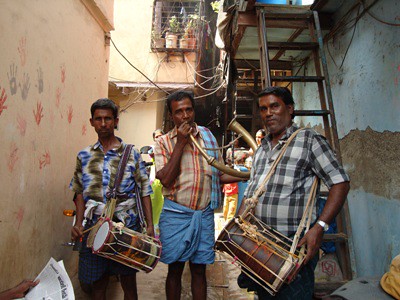
The first thing we saw (heard) were the drums. Three men came walking from a little lane, and posed for me.

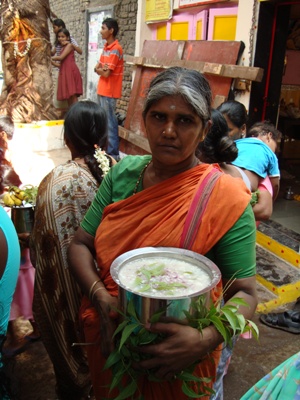
Then the women emerged from several lanes, carrying offerings for the goddess. Their bowls had a sort of thin gruel, made from ragi and buttermilk, and flavoured with chillies. Ragi, or finger millet came to India 4000 years ago from Ethiopia. It is now a staple part of the local diet.

There were neem leaves in the ragi gruel. Neem has medicinal properties and is used all over the country as a cure for chickenpox.

Several children and young girls wore skirts of neem, as protection from the pox.

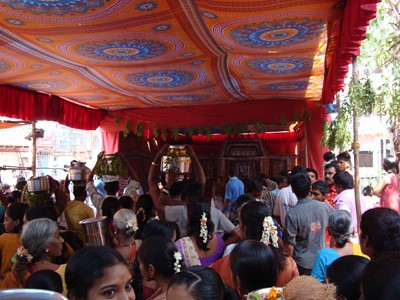
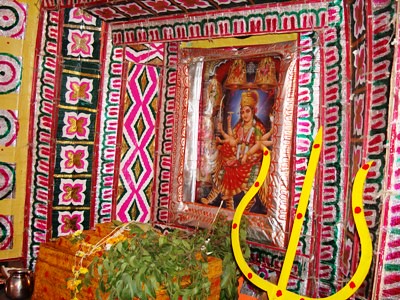
A temporary tent had been erected, where everyone gathered with their offerings.


Inside the tent, there was a little shrine. In the villages of South India, there's a distinctly different looking Mariamman. But this is Bombay! There is no consecrated idol of the goddess here, so a popular representation of Durga was housed inside the tent, with the customary trident.

Mariamman is a proto-Dravidian goddess, not a part of mainstream Vaishnavism or Saivisam. But as usual, both Saivaites and Vaishnavites have appropriated her, because she has such a large following.
.
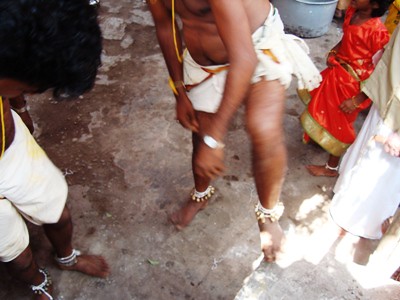
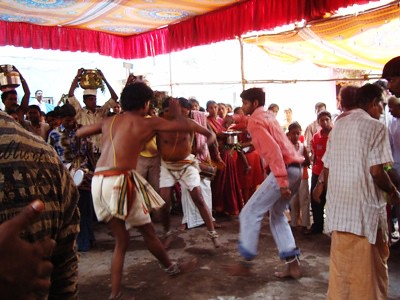
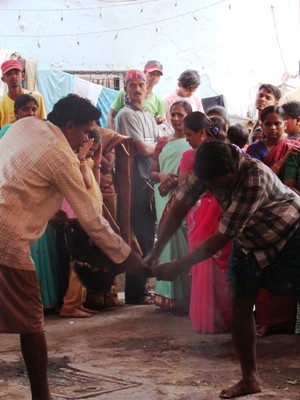
To get things going, there was a dance. Two male performers had come from a little village in Andhra Pradesh. They were not just dancers, they were more like shamans, intermediaries between the Goddess and the rest. They said a little prayer and tied anklets on their feet.

The dancing lasted a short while, but it was energetic and graceful.


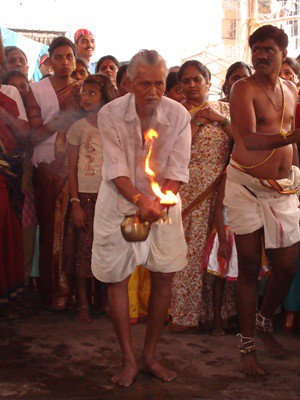
After the dancing, there was a brief prayer ritual. An elder from the community performed the arati. The prayers to Mariamman are "non-agama" i.e. not from the sacred Vedic texts. Brahmins do not conduct prayers to this Goddess, except in a couple of very large Mariamman temples in Tamil Nadu, where the worship has morphed into a fully agamic tradition.

After the prayer, a desi fowl was offered as sacrifice to please the Goddess and ask her protection.

This pot would be taken around the city after the sacrifice. It was filled with water, turmeric and neem leaves, and decorated with turmeric, red sindoor, neem, lemon and flowers. In Bombay, this vessel goes to various Tamil and Andhra localities in Dharavi.
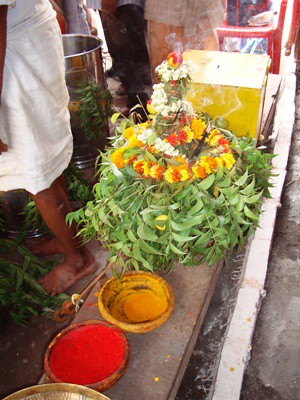
The ragi gruel was then served to everyone as prasadam. It was delicious and cool, by the way. There were a couple of neem leaves in mine, bitter as expected. I ate them, mindful of all the medicinal properties neem has.

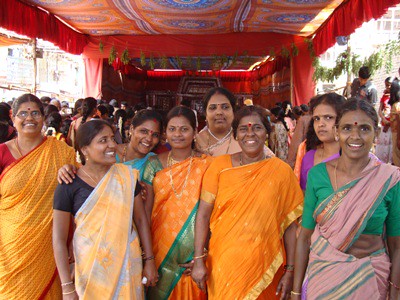
Customary group photo at the end of the day. This is a section of women from my maid's community. They are Yadavas, a Kshatriya caste who are traditionally cowherds and shepherds. My maid Vasantha is on the extreme left, in an orange saree and red blouse.

(Modified version published in the Hindustan Times HT Cafe City Beat page May 10 2008)

Tuesday, April 22, 2008

Desi pickle, foreign spice

- By Deepa Krishnan
.
The green mangoes I bought from the market are now safely pickled. This sort of pickle doesn't keep, so it has to be polished off quickly. We've been eating it everyday with rice and yoghurt.
.

Here's what went into the making of the pickle: Fenugreek, sesame, red chili powder, salt, groundnut oil, and last but not least, asafoetida or hing.

Have you smelt asafoetida? Aza - resin, foetida - stinking! When you fry it in oil or ghee though, it has a tangy sort of smell, like onion and garlic. It is a great substitute for onions, so it is used widely by the Jains in Mumbai, and by South Indian Hindu Brahmins who don't eat onions.

Hing used to come in little smelly pieces, that you soaked in water to soften and extract the essence. These days it comes in powdered form, in white plastic containers. A clever scientist at the Mysore Central Food Technology Research Institute figured out how to make hing powder. I'm sure millions of grateful Tamil maamis would give him daily thanks, if only they knew who he was.

Indians are the largest consumers of asafoetida in the world. But strangely, all of India's supply of asafoetida comes from Iran and Afghanistan. The damn thing doesn't grow here, I don't know why.

Laljee Godhoo & Company, they guys who make LG Hing, are a household name. They are an old trading company, established in 1894. In my fertile imagination, I have LG Senior doing a long arduous trek through cold mountain passes, to forge trade links with bearded strangers in Afghanistan. In reality, it was possibly an adventurous Pathan who came to Mumbai, bringing with him a smelly yet precious cargo of hing. I've always wondered why there were Pathans roaming around all over India. Now I know one good reason at least!

Today LG imports the raw stuff, and then compounds it in their factory in Andheri, Mumbai. Three generations of their family have been selling hing, and they have 70% of the Indian market. A nice but smelly business to be in, huh?

Monday, April 21, 2008

Prasad at Mumbadevi

- by Deepa Krishnan
.
In the little lane behind the Mumbadevi temple, doodh pedhas are still made the old fashioned way.
.
Milk is mixed with sugar, heated and stirred constantly, until it thickens and acquires the colour of a creamy latte.
.
It is then hand-rolled into little offerings for the Goddess Mumba. Not that she hangs on to them permanently - she merely blesses them, and the priest at the temple hands them right back to you as holy prasad.
.
Prasad or prasadam is a Sanskrit word which refers to any material substance that is first offered to the deity, and then consumed (usually fruits, sweets, flowers). The process of offering is called naivedya. Once accepted, when the prasad is returned to the devotee, it has the deity's blessing residing within it. So every temple visit usually has a two-way transaction in it...you offer something to the Gods, and you get it back enriched with blessings. What's more, when you go back home, you also get to share it with friends and family.
.
In the early Rig Vedic texts, though, prasad was something else altogether. It was originally a sort of inner mental state experienced by the Gods, or by wise sages, characterised by a spontaneous generosity and a bestowing of boons. The morphing of this mental state into a material substance appeared only in later texts. Perhaps devotees needed something concrete to take back from the daily ritual of prayer at the temple. Or perhaps this very pragmatic religion understood that religion should nourish not just the soul but also the body! Personally, I like to think that the ancients discovered guilt-free eating many years ago, and institutionalised it into edible prasad. At the Mumbadevi temple, you get to take prasad home and eat it happily, safe in the knowledge that you're acquiring merit with every calorie!
.
Coming back to the pedha - to me, the doodh pedha has always been a very comforting sort of sweet. Perhaps it is the simplicity of the whole thing - just milk and sugar, really, stirred patiently for hours. The texture is not too grainy, and not too soft. It is a perfectly balanced fudgy smoothness that melts when you bite into it.
.
Some pedhas have dry fruits and spices for flavouring. Cardamom is popular, so is saffron (kesar peda). But honestly, I like my pedhas simple. Milk and Sugar. That's all I need. Why mess with something that works so well?
.
If you go on the Mumbai Magic bazaar walk, make a pedha offering to the Goddess. And tell me if you like your prasad plain or flavoured!

(Published in the Hindustan Times HT Cafe May 3, 2008)

Friday, April 11, 2008

The Teacher Taught

- by Janaki Krishnan
.
With more than three decades experience as a teacher, dealing with students ranging from ten to twenty years, I had developed a sense of pride in my teaching abilities. I thought I could teach or coach any student for an examination - all I needed was the prescribed text book, and a model question paper.
.
But lately, my attempts at teaching my ten year old granddaughter her CBSE curriculum at home have taught me some new truths.
.
I have come to realise this: teaching in an educational institution, and teaching at home have nothing in common! The theories in Child Psychology I learnt in B. Ed (I got a distinction) have been tried and found sorely lacking.

My successful teaching tricks - a serious tone, a stern face, and a cultivated reputation for strictness - have no place at home. The only things that really work with my granddaughter are saama - sweet words and negotiation, and daana - outright bribery! My chances of success are better if I approach the unwilling learner lovingly, make requests, promise rewards, and allow adjustments and suggestions in the study plan. It is also better for me to turn a blind eye to little time-wasting ploys - for example, lengthy visits to the toilet, forays to the fridge for sweets, or a chatty phone call to a friend.

But that's not all I've learned. Teaching my 10-year old granddaughter has also taught me that the old saying "One thing at a time and that done well" is not a universal truth. Kids these days do a lot more things than they used to: they juggle many activities and have a lot on their minds other than schoolwork. Today's children are smarter and more knowledgeable in many areas - it is the grandparents who are ignorant. Giving children space to grow and think in new ways may be the best gift a grandmother can give. To quote Kahlil Gibran:

Your children are not your children
They are sons and daughters of
life's longing for itself.
.
You may give them love,
but not your thoughts,
for their thoughts dwell
in the house of tomorrow
which you cannot visit.