Friday, November 28, 2008

For all of you who mailed me

For all of you who mailed me, I can't tell you how moved I am by the concern and care pouring in from all corners of the world. I have had emails yesterday from Australia, Japan, France, Germany, Spain, UK, USA, South Africa...and the messages still continue to pour in this morning.
.
Those who have visited Mumbai in the past, and seen it through the eyes of Mumbai Magic tours, are expressing not just shock, but distress. "I am just heartbroken that this is happening to your wonderful city" are the words of a lady who went of one of the tours last month.
.
Many of my work colleagues from Barclays, who stayed often at the Oberoi and Trident while we were working at the Nariman Point office, have expressed disbelief at what's happening. How can this quietly efficient luxury hotel be the site of so much violence, they ask.

People who are planning to visit Mumbai have sent, as I expected, emails of alarm and concern, but alongside it, they have also sent an outpouring of sympathy and love. This is especially true of people from cities which have experienced terrorist attacks - London, New York, Madrid - they have sent incredibly moving words of empathy. From New York, I had this email:

"Listening to the first reports from Mumbai of today’s horrible news, my first thoughts were of Deepa. How is she? Is she safe? Yet I know, since I am a New Yorker who went through the Sept. 11, 2001 terrorist attacks, that even if Deepa is safe, she is also very saddened and very angry. Sad and angry that such bad things happen to her lovely and beloved city and country. I and my wife understand a bit of how you feel and what you are going through."

Since the queries continue to pour in, yes, I am well, so are all my guides and other associate staff, and my loved ones. Two friends who were at the Taj last night were rescued and are back home safely. But there is an element of uncertainty as well, because the hostage situation is not yet over. I have no news also of some friends who work at the Trident and the Taj.

As I said in the earlier post, the hostage situation feels like something out of a Hollywood movie, quite unreal and something Mumbai has not seen before. I'm almost expecting Bruce Willis to walk out, announcing that the "bad guys" are dead. But are they "bad guys"? Will they go to hell, as many believe, or to heaven as they themselves believe? That is the real tragedy - that these gunmen believe - truly, truly believe - that they are doing something moral. When I saw the first blurry photos of the gunmen, what I found most difficult to handle was how young some of them looked. What a tragic stupid meaningless waste.

In homes all over Bombay, people are discussing how to solve the "terrorist problem". Tighter security, better intelligence, better emergency responses - all of these are being spoken about, in bitter and angry tones.
.
But really, I wonder, can this battle be fought by stealth or might? My usually practical husband said over dinner last night, "We cannot win except by winning hearts and minds." I fell in love with him all over again, when he said that. Because he is right. As long as communities feel marginalised and victimised, terror will breed in ghettoes around the world. Inclusion and integration is the only way forward. Just to clarify, I am not saying we can hug terrorists and make them change. But we can change the hearts and minds of ordinary people and take away the breeding grounds.
.
The enormity of the task is daunting, but I really believe there is no other choice. It is no use waiting for a 21st century Gandhi to do it! You and I must do it, if we are to change the world. I am definite about one thing - I'm going to sit back and think about how I can do it.

Thursday, November 27, 2008

Raising a toast

A toast, then, to the Queen of the Bay, through her troubles!

May she shine always, graceful and proud!

Friday, November 14, 2008

Rediscovering the khun

There's really no denying it - the khun is an asbsolutely beautiful brocade. Rich as silk, soft as satin, with the coolness and comfort of cotton - what more could a woman ask for!

There was a time when you saw Maharashtrian women everywhere wearing these beautiful khun blouses, with traditional cotton sarees. These days, though, it looks like only the older generation is still wearing them.
.

I guess the younger generation has shifted to polyster and nylon sarees, with matching "2x2" blouses. What a pity. The khun is really a gorgeous fabric, that retains colour and lustre even after several washings.

On a recent trip to Dadar, I bought myself a golden-yellow khun. It was folded into a neat triangle for me to take away. The shop keeper took great pride in folding it correctly, and demonstrated the technique for me to learn (so if any of you want lessons in blouse-folding, just ask!)

I teamed the blouse with a plain rust-coloured saree, and a necklace of amber and silver. The minute I wore it, I felt good. Maybe it was the golden glow of the khun, or maybe it was the pleasure of rediscovering something traditional - but I felt absolutely on top of the world.

This is of course, not the first time that I have fallen under the spell of traditional fabrics. But it's not just me, you know. That evening, my sis took one look at the blouse and said "Heyyyy, this is nice! I want one too...tell me where you got it!"

The khun had found yet another fan.

P.S: For those who're wondering how 'khun' is pronounced, it rhymes with 'bun'

Thursday, November 13, 2008

Nat Geo lists Mumbai Magic!

The National Geographic has listed this blog on their Mumbai Destination Guide! Here's what they have to say about us:
.
"Cull cultural tips and highlights from this family's three-generational approach to Mumbai. The insightful photography and anecdotal writings stem from the three women's local expertise."
.
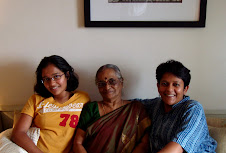
So anyway, I guess this is the right time to post a photo of the three of us! Here's Aishwarya (my daughter) in the yellow T-shirt, Janaki (my mom) in the centre, and that's me in blue on the right.
.
Here's to family! May the clan continue to write!

Sunday, November 02, 2008

Lights! Action!

Yesterday, I spent a couple of happy hours exploring the shops in Lohar Chawl near Metro Cinema.

My cousin Girish was looking for wall lamps and energy-saving tubelights, and I was looking for focus lights for two paintings. Lohar Chawl is the "Mecca of Light Fixtures" - I've had many people tell me about it, including my interior designer - so I thought it was time I checked it out.
.
After battling a couple of one-way streets, we finally navigated our way into a narrow street with a long string of small shops, each offering a wide range of lighting and electrical options for offices and homes.
.

We went to several stores, eventually buying what we needed from several shops. We found that the best way to shop on this street is to go to multiple shops, until you find the specific designs that you like.

"Earlier, all shops sold similar light designs", said the owner of Avenue Lite, one of the bigger shops. "But these days, while we do stock some things in common, there is such a wide variety available in the market that the shops reflect these differences."

We certainly saw a lot of differences! From sleek sophisticated designs to colourful kitschy stuff, the shops have something for everyone.

Although retail customers also shop here, Lohar Chawl is primarily a wholesale market. The shopkeepers on this street mostly speak Gujarati. As we walked around I heard them on the phone, negotiating bulk rates, enquiring about prices and availability, and agreeing on delivery dates. The conversations were a happy mixture of small talk and clear commercial negotiations - and I realised yet again why the Gujarati community make such good traders.
.
The shops also offer excellent service. In one shop, I saw an interior designer with his fussy clients, debating little points about decor, while the shop owner patiently assisted them. In another, I found a smartly dressed couple arguing over what would work best for their living room - the salesman attending to them was discreet enough to give them their space, but attentive enough to step in with creative suggestions when needed. In yet another shop, an entire family was there, quizzing a salesman on the merits of a huge chandelier. No matter how difficult the customers were, the salespersons - young men and women in their twenties - were unfailingly helpful and keen to make the sale.
.
Clearly, we were in the very heart of the light fixtures market, and I simply loved being part of this busy, professional, quintessentially Bombay kind of commerce.
.
At the end of two hours, we walked away with bags full of goodies, at prices that were probably among the lowest in the city. As we were waiting for the car, Girish said to me, "Look up, Deepa. See how interesting that building looks".
..
.
He was pointing to the circular building at the corner of Lohar Chawl, which is a sort of landmark in that area. I turned and clicked one last photo, and then we headed home.
.

Tuesday, October 21, 2008

Friday Market at Chor Bazaar

If you're ever near the JJ Hospital on a Friday afternoon, head for the Juma Market at Chor Bazaar. On Friday, the regular shops at Chor Bazaar close their shutters. Instead, a vibrant street market appears in the narrow lanes, selling everything you can possibly dream of. As you wander under the awnings, with the backdrop of the mosque and the sound of prayer, you feel like you're in an Egyptian or Arabian souk.
.
I don't know what it is about markets that fascinates me. Perhaps it's the sound of vendors calling out their wares briskly. Or perhaps I just like to watch people as they wander around, idly examining goods, or bargaining in earnest.

This young boy was having a good day, sales were brisk at his little plastic store.

Pencils had to be bought by the dozen, but the prices were half that in regular shops. I wondered where the pencils came from. They said Natraj on them, but I don't think they were genuine.
.
The Friday Market usually has more men than women. But I spotted several women looking for bargains at footwear shops.
.
There was a big crowd of people - both men and women - scrambling to buy buttons and thread. Apparently pink is the new black. And blue buttons are hot.

There were no takers for water-proof watches, although their water-proofness was beyond doubt!

It was near lunch time, and big dishes of rice were being cooked on coal fires. Cooking had begun early in the morning; and now the saffron and bay leaf flavoured rice was ready. I was pretty sure there was a layer of mutton below the white rice.

"What's underneath the rice?", I asked anyway.

"Mutton", came the very satisfactory reply.

"Is it ready?", I asked.

"Almost. We only need to add a little ghee on top of it now, and it's done."

I would have stayed to watch the ghee layering, but didn't have much time to spend. So I walked away, photographing everything I saw. A lot of the shops had hardware for sale - nails, hammers, screwdrivers, brushes, and other implements. But I also photographed roller skates, weighing scales, mixies, grinders, music systems, car horns and all sorts of other things. The only thing I didn't photograph was a little shop selling male underwear. It looked like branded underwear, Jockey perhaps, or something similar. The guy had a mike announcing his wares. By the time the announcement came crackling out on the speakers, I couldn't understand a word of what he said. I was quite grateful to be spared my blushes.

Monday, September 29, 2008

An evening on Marine Drive

My friend Praveena just landed a new job, so we went out to celebrate. She bought tickets to a play, it was being staged at the National Centre for Performing Arts on Marine Drive, at 4 p.m.
.
'Chaos Theory' by Rahul da Cunha is the story of two people, starting from their college years in the sixties, to their present day life as academicians in New York. Reasonably good ingredients for a play, I guess, although this kind of storyline has been done to death already.
.
Here's a scene from the early part of the play. The two first meet at a college party in St. Stephen's, Delhi, where they discover they are both students of English literature. He is a pompous but funny wastrel who loves to drink; she is sharp and witty and destined to be top of her class.

There was a projection screen at the back, on which they used a montage of music and visuals from each decade to show the progression of time. The images and songs were right for the period, but it looked like the sort of thing an amateur would put together on Powerpoint. A little more attention to style and design would have helped. I felt like I was back in college, putting on a last-minute show for some college festival.

The play itself was pretty decent, some of the lines were really funny, although the conversations sounded like they were set in Eton rather than Delhi. I must confess, I'm not a big fan of the kind of Indian theatre where the script sounds like an Englishman wrote it. Granted, the main characters were students of literature, but they sounded so very unreal. There was also a lot of slap-stick by supporting characters, and a final emotional scene with so much gawky hamming by the drunk wastrel that both my husband and I couldn't bear to watch it. Overall, though, not a bad effort, 6 out of 10 on the Deepa Scale!

The play finished at 5:30, so we decided to wander down past Marine Drive to Chowpatty Beach. Everyone wanted to eat pav-bhaji.

At Chowpatty, the stalls were already beginning to see the first customers of the evening (peak time at the stalls is from 6:00 to 8:00 pm). We went looking for pav-bhaji, but got sidetracked by the Badshah panipuri stall.

.

Badshah has absolutely delightful panipuris. They're served by a guy wearing a pair of gloves, so of course, they lack that extra tang of sweaty hands! But it's lip-smackingly good, and you can ask for a filling of your choice (potatoes, sprouted moong, chole, or boondi). I had hot chole filling, with ice cold pani and an absolutely heavenly meetha chutney. After you're done eating, there's a guy who comes around handing out paper napkins.

After panipuri, I dragged everyone to my favourite pav-bhaji stand - Shetty's. They also do some really good sandwiches.

Pramod, me, Praveena and her husband Rajeev. Four very hungry people. I ordered a cheese pav-bhaji, while they stuck to the normal stuff. Pramod as usual, wanted his pav without maska.

Piping hot and mouth-wateringly tasty! It was spicy as well, the kind of spice that sets you thinking about ice-creams and golas for the next course.

Kulfi seemed like a better option than golas. There were lots of flavours to choose from; including some names that seemed inspired by Playboy. (I'm not kidding. I found a Kulfi called SANGAM 3-IN-1, and another one called MILAN 4-IN-1.) There was also a whole sub-section called Punjabi Special Item (are you thinking what I'm thinking?) - which included Punjabi Rabdi Kulfi, Kaju Draaksh Kulfi, Anjeer Kulfi, Sitaphal Kulfi, and a very, very modern-sounding 2000 MILLINIUM KULFI. Pramod ordered a Punjabi Rabdi, and it was outstanding. Praveena and Rajeev had Sitaphal.

By this time, the sun was setting over the Arabian Sea. The municipal van came around on its patrol, so the hawkers selling colourful paper fans and balloons disappeared. We decided to head out to Dragonfly at Express Towers for a drink. It's quite a swish lounge bar and restaurant, and some of the tables have really lovely views of the Arabian Sea.


We hung around near the bar. Drinks were ordered, and pronounced satisfactory. After all the stuff we'd eaten, none of us could bear the idea of more food. It was a quiet night, since we were there early, so we had our pick of tables.

I didn't want to sit anywhere near the big TV screen, so every now and then Rajeev would pop around the corner to watch the Singapore Grand Prix. We were discussing Lehman Brothers and bonuses - or the lack of them - when Rajeev suddenly piped up: "That's the Spanish national anthem!"

"Huh?" I said

"Must be Alonso!"

"Er...?"

"Alonso! He must've won!"

"Ah", I said, nodding like it all made sense.

At some point, we finally paid our tab (well, Praveena paid!) and left. Downstairs, the Victorias were doing their little pleasure rides on Marine Drive. I watched a young couple (honeymooners?) smiling and enjoying their ride on a jingling carriage.

By the time we got into our car, I had a beatific smile on my face. Good company, great food, good conversation...and great views of the Arabian Sea. I can't think of a better way to spend an evening on Marine Drive!

Sunday, September 14, 2008

The real Ganesh Chaturthi

As I sit at my desk and type this, I hear the noise of dancing and singing on the street. Big Ganesh processions make their way down the main road, heading towards the beach for immersion. The firecrackers are loud and almost endless. Some of the men are drunk. I am deafened by it all.
.
I think of this morning's drive with Alex, and our little walk on Chowpatty beach. It was not noisy then...there were no fireworks or cymbals or drums. Instead, there were small families and little groups of people, chanting and singing and clapping their hands as they said goodbye to their own little idols of the Elephant God.
.
What I saw gladdened me. It was a time for togetherness, for bonding with family and friends through the familiar rituals of prayer. Surely this is what this festival should be?
.
This family poses, their son clicks a photo so they can remember this year's idol.

Another family just starting to set out the idol in the sand for the last puja before immersion.


The sound of rthymic clapping, and the voices of children singing drew me to this little circle.

This man's voice rose strong and confident as he bid a personal goodbye to Ganesh.

I came away from Chowpatty refreshed by the sights we saw. After the ugly sponsored commercials and hoardings for paan-masala all along the Ganesh mandaps on the road, the sight of the festival's true spirit was very rewarding indeed.

Monday, September 08, 2008

Found Found Found - A Tree with acne?!

- By Aishwarya Pramod
.

We were on a nature trail at the Sanjay Gandhi National Park on Sunday morning, when I came across this wierd looking tree with knobbly protrusions all over the bark. What were they, an infestation? An infection? No, said our BNHS guide, they're insurance against dry days. This is the Red Silk Cotton tree and the spines/thorns are how the tree stores water.

We walked a little further, and found another individual of the same species. But I was more interested in the liana twirled next to it. These woody climbers are pretty strong, they grow straight up until they find a suitable host and then start to twine themselves around the host. But why do they do this when they aren't parasites?

Well, in a vine-eat-vine world, it's each vine for itself in the race to reach sunlight. Because in a tropical dry deciduous forest like this one, the tree cover is very thick, especially in the monsoon, and can completely block out the sunlight.

Lianas form bridges between the tree canopy, connecting the entire forest in an intricate network of entangled vines. Fully developed lianas are strong enough to take the weight of arboreal animals like macaques, hanuman langurs and the occasional flying fox. It's easy to figure out why lianas are also called Tarzan Vines!

The Park is very pretty, and we had a nice time there. Did you know that Sanjay Gandhi National Park is supposedly the largest national park in the world within the limits of a city? Check it out some time. BNHS organises great walks every now and then. We certainly enjoyed this one! :)

One morning in Dharavi

- by Deepa Krishnan
.
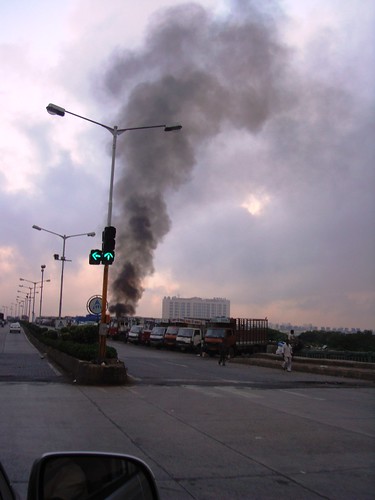
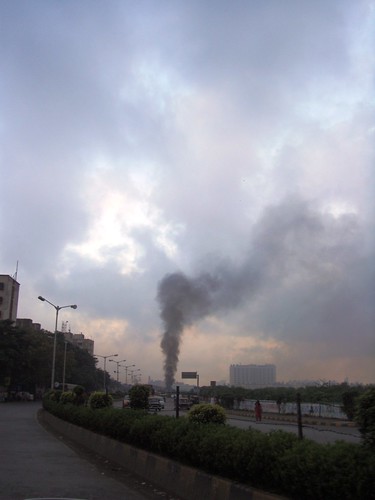
It was 7:00 a.m. I had dropped my daughter at school, and was driving home past Bandra Kurla Complex, when I saw a tower of thick smoke rising to my right.
.
"It's coming from Mahim", I said to my driver. "Do you think it's a fire?"
.
"No, it's from Dharavi", he said. "I've seen it before."
.
I had seen smoke at Dharavi earlier, but today it was exceptionally thick and dark. I thought we'd take a look. Sometimes early morning disasters don't get reported in time; perhaps I could stop for a quick check.
.
We drove closer. The smoke seemed to be coming from a residential area of Dharavi. I knew there were thickly populated bastis on the left on the road, where most of the recycling work gets done. We often take tourists to some of those places, and I thought to myself, what if it's one of the recycling compounds? They have enough inflammable things in there to start an inferno.

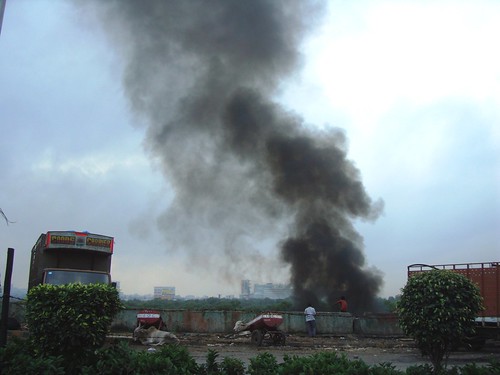
When we got closer, I realised it was coming from the opposite side of the road, from the marshy land opposite the hutments. It seemed to come from a line of trucks parked on the road. There was none of the panic and shouting associated with a fire.

We stopped for a closer look. Here's what we saw - in a clearing behind a low wall, a big rubbish heap was being burnt. Maybe they were burning the left-overs from the recycling factories - the thick smoke told me it was probably at least partly plastic. A young man was sitting there - he didn't move at all in the 10 minutes that I was there - I got the feeling he was watching over the fire. There were two bullock carts, transporting oil, the bullocks resting in preparation for the day ahead.
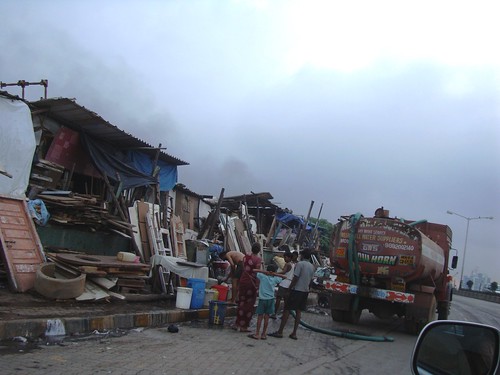
I realised it was just another day in Dharavi. Nobody gave a damn about the dense smoke, although my chest burned from just 10 minutes exposure. Just across the road from the burning, the daily routine had begun. The water tanker had arrived and big plastic drums were being filled for the day.

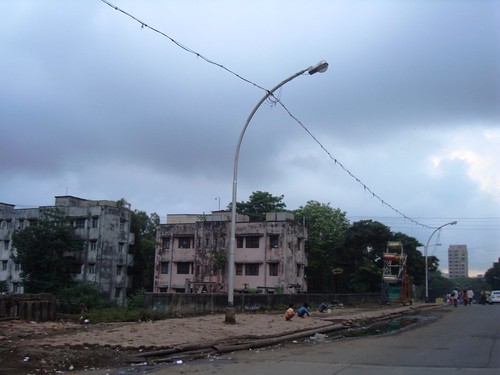
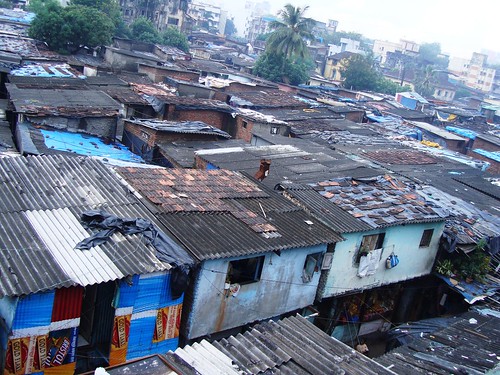
About 100 metres away, the shanties were already abuzz with activity. Little shops were open, and people were walking in the narrow lanes.

And naturally, since this was 7:00 a.m., every available inch of open space had been converted into a toilet. Little kids sat unmindful of passing traffic; while grown men found convenient bushes behind walls. The women, of course, had risen much earlier, while it was still dark, so they could have some desperately sought privacy.

My spirits sank at the sights I'd seen - pollution, dirt, stench...we're talking of Shanghai-like towers and skywalks and bridges, when we can't even get running water and toilets in place?

I was still thinking gloomy thoughts when we drove past a busy central thoroughfare and spotted several bright-eyed children going to school. Some of them were walking with siblings, others were riding pillion on their father's motorbikes. Many, especially the little ones, were walking with their mothers. I saw mothers carrying schoolbags and tiffin boxes and bright plastic water bottles, walking in that determined way that only mothers have, hustling their kids to school in time. After the depressing sights I had seen, the sight of these young kids was like a ray of sunshine. Here were children just like the ones I saw at my daughter's school; here were mothers with the same determination as me.

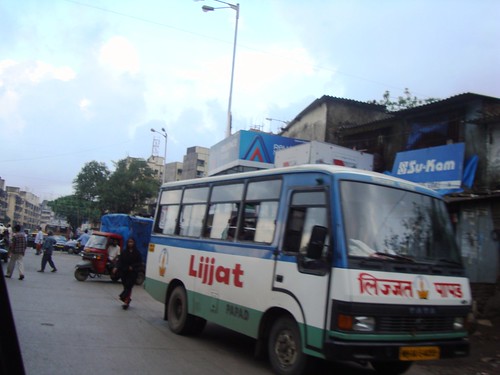
Still further down, I saw the Lijjat Papad van making its rounds, collecting papads and distributing fresh dough for making more. I thought of all the papad-makers I knew, women who supported their families through papad co-operatives. It lifted my spirits.

It's not all beyond repair, I told myself. There are good things too. Even among squalor and depressing conditions, Dharavi always manages to show a little bit of its bright side to anyone who cares to see it.

I remembered my first meeting with ragpickers from Dharavi a couple of years ago. They were sisters, giggling and collecting trash at Horniman Circle. I chatted with them only briefly; but talking to them changed me, transformed me from an outsider to an insider. As long as we don't turn our faces away from the reality of Dharavi, as long as we see commonality and shared humanity, there is hope yet - for the people of Dharavi, and for all of us in Mumbai who live side-by-side with it.