.
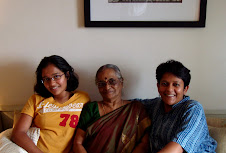
A blog on Mumbai - the city, its people, its culture. Three of us write here - my daughter Aishwarya, my mom Janaki, and I. If you like something, leave a comment! - Deepa

At Thoppil Muttom, the luxurious growth of trees - coconut, mango, jackfruit, arecanut, chikoo and orange - would actually hide the very existence of the house in the centre. It was like living in a green forest. Of course, he could also have named it after one of the perennial Himalayan rivers, because the well in the compound never ran dry, and was a regular source of water for neighbouring houses even in the driest years.An emotional attachment to one's place of birth is natural - but very few people who come to Bombay are able to go back to live in those surroundings. No wonder one of my relatives in suburban Goregaon named his home Bilwadri House, in honour of the presiding deity in his village, Bilwadrinathan.
Housing societies where people of all communities live prefer secular names. The complex of three buildings where I now live is called Tribhuvan Society (Three-Buildings Society). The Air Force Quarters at Sion has named its two buildings Engineer and Mukherjea, presumably after some meritorious officers, to ensure that their memory remains alive. A residential building near Sion Fort has called itself Sahas (Courage) - perhaps indicating the owner's willingness to fight against all odds!
These days, I've been having a rather passionate affair with sabudana. My maid makes brilliant sabudana khichdi for breakfast. I'll post photos here, soon as I find them. They're here somewhere on my PC.
For the guides too, the tours are an opportunity to meet people from different parts of the world, to learn new things, and to see the world a little differently. There are five guides - four girls and one boy - the tours give them an opportunity not just to earn pocket money or supplement their family income, but also to learn how to handle a wide range of situations. They are growing increasingly confident with each tour, so I am personally very happy.
NDTV interviewed me as well, and I spouted some nonsense about the tour - I didn't fumble, thank God. They told me later I was "a natural". I should've dressed for the interview, of course, instead of showing up in my oldest T-shirt and cargo pants. I thought I'd play it cool, you see? So there I was, on national TV, faded Tshirt, streaked kajal and limp hair, and looking like a small sized blimp. Sigh. So much for playing it cool. I don't dare post a photo, but the video is here on the NDTV site.
I don't know a thing about coins, but I figured they were fake (note the variations in the Om symbol). Besides, the coin in the centre has 1939 minted on it. I thought the Company Sarkar was abolished in 1861 after the Mutiny? We asked for the price of a single coin, and the man said Rs 50.
Another store was selling metal armour (who buys these things anyway?) I stood for a minute and looked at the design of the armour. Are those trousers? How do you pee if you wear these, for God's sake? Or maybe battle is about holding it in while you slash and cut your way through to the nearest toilet.
All in all, Chor Bazaar is quite interesting. I keep discovering new things every time I go there.
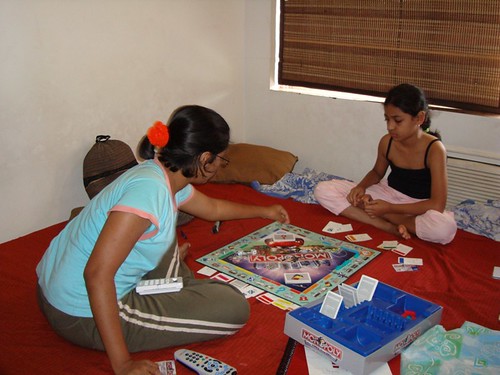
As I watch the game, I am transported to a scene from my own childhood - my sis and I playing Monopoly in the summer holidays. We compete fiercely, but I always seem to lose, while she makes infuriating amounts of money. It is the same with any game of chance - Ludo, Snakes and Ladders, cards - I always try hard, but she always wins. So if your family is addicted to restaurant food, go to Crawford Market and take a look at Tasty Spices on Lane 1. Maybe you'll re-create that strange restaurant magic at home, and have everyone asking for more!

Once the dates and places were keyed into the computer, here's what it produced - an analysis of the two charts, and a recommendation. The report starts with a little disclaimer:
"It should be understood", says the disclaimer, "that marriage is pre-ordained by Almighty Providence, and actually one has no control at all over the selection of one's partner in life". Some other very sensible advice on the disclaimer: "Astrology is only capable of indicating tendencies and potentials. The user of this service should treat these predictions with due discretion".
Vedic Astrology is a practical sort of thing - it determines the compatibility of horoscopes by checking whether the couple is mentally and sexually compatible, whether the marriage will bring luck or prosperity, whether the attraction in the relationship will last, whether the bride and groom will live long, and of course, whether they will have children. A reasonable recipe, actually, for a successful marriage.
The methodology is complex, but primarily includes an analysis of the major gunas (characteristics) of a person. The assumption is, of course, that the position of the stars and planets at the time of your birth influences your gunas.
There's a scoring system to see how well the gunas of the man and woman match. If you don't make the minimum cut-off (18 points), then the match is not considered very good. An average "acceptable" level is 18 - 24 matching gunas, but the higher the score, the better the marriage. Scores of 32 or above indicate that the marriage will do really well.
I don't know if Anne's horoscope matching was correct, or whether she figured out new secrets for great client-vendor relationships. But I'm hoping it will give her a couple of anecdotes at least, for her next presentation!
Apart from horoscope matching, you can also get a glimpse into the future - a 20-year prediction costs 700 rupees and tells you everything you want to know about yourself, year by year. What's more, this is a multi-lingual service. You can order the prediction in Gujarati, Hindi or English. While I waited at the shop, several prosperous looking people came in for future predictions, and remedies for current problems. They got neatly stapled printouts, with advice on what lucky stones to wear, what mantras to chant, what prayers to offer, and what colours to wear.
Me, I prefer not knowing the future. My grandmom had a simple philosophy - do what you have to do, don't harm others, don't think bad thoughts, and let the future take care of itself. If my future is meant to be good, then it will happen anyway. And if the future's bad, I don't want to ruin the present worrying about it.