Sunday, February 24, 2008

Mumbai - an Avial

- by Janaki Krishnan
Having lived in Mumbai for more than seven decades, I have a strong affinity for all things that belong to this city. For breakfast, I love sabudana khichdi and kanda poha. But at lunch time, my South Indian tastebuds take over. My favourite is the avial.

I love the avial's rich mix of vegetables, simmering in coconut gravy. My mother used to say "Aadu thinnada elai illai, Avialukku podaadha kaaikari illai" (There's no leaf that a goat won't eat, and there's no vegetable that you don't put in an avial). White pumpkin, red pumpkin, yam, raw banana, beans, drumstick, and snakegourd...you can use whatever you like in an avial. Mumbai's chefs have added carrots, peas and dudhi to the list of avial veggies, and in some homes, I've seen bitter gourd used as well. White pumpkin is essential, and makes up almost 40% of the avial.

You need a minimum of 5 different vegetables to make an avial. Cut the vegetables into 2 inch long strips. Harder vegetables like yam are cut thinner while others are cut slightly thicker. Cook the vegetables with turmeric and salt, making sure each vegetable piece is intact and not mashed into others. Every vegetable must be visible separately. Grind coconut and green chillies, and add to the cooked vegetables, along with sour buttermilk. Stir gently, so that all the vegetables float colourfully in the gravy. Garnish with a spoon of coconut oil and curry leaves. Serve the avial with hot rice and papad. Or, like many south Indian households in Mumbai, serve it with phulkas.

Cliched maybe, but I like to think of the avial as a metaphor for Mumbai. People from everywhere arrive here, and the city seems to welcome them all. Although they're different from each other, very soon they begin to fit into the city, and become part of the city's unique cultural blend. Like the fresh aroma of coconut oil from the avial, the Mumbaikar has his own unique cosmopolitan flavour - a strong work ethic, a tolerance for differences, and a willingness to adjust to multi-cultural life in the city.

Saturday, February 09, 2008

When dance mirrors life

O-Kayyyyyyyyy. For those who know me, here's that photo of me in a funny orange turban, posted by popular demand.
.
For those who don't know me, no, I *don't* look like this on a daily basis! So why the turban and special effects? The photo is from a dance drama that I was part of. On Jan 28, students from my dance school enacted the story of Maharashtra's 800-year old Bhakti tradition. I had a small role in it as a Warkari pilgrim.
.
If you want to see what Warkari pilgrims really look like, check this out. The Warkaris go on a pilgrimage twice a year to the Vitthal temple at Pandharpur. As part of our research for this dance-drama, I went with my guru to check out the pilgrims. We wanted to study Warkari costumes, to incorporate it into our dance-drama. I think we did a pretty good job, what say?
.
Here's another photo, of us carrying a palki of Lord Vithala. That's my neice Ramya, she played a much bigger role than me in the dance.
.
Here's another photo from the dressing room - this beautiful lady is my dance guru Jayashree Rajagopalan.
She got a lot of appreciation from the audience for not just the concept of the show, but also the painstaking research she did for authenticity, and the final beauty of the production.
.
If you click on the photo for a better view, you can see the make-up kit that is part of the dance preparation. Brushes, eye liner, foundation, rouge, nothing "traditional" I'm afraid! With a total of 30 performers in the dance, we had a whole army of people in the dressing rooms, including harried mums fretting over safety pins and unruly wisps of hair. That's me in the background, photographing everyone.
.
My parents came to see the show, so did my aunt. And I was very pleased to see in the audience, two of my school teachers. When I greeted them, they were pretty surprised. Let's face it, what with the turban and the extra kilos, I wasn't really the skinny kid they knew in the 80's!

Sunday, January 27, 2008

My dear 'Kaka'

- By Janaki Krishnan

It is ten in the morning. I am stuck in a traffic jam near Sion Hospital. My house is just a two minute drive from here. But I get tense, for my dear friend's lunch will be delayed.

It is a daily ritual in my life. I make two balls of cooked rice, mix a little vegetable and curd, and place it on our compound wall. The very next minute, my winged friend comes swooping down and pecks at it. He is a small lean fellow, my friend Kaka the Crow. Very soon, eight to ten of his clan turn up. They stand one behind the other on the wall, in a neat queue. My friend moves away and allows them to eat. There is no rushing and fighting. One after another, they have their share and fly away. After they leave, my little friend comes back to have a second helping.

As against my friend's disciplined behaviour, my brother's feathered pal in Matunga is a spoilt brat. Unless the dahi is visible on the rice ball, he won't touch it. And only when my brother places the food on his outstretched palm does he come closer to take a look. Then, he perches on my brother's shoulders and enjoys his meal. But that's not all - every now and then, he must be served his favourite dish - potato curry. He also insists on home-made murukkus.

My Sindhi friend says he's not surprised about the murukkus. He feeds his crows sev. He said to me "Janki-ji, they love it. As soon as I throw a little sev on the ground, they come in large numbers cawing joyously"

Mumbai's crows don't have to depend on us to feed them, of course. The city's high rodent population offers them a regular supply of fresh meat. The fishermen's daily catch is yet another interesting source of food. In fact, the only problem our winged heroes have in the city is scarcity of accommodation. With the city becoming more a more a concrete jungle, like all Mumbaikars, the crows too must go to distant suburbs if they want to find safe, spacious and peaceful homes for their offspring.

Tuesday, January 22, 2008

A panki? What's that?

For foodies, Swati Snacks is a bit of a religious experience. For me, it is an education in Gujarati cooking. This time, I learnt about the panki.
.
I'd never seen a panki before, although I've lived in Bombay for more than 20 years. The couple at the table next to me ordered it, and they seemed to know what they were doing. So I recklessly said "I'll have whatever they're having".

Ten minutes later, my plate arrived. It had this yellow, paper thin pancake, steamed in banana leaves. You open the folded leaves, peel off the panki and pop it in your mouth with green chutney. It tastes divine.

The panki is made of ground rice mixed with a paste of yoghurt, green chillies, fenugreek and asafoetida. It is not spicy, and therefore the tangy green chilli in the chutney complements it wonderfully. 

The panki is Swati Snacks' signature dish - if you do go there, you'll find others ordering it. You'll also see some variants of the panki on the menu. Just do what I did - look around, subtly point at someone's plate and say 'I'll have what they're having!".

Sunday, January 13, 2008

No problem, yaar!

- by Janaki Krishnan

Mumbaikars have mastered an interesting knack - the ability to sail skillfully through life in housing cooperative societies, even in the face of irritants. I refer to the parking problems we face in our society, with three buildings, 48 flats and 15 cars. There is just enough parking space for the existing cars, at a payment of Rs. 300 per month. The problem arises when the cars do not check in at the usual time, and are forced to park wherever space is available. Since my husband is the Secretary of the Building Society, I get a ring-side view of the results.

It begins right at 6:30 a.m. The watchman comes running to our house and says 'Saglay mala oradtaat. Gaadi majhi aahe ka?' (Everyone's shouting at me, is it *my* car?). Before he finishes, our Sindhi friend Mr. Bhavnani, owner of two transport buses comes fretting and fuming. He delivers a fast-and-furious speech about his parking problems, most of which the Secretary cannot understand. "Bhavnani saab", the Secretary coolly says, "Repair work is going on in your building. You have to adjust for a few days." Bhavnani is stumped, but he delivers a parting shot before he leaves. "Whatever you have to say, you give it in writing", he says.

Next comes the mild-manned Rajaram Iyer, with his grievances. "Sir, Mr Jain has parked the car in front of mine and is still sleeping. Now I have to climb three sets of stairs to get his car key. Please, from next time, you keep a duplicate key!"

Next in line is Preeti, our Gujarati neighbour. Coming from the land of the Mahatma, she wants justice. "Uncle", she says, at the Committee meeting, "Only cars that are registered in the member's name should be allotted parking in the society's premises. Why is Ranade's married daughter's car here?" This sparks off a furious debate about parking rules. The Secretary tries to be calm. "Preetiji, today Mr. Ranade had a mild heart problem. His daughter has come to take him to the hospital."

Then, Mr. Joglekar, a senior citizen and a Committee member, steps in. With Maharashtra's legacy of legal luminaries like Ambedkar and Tilak behind him, he speaks about rights and duties. "Secretary saheb, when society work is to be taken up, nobody comes forward. Those who do not do their duties have no right to ask for privileges." As the Secretary smiles at him, Mr. Kamath, another Committee member of 82 years, takes up an advisory stand. "Mr. Krishnan, don't be scared of all this shouting. We cannot satisfy everybody. You do what you feel is right."

Finally comes a diplomatic reply from the Secretary. "I understand your problems fully. Therefore I have written a letter to the Secretary of the Mumbai District Cooperative Housing Federation, regarding rules to be followed for parking in cooperative societies. Very soon, I shall send you a copy of the rules. Till then, let things continue as they are."

After this, the meeting disperses. The members stand around, discussing why the watchman never opens the gate in time, the unhygenic conditions around, the sweeper's indiscipline, and other common problems. I observe their behaviour, and realise that a Mumbai housing society is a cohesive unit with its own unique character. Perhaps this is what separates the Mumbaikar from others in the country - we can live *happily* in groups, complaining to each other about our innumerable problems, while we continue with our daily tasks!

Sunday, January 06, 2008

Jai Jai Vithala

- by Janaki Krishnan

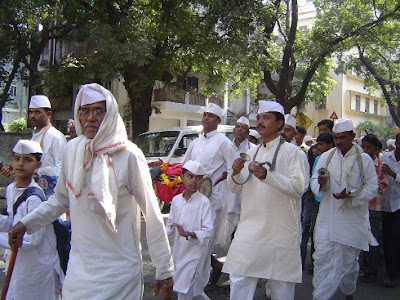
It was 'Vithala Vithala' all the way this morning, as hundreds of Varkari pilgrims danced their way from Cotton Green to Shivaji Park.

They were on their way to the Vithala temple at Pandharpur, 450 kilometers from Bombay.

Men in traditional white caps and dhotis, with cymbals hanging from their necks, danced and sang devotional songs composed by Tukaram and Gynaneshwar, the great Bhakti saints of Maharashtra.

They were accompanied by women in nau-varis – long nine yard sarees – skillfully balancing tusli saplings on their heads. Some carried copies of the Gyaneshwari, a 13th century translation of the Bhagavat Gita from Sanskrit into Marathi.

A colourful palanquin, drawn by bedecked oxen, contained the idol of Lord Vithala. It halted at intervals, for people to pay obeisance. Residents of nearby buildings showered flowers on the ox cart.

My attention was drawn towards two brightly coloured cut-outs of Vithala and Rakhumai, the deities of Pandharpur. Vithala is another name for Krishna, the eighth incarnation of Lord Vishnu. Little children, dressed as Krishna and Rukmini, brought a smile to my face.


The procession halted at Five Gardens for lunch. This family, led by a kirthankar with a stringed tanpura, had brought their own simple food.

There were others who ate in larger groups. They were served rice khichdi in disposable plates made of leaves.

Lunch was not a prolonged affair. When the sound of drums and cymbals started again, the whole group – men, women and children – rose quickly to their feet, and resumed their singing. I stood for a moment and watched them. When the rest of the city seemed to be revolving around fashion, fame and money, here was a group totally oblivious of everything around them, walking to a different beat.


This was no ordinary noisy procession, such as the ones I see every year during the Ganesh festival. The members of this group, young and old, seemed to be floating on a different plane, with Pandharpur in their heart and Vithala on their lips.

Tuesday, December 25, 2007

There and back again - A family holiday to Murud Janjira

- by Aishwarya Pramod
We started off on a Friday afternoon in our trusty Innova for Murud, a quiet fishing village, a mere 165 km away from Mumbai. We had heard of the island fort of Janjira, and my mom, being the history freak she is, HAD to see it.

We drove through Pen & Alibagh (small villages on the way) and by early evening we reached the Golden Swan Resort, a nice place right by the beach.

The first thing we saw was this fort in the sea (can you see it in the distance?), and naturally, we thought it was Janjira fort.
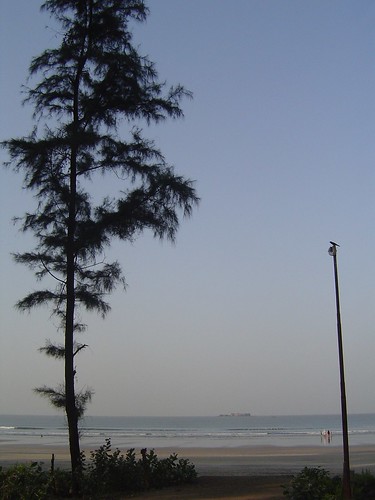
But as it turned out, there are TWO island forts in Murud. This one was called Kasa fort, it was built by Shivaji’s son Sambhaji after repeated Maratha attempts to conquer Janjira fort failed. By the way, that’s a Casuarina tree in the foreground of the photo. At night we saw a noisy fruit bat colony flying out of the Casuarina grove.

We had a great dinner, watched TV, and got up the next morning, refreshed and ready to see the Janjira Fort (well, I dunno about the others but mom was definitely ready).

We saw these deserted ruins on the drive to the fort, and later found out that they were the tombs of the Siddi kings, who built Janjira Fort.

The Siddis are black Africans who were originally sold as slaves in the Indian subcontinent. However, because of their success as fighters and seamen, they rose gradually to power. Small Siddi kingdoms were established in Western India in Janjira and Jaffrabad as early as the twelfth century. The Siddis played an important role in the history of Western India, particularly in the struggle between the Marathas and the Mughal empire; with the Siddis often aligning themselves with the Mughals.

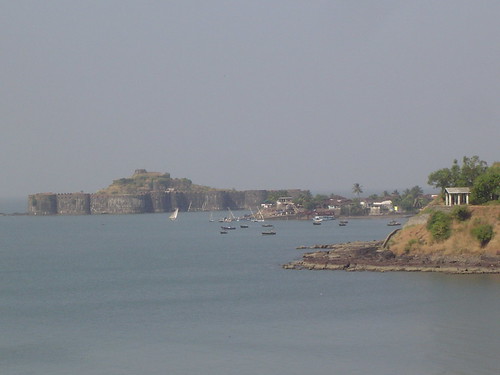
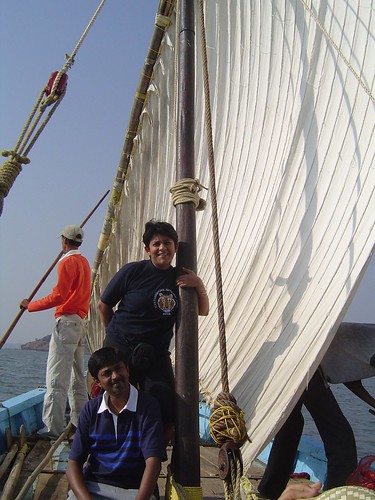
Here's a closer view of Janjira fort, accessible only by sailboat. I’d never been on a sailboat before. This was a novel way of traveling - no motors, no noise. Very Siddi.

Mom and dad in the sailboat. The white sails are really nice, don’t you think?
The first thing we saw when we disembarked at the fort was the royal insignia of the Siddis , a lion climbing up on the backs of elephants. Does that signify Africa over India, I wonder??? The boatman told us that in order to gain access to the fort, outsiders had to first display a coin or ring with this seal.


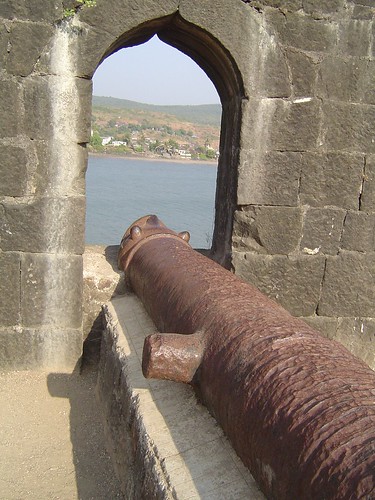
The fort is large, and there's lots to see. There are nineteen rounded bastions; each bastion houses a cannon, intimidating would-be attackers. Here is one of the smaller cannons. It is called ‘Go-Mukh’ meaning Cow-Face. (You can see why, right? Check out the ears!) The cannon is made of an alloy which keeps it from getting too hot in the summer sun.
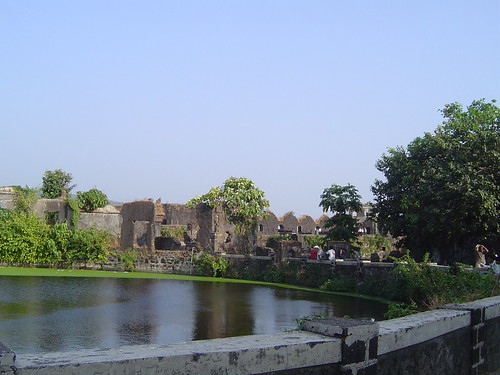
This is the water tank inside the fort, fed both by an underground spring, and rains.

Down below is a secret entrance into the fort, designed cleverly to look like just another window. During high tide it is completely hidden by water.
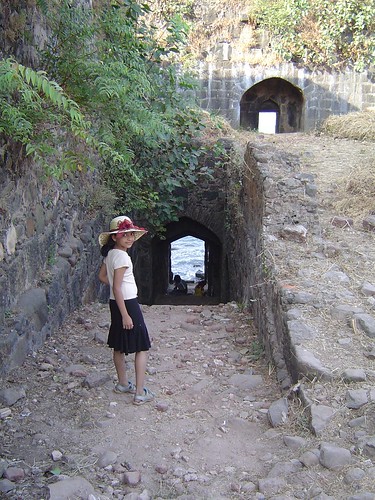
The guide also showed us an undersea escape passage from the fort, which is supposed to open out into the mainland (I didn't know whether to believe him!). The passage has now been boarded up, for safety, he said.

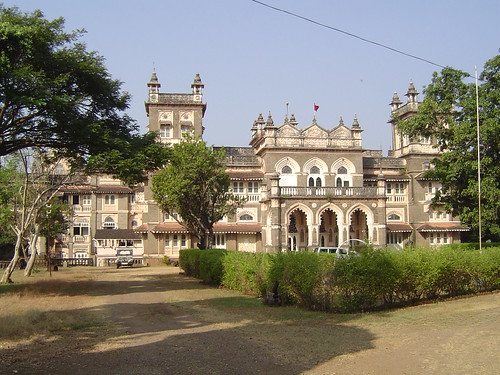
We left the fort and returned to the mainland, again by sailboat. On the drive back to the resort, we saw the palace of Sir Siddi Ahmed Khan, the Nawab of Janjira. Before this palace was built in 1885, the Nawab used to live in Janjira Fort. Now his descendants live here. The Nawab was a very farsighted man. One of his many projects was the Victoria Jubilee Water Works, which even today supplies water to Murud.

Later that night, we hired the same sailboat and we went for a one hour sail. We took snacks and drinks from the resort and ate them on the boat. The stillness, the moonlight, the gentle rocking of the boat, and the dark fort walls looming on one side, all made the sail a surreal experience. And the tikkas were great!

The next morning, after breakfast and a buggy ride on the beach, we drove back to Bombay. The route back is dotted with little farms and villages. We stopped and clicked lots of photos, but more about that some other time!

Thursday, December 20, 2007

Why the Dandi march is a big deal

If you walk into Mani Bhavan on Laburnum Road, you'll see this striking illustration by Nandlal Bose - it is a portrait of Mahatma Gandhi, at the 1930 Salt March in Gujarat.

"Here was the pilgrim on his quest of truth - quiet, peaceful, determined and fearless." - Jawaharlal Nehru

Why was the Salt March a "quest of truth"? And why did Gandhi decide to do it?

In 1780, the British Governor-General Warren Hastings brought salt manufacture and taxation under total government monopoly. By the 1800's salt had become a major source of revenue for the East India Company. Prices of salt were so high that the common man could no longer afford it. In fact, in 1836, at a Parliamentary Select Committee, Dr. John Crawfurd of the Bengal Medical Service gave the following evidence: "I estimate that the cost of salt for a family in Bengal as being equal to about two months’ wages, i.e., 1/6th of the whole annual earnings."

The Salt Tax seemed morally unjustifiable to Gandhi - here was a widely manufactured essential commodity that had been summarily appropriated by the Government. The objective was clearly the spreading of the widest possible dragnet for tax collection, with no concern for the hardship it imposed.

Already, a prosperous rural economy had been destroyed by ruthless land revenue and forest management acts. The British had seized and converted local farmland to foreign-owned plantations, restricted internal trade, destroyed the livelihood of nomads, taxed Indians heavily to support unsuccessful expeditions in Afghanistan, and set in motion inflationary measures that increased the price of food. (To get some perspective into this, just look at this statistic: Between the period 1875 to 1902, 26 million Indians died of famine).

Not surprisingly, Gandhi called the Salt Tax "the most inhuman tax the ingenuity of man can devise". He first protested against it in 1891, in an article in 'The Vegetarian'. In 1930, as part of his Civil Disobedience Movemenet, he decided to organise a mass protest against the tax.

The protest took the form of a long walk, through Gujarat, from Sabarmati to Dandi on the coast.

The Salt March: 241 miles in 24 days

The walk went through many villages in Gujarat, and grew in size and number as it moved on. Gandhi halted at several locations and delivered speeches. In the three-week period, it got widespread international and national press coverage. On the morning of April 6, Gandhi and his followers made their way to the seaside at Dandi, where after a ritual bath in the sea, he picked up a handful of muddy salt.

But was the Salt March a success? Did Gandhi's defiance of the law have any effect?

Immediately after Gandhi broke the salt laws, what began as a Salt March quickly changed into a nationwide movement. Mass civil disobedience spread throughout India as millions broke the salt laws by making salt or buying illegal salt. Salt was sold illegally all over the coast of India. A pinch of salt made by Gandhi himself sold for 1,600 rupees (equivalent to $750 dollars at the time). In reaction, the British government jailed over sixty thousand people by the end of the month. Gandhi was jailed for a year. However, the salt laws were not repealed in the Gandhi-Irwin pact of 1931, and freedom came to India only 17 years later.

All the same, in my eyes, the Salt March was a resounding success.

In the first place, it was the beginning of the common man's participation in a mass nation-wide struggle. "People of common clay felt the spark of life." said Jawaharlal Nehru, describing the phenomenon. Secondly, it was the first time Indian women played an active role in the freedom struggle. A government report at the time stated that "thousands of women emerged....from the seclusion of their homes...in order to join Congress demonstrations and assist in picketing: and their presence on these occasions made the work the police was required to perform particularly unpleasant."


The Salt March also brought for Gandhi, immense media attention from the West. In 1930, Gandhi became the Time magazine's Man of the Year. And much to Churchill's annoyance, the Government had to parley on equal terms with the leader of a subject nation.

While these things were important successes of the Salt March, to Gandhi the march was always about doing what was morally right. "I want world sympathy in this battle of Right against Might", he wrote from Dandi, in his endearing scrawl. You can see a copy of this letter at Mani Bhavan.

If you're planning to visit Mani Bhavan, then read the little paragraph below before you go. It is Rabindranath Tagore's description of Gandhi the Mahatma (Great Soul). The magic of Gandhi comes alive in Tagore's words.

"
He stopped at the th
reshold of the huts of the thousands of dispossessed, dressed like one of their own. He spoke to them in their own language. Here was living truth at last, and not just quotations from books. For this reason the Mahatma, the name given to him by the people of India, is his real name. Who else has felt like him that all Indians are his own flesh and blood?

At Gandhi’s call India blossomed forth to new greatness, just as once before, in earlier times, when the Buddha proclaimed the truth of fellow-feeling and compassion among all living creatures
".

Sunday, December 16, 2007

Popcorn, local style

Spotted on the Mumbai-Pune highway: Chaat Masala Popcorn. Now I've seen it all.

Thursday, December 06, 2007

The Great Indian Bargaining Game

Many overseas visitors to India are taken aback at the kind of street shopping that they experience.

The touristy parts of the country - Delhi, Agra, Rajasthan - are full of pushy vendors trying to sell them things at downright outrageous prices. In Bombay's Colaba district, I often see street vendors quoting tourists twice or thrice the normal price.

I met an American lady recently, it was her first visit to India. She said to me, "Deepa, when I shop here, I feel so much at a loss...I'm the outsider, and I feel like I have to constantly watch out so I'm not cheated." She was a smart, savvy woman, but she felt almost abused, emotionally as well as financially.

I thought about what she said - and realised that she was experiencing a kind of culture shock.

Any Indian woman will tell you that if you look prosperous, vendors will always quote you a higher price. All of us learn to handle this sort of situation - by watching other women, and of course, by learning from experience. I used to find bargaining very intimidating. But these days when someone quotes me a totally wacky price, I just grin widely and say the Hindi equivalent of "Yeah right, go pull the other one". Then we haggle back and forth a bit, and when the price gets to the point where I think the vendor is making a good margin, I give in. It's all part of the Great Indian Bargaining Game, and it has taken me a while to master it.

So I sat down to explain it to my American friend. I said, shopping in India is a state of mind, a game that you play. To treat this overcharging-bargaining game as a personal insult, or worse, to think of yourself as a victim because this doesn't happen in your country, is just totally missing the point.

I told her she needed to apply a different yardstick when in India. No one was singling her out for extra-harassment...this is how the shopping culture in this country works. Street vendors are not demons - they're just a bunch of fairly poor people trying to get a few extra dollars off anyone who looks like they can afford it. In my MBA school they called this "what the market will bear" pricing.

India is a both a destination and a journey. It has woven its magic for millenia now, on travellers from all parts of the world. It is a complex and rich culture, with so much to offer - but the rules are different. To explore this sort of complexity, you have to step out from the comfort zone of neatly labelled racks and polite checkout greeters. You have to embrace the street shopping and bargaining spirit.

It can be fun, actually. There's the crafty assessment of what something is really worth, the starting position, the bantering conversation and the give-and-take, the testing of each other's mettle, and the final agreement on how one particular shawl fits into the overall cosmic scene of things!

Travel wouldn't be half as interesting if the world was one big Walmart.