Sunday, March 08, 2026

The limited utility of the Gender Lens

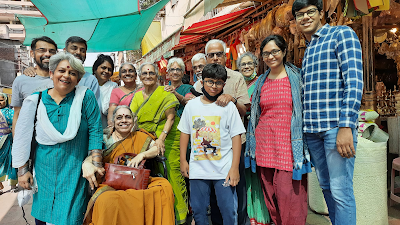
I was in Assam, in a small village of the Karbi-Anglong people. We were greeted by two Karbi women, and one of them tied a friendship band on my wrist. It felt lovely. It is always like this - in tourism, whenever I meet local women of any area, I feel a certain kinship, a bond, because I know we have many things in common.

In my travel company too, I employ many women. It is an unwritten rule, that we will prioritize hiring of women guides. Over the past 20 years, I think we have probably developed India's largest network of women in tourism, working not just as guides, but also as cooking hosts, art and architecture specialists, craft specialists, and so on. 

And yet - I do feel that the 'gender lens' is just one way to view the world. It is an appropriate lens sometimes. Gender injustice is real. But we should not forget that any lens, if used for too long, eventually excludes you from seeing other views. 

I use lenses very often, so that I can learn to walk a mile in someone else's shoes. But if I wear any singular lens all the time, it will diminish me. 

The universe is multi-dimensional and rich. You need a million lenses and an open heart to comprehend it compassionately. 

#deepasvoice #anekantvad

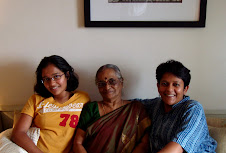
P. S. Thank you Nancy, for the lovely photo! 

Monday, July 15, 2024

The complex nature of Jati (community) and Varna (caste)

 Large parts of India are highly endogamous, with deep awareness of jati. I agree that jati/varna awareness is problematic. But I'm not sure we can erase all mention of community unless we erase our entire culture. 

What we eat, how we celebrate, how we pray, what sort of jobs we do, and many other elements of daily life are associated with the communities we come from. Our literature itself is full of specialised community references. These form a very rich tapestry of Indian culture. When we remove all references to such community identities, we will lose a certain continuity which is a source of strength and richness. 

For example, I work with Warli, Thakar and Katkari tribal communities and its a crying shame to lose those living traditions. Similarly I want the Chippa community to not lose their specialisation in their block printing, traditional wood carvers to continue making their glorious chariot carvings etc. These craft occupations are hereditary. They are often not inclusionary, but that's what leads to excellence. Many of these crafts are tied up with religion since it was the temple which gave patronage. 

Erasing community / clan notions with their specialised ways of life, is a very complex issue. It means we will become like a bland tasteless porridge. It's a price we must choose deliberately to pay. 

Mao attempted to remove all culture and replace with a new set of values, putting the nation first. Americans did it successfully by adopting consumerism as the new religion and evolving a new caste system based on money and external badges of money display. 

What should India's path forward be? How do we evolve, without throwing the baby along with the bathwater? A big question to ponder upon. 

P. S. the simplest way to kill jati/varna orientation is the "love marriage". Bollywood is our strongest ally and Ek Duje Ke Liye was its first major Brahmastra.

#deepasvoice

Photo: Bishnoi elder, courtesy Ranjeet Bhardwaj

Friday, May 10, 2024

Four tips from my visit to Tadoba

Four tips from my visit to Tadoba-Andhari Tiger Reserve:

1) Adopt the Coconut-Seller Look early in the game. After repeatedly shampooing red dust from hair, I realised that a turban is the only real solution. Now I am offering this free tip to anyone who is mad enough to do summer safaris in the Deccan Plateau heat: Take a stole, people. And become a coconut seller. The beautiful complexion you are seeing in the photo is actually laal-laal Dakkhani mitti with an under-layer of sunscreen (the bonus is that it hides all skin defects).

2) Oh by the way, take a second stole also, if you value your skin and lungs. Naak-mooh dhak-kar saans lete rahiye, as the famous airline announcements say. It's perfect advice for safaris also.

3) There is a strange phenomenon in Tadoba. Vodafone works there. This has never happened in recorded history. That Vi works where other networks fail 🙂 Now you must be wondering if Jio works. Yes, it does. We expect nothing less from the country's juggernaut. But all networks are spotty, so go to Tadoba safaris only if you enjoy being connectivity-free.

4) They don't allow you to click photos on mobile phones while in the forest. So your fancy i-phones are only ornamental. Big-ass cameras are OK, provided you cough up a 250 rupee fee. So my last tip is to go with a photographer friend, preferably one who enjoys carrying around big lenses. Tiger ko door se dekhna hi sehat ke liye accha hai.

#deepasvoice

#freeadvice

#tadobaandharitigerreserve

Sunday, February 25, 2024

The Prince of Wales lunching in the Caves of Elephanta

In October 1875, Albert Edward, Prince of Wales, the eldest son of Queen Victoria and Prince Albert embarked on an extensive 8-month tour of the Indian subcontinent. In Mumbai, the royal party was entertained at the Elephanta Caves.

The Illustrated London News faithfully reported the entire trip to eager readers back home. They commissioned William Simpson, an artist and lithographer, to cover the entire visit. Simpson would send draft sketches, which would then be engraved in London and the pictures would appear with a four-week lag. For the sake of speed, Simpson would typically only draw in detail the main parts, and send notes and descriptions to help the engraver figure out the costumes etc. 

Today these pictures are somewhat disturbing examples of what Edward Said defined as "Orientalism" - the imagining of the East by the West, in which the imperial regime controlled the way the subjugated culture was perceived. One of the features of this Orientalism is the figurative embedding of the Prince of Wales within that imagined Orient, asserting a superior 'civilised' culture. "We deserve to rule these chaps", seems to be the message. 

Take a closer look. The Prince of Wales lunching in the Caves of Elephanta. Illustration for The Illustrated London News, 11 December 1875. Creator - Charles Robinson, English (1840–81). Artwork medium - engraving


Monday, March 27, 2023

Spice Market at Lalbaug

A fun morning among masalas and pickles at Lalbaug Spice Market and Chivda Gully. Came home with a nice loot. Lunch at Shivaji Park's Gypsy Corner Maharashtrian eatery and the first mangoes of the season at Naturals icecream. Pramod's cousin Jaggi is a food fiend and naturally we had a blast.


Monday, February 27, 2023

The Accidental Professor!

- by Deepa Krishnan

In 2015 October I took charge of Abhyudaya, an education NGO, and suddenly found myself also becoming part of the teaching faculty at SPJIMR, which is the chief sponsor of the NGO. It was, I confess, a challenging assignment.

Never having taught formally, I found myself attending training sessions and trying to develop a teaching style and curriculum of my own. I learnt the basics of academic research, wrote papers, became a columnist for strategy+business, and got empanelled on the editorial board of an academic journal (Emerald Emerging Markets case studies). Eventually I became good at delivering lectures and academic course design. Awards and recognitions came my way as well.

But one of the nicest things in this academic journey are the student committees that I get to work with. The SPJIMR student committees are packed with hardworking and talented young people, who start out as strangers but end up coalescing into strong teams. Guiding their journey into a smoothly functioning unit is an exercise in mentoring and leadership. It has helped me grow as a teacher and as a person. Photo is from the Abhyudaya Committee dinner that we had last night. This is the fab team that organised all my events this year. Thank you AbCom for a wonderful year!

Sunday, June 19, 2022

In which Amma gets a smart phone

Yesterday Amma got her first smart phone. What a fun morning calling everyone! 

The best call was to me, from one room to another! "Hello, who is speaking?" "Amma, it's me, Deepa." "Oh is that you?" And a long fake conversation after that in the Queen's English on useless topics! Just like kids playing "telephone-telephone".  

My sister Roopa clicked this pic 

But more seriously, it made me painfully aware that one day, I too will be tech-challenged. I too will be slow to push the right buttons or read a scrolling screen quickly enough. Already I am on the edge of that. Although, I must confess, starting a new online business has taught me new some skills! I can now make insta reels and what not. Still...the day when I get both outdated and slow is not far away. 

The most painfully beautiful thing about being near an aging parent is one's acute awareness of one's own future. I have my mother's body structure and temperament. Will I also have her frailties?

- Deepa

Sunday, May 01, 2022

Visit to Pandharpur - March 2022

Visiting major pilgrimage sites is always an ordeal due to crowds and endless queues. But Pandharpur is an easy experience. 

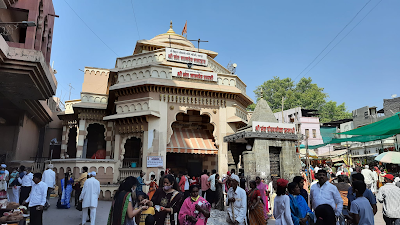
Our family in front of the temple, three generations
If you book online slots for darshan it is a shorter queue and you are out in half an hour. The temple has long experience of managing lakhs of warkari pilgrims. The physical space is small so they have created a warren inside where the queues meander across multiple floors. 

For those on wheelchairs there are special arrangements for quick darshan. No photography allowed inside, so this is the exterior.

First sight of Namdev and Chokha Mela shrines
Namdev Payri is the samadhi sthal of the saint Namdev. "Jivanta Samadhi" was taken by 13 members of his family and Janabai in this place. The smaller shrine is of the poet Chokha Mela, who was one of the many followers of Namdev. His song Abir Gulal Udalita Rang is well known and widely sung. Being from a low caste, he was denied access to the temple. His bones were buried outside the temple, and many visit this spot where there is a small shrine. One cannot get away from caste and its hold... even in the India of today. Although things have improved a lot, there is still a lot of discrimination. 
Commerce and religion, always side by side :)
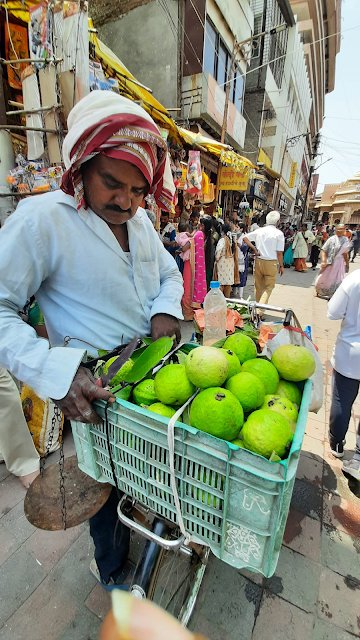
Guava seller outside the temple
Guava is called Peru in Maharashtra. The term is likely derived from the source / origin of the fruit... they are from Central America / Mexico and were introduced into India in the 1600s by the Portuguese. Peru + masala... great combo.
Getting symbols drawn on hands

Tukaram sings:
Gopichandan-uti tulasichya mala haar milwiti gala,
Taal mrudung ghai pushpa varshav,
Anupamya sukhasola re
The pilgrims have anointed themselves with sandalwood paste and put on garlands of basil leaves. Drums are reverberating and flowers are being showered. The joyous celebration is beyond words.

The pilgrimage experience includes getting markings on ones hands and forehead. Experiencing Vitthala not only through the eyes (darshan) but also through one's own body.

Little boys come running with pastes and metal moulds when you reach the temple. The most popular are the Vaishnavite urdhva pundra marks on the forehead, but arms are also decorated with outlines of Vithhala or the temple or other sacred symbols.

Amma with the forehead Vaishnavite tilak mark

There is a lot of sugarcane grown in this belt, so of course, we had to stop to taste fresh juice!

Overall, a great happy visit, and one that the family is still talking about it! We are already wondering where to go next.

Monday, October 04, 2021

The Magic Room

The Magic Room is a textiles and crafts store in Sion, which I opened this month. 

This pic is from our Navratri Exhbition, when my mother and daughter were both present and we got a 3-generation photo. Of course, I had to put it here! 

The Magic Room is social enterprise that supports handmade products from India, with a focus on sourcing fairly from craftspersons, and supporting women entrepreneurs wherever possible. We also have a tailoring livelihood program for women (and men!) from low-income areas of Mumbai.  

Do drop in at 331, Champaklal Estate, if you would like to see all the nice stuff we have on offer. 

You can check us out on instagram here: https://www.instagram.com/magicroommumbai/

Our facebook page is here: https://www.facebook.com/TheMagicRoomMumbai

Saturday, May 08, 2021

Learning to Let Go

- by Deepa Krishnan

The government's handling of the pandemic has become a heated political debate. Today in three of my WhatsApp groups, I watched people leaving the group on account of differences in view points. A couple of them left without any explanation. A couple of them wrote a few lines and left without reading responses. I am sure all of you are familiar with such abrupt exits.

I used to be one of those abrupt exiters. Some years ago, you remember that time when all of us were having Modi-Wars and Trump-Wars and so on? In one such debate, I stormed out of a WhatsApp group, where there was a guy making me see red. At the time when I left, a couple of friends in the group reasoned with me, saying that I should learn to be more tolerant. I answered angrily that values mattered, and that such tolerance was in fact, cowardice. But eventually I went back to the group. And I learnt to tolerate the people who made me angry. 

It's not easy, the process of learning to tolerate someone who is the opposite of you, and whose very presence is constantly pushing your buttons. I really struggled a lot. I still struggle, but it is getting easier. What made it possible was my realisation that the group was a community in which I lived (albeit virtually). Communities are made up of all kinds of people, just like the real world around me. I deal with a lot of diverse people in the real world, without getting into fights. Then surely I could do the same in the virtual world? As soon as I realised this, my online life changed and I stopped heated verbal duels. Instead I started modelling my online behaviour in line with my real world behaviour. It's nowhere near perfect, because hey, my real world behaviour also is very immature and impetuous. I still cuss and swear, but everything is much more calm than it used to be.    

As I get older, I am trying to accept that people have different kinds of viewpoints, different levels of awareness, and different levels of sensitivity to certain values that I take for granted. What we think, is largely a matter of our upbringing, and the company we keep. If someone has been blessed with parents or teachers who made them think a certain way, or has developed a reading habit that made them more aware, they'll be a different type of person. Sometimes it's crisis that changes us. A friend of mine changed completely after her husband's affair. Another changed completely after his daughter went through a medical crisis; and started frequenting temples. It's really a complex cocktail. That's why political and relgious debates have no easy resolutions. Each person has to navigate their way through it.

Then what to do? Nowadays when I meet people who don't think the way I do, I engage upto a point, and then try to politely leave them to their doings. Instead of trying to convince them, I focus on my own work. I tell myself that I am responsible for my own path and my own growth as a human being. Others can find their own paths. 

Doing my work gives me meaning and direction. That is enough. I really feel no need to evangelise these days. I feel no need to get angry. There is no benefit in anger except to make oneself sick, anyway. Often my blood boils and I want to kill someone, but I have learnt to leave the arena when it gets unpleasant or acrimonious. I, who used to be the original debating champion, am learning to let go. Is it cowardly? Yes. But it is also very liberating.

Tuesday, July 07, 2020

Lessons from Mumbai's bubonic plague

I'll tell you an interesting story.

It's a little long, but bear with me. If you want to know how epidemics actually play out in India, and how people react to it, you should listen to this story of the bubonic plague that hit Mumbai in 1896.
It has lots of similarities with how things are playing out with Covid. Lots of learnings, particularly in how people and governments behave in times of stress. And how epidemics behave in general.

In 1896, a strain of bubonic plague of Chinese origin, came to Mumbai. First it reached Hong Kong, and then came via ship from Hong Kong to Mumbai, carried by the rats in ships. As the plague spread among the rats, the rats died in large numbers. It turns out that the rats were carrying infected fleas on their bodies. When the rats died, the fleas on the rats jumped on to the nearby humans, looking for an alternative host. When the flea bit the human host, the human got the infection.

The plague hit Mumbai hard. The ground zero was a chawl in Mandvi (Masjid Bunder area) where Bania and Jain merchants had their warehouses on the ground floor, and workers lived in crowded conditions in the floors above, with common washrooms. When the plague was discovered, the grain merchants refused to kill rats citing religious reasons. In fact, they wouldn't let the British appointed rat catchers into the grain godowns. That ground zero area, as described in British record had leaking water, it was permanently dark and damp, with rotting grains and dead rats. And lots of people.

Naturally, more people started getting infected and dying in droves in south Mumbai. The main brunt was borne by the mill workers, mainly Hindu migrants from other parts of India.

The British were familiar with the plague, having seen The Black Death epidemic earlier. They cracked down fast on further spread by quarantining, strict isolation, disinfecting and washing streets, and insisting those who were infected get treatment (they put restrictions on what they felt were quack local medicinal practices). Fairs and pilgrimages were cancelled. House to house searches were made, and people forcibly evacuated and moved to camps. They had strict inspection in train compartments, with examination of both men and women to see if they were infected. Infected belongings were burnt to limit the epidemic. A huge outrage ensued among Hindus at these protective measures.

All containment measures were of no use. The British could not do anything about the panicked local junta, who fled the city. Some climbed up Malabar hill where they thought the plague could not reach them. Some fled across the Mahim Creek to Bandra, seeking protection there. Many crosses were built in Bandra at this time, some specifically to St Roch who is the patron saint of the plague.

As the deaths continued, more people fled into the interiors, taking the infections still further with them. Within the first 4 years of its arrival, the plague had killed 8 million people, say some accounts. Others say it was 6 million over a decade. Either way, it was a very high number. The deaths peaked in 1907, although the plague started in 1896. The deaths were mainly in Western India, but also in Punjab and MP, where people had gone carrying the infection. Rich or poor, it spared no one. The mortality rate, by the way, was less than 2%. Malaria and TB killed twice as many people in the same time. Similarly cholera and smallpox caused far more deaths. But it was only the plague which caused crazy panic.

Once people started fleeing everywhere, the British realised the futlility of their containment efforts. They switched to vaccination as a method to treat it; which by then had been developed at Parel by a clever guy named Dr. Haffkine. The bharatwasi public had no understanding of vaccination. Conspiracy theories sprang up, that the British were "giving injections to poison us". Quarantine and forceful evictions from houses continued, in the interests of public health. People beat up health workers. Tilak wrote long reams of protest in Kesari about how brutal the plague handling was. One British guy called Rand was appointed in Pune as Plague Commissioner. The Chapekar Brothers shot and killed Rand and his assistant as "revenge" for the insult to the "honour" of the city's women. This scared the British into thinking whether another Mutiny was now on the cards. So they backed off a bit, and authorised native vaids to implement the vaccine, hoping for more acceptance.

Did the vaccinations mean the plague ended soon? Hell no. The bubonic plague continued to kill people for 30 years. But the numbers were only high in the initial outbreak locations for the first 3-4 years. After that, people got smarter in keeping track of dead rats and outbreaks. Haffkine institute continued to do testing and control. There was no crazy panic. Vaccinations grew. They finally recorded 12.7 million deaths from 1896 to 1957. This strain of the bubonic plague was active till 1960. In that year, the worldwide casualty had dropped to about 200 people, and WHO classified the pandemic as over. So that's what it took. 60 years, for the plague to go away.

But we are not in an exactly similar situation now. Our medicine has advanced a lot. We have also taken containment steps. Long distance transport has been locked down. People believe in teeka (vaccination) and we have implemented many large scale such vaccinations so we know how to go about it. Our count of hospitals and facilities is much better than at that time. I do not believe the current epidemic will play out like the 1896 plague. I think soon the cure will be in place and available. Meanwhile please support government efforts at quarantine and keep social distance. Stay at home. Wear masks. Don't spread it to your friends and those around you.

Photo: Bombay plague epidemic, 1896-1897: interior of a temporary hospital for plague victims.
Reference number: b1539282x
Persistent URL: https://wellcomelibrary.org/item/b1539282x
Catalogue record: https://search.wellcomelibrary.org/iii/encore/record/C__Rb1539282

A good article for data: https://www.ncbi.nlm.nih.gov/pmc/articles/PMC2555600/pdf/bullwho00328-0149.pdf

Saturday, January 04, 2020

Pickled peppercorn

The sight of fresh green peppercorn in the market brings out the pickling fiend in me.
This is the simplest of pickles, but packs such a punch! Green pepper, marinated in salt and lemon juice, with a little bit of turmeric powder. Over time it acquires that crinkly salt-and-lemon soaked perfection. The photo on the left is from my last year's batch. The brine is even tastier than the peppercorn!

And in my south Indian household, this is the perfect accompaniment to thayir-saadam.

#indianpickles #picklespreservesandchutneys

Thursday, October 24, 2019

Coral Jasmine - a carpet of flowers

If you visit a flower market in Mumbai, you will usually not see the coral jasmine. It flowers at night, and when day breaks, all the flowers fall, leaving a beautiful carpet of flowers on the ground. It is a fragile flower, that fades quickly, and doesn't do well when transported to markets.

In my mother's apartment there is a coral jasmine plant; and every morning, the night watchman gathers up the flowers and gives them to my mother. Some of them go into the kitchen temple, but the others are used like this, as a beautiful carpet for her plants.
Coral jasmine, offered to the Tulsi, and to other plants 
This jasmine is offered to gods, even after it has fallen to the ground. In Tamil, it is called kanaka malli, where kanaka means coral, and malli is jasmine. In Hindi, the coral jasmine is called harsingar, or the adornment of God. It is the state flower of West Bengal. In Bengali it is called sheuli.

This flower is also identified as parijat, a legendary flowering tree that is mentioned in the Puranas. As is common in Indian legends, there are multiple candidates claiming to be parijat :) In Tamilnadu, the parijat of legend is a much larger, all-white flower, with a very intense fragrance.

Krishna Uprooting the Parijata Tree, folio from a Bhagavata Purana manuscript (text in Sanskrit), Delhi region or Rajasthan, India, artist unknown,1525–50; opaque watercolor and ink on paper. Los Angeles County Museum of Art. 

Saturday, October 19, 2019

Walking through Dharavi

It's always eye opening to walk through Dharavi. Today I was with Kathy and Clive, they have been to India 5 times already, but to Dharavi for the first time. It struck me how many times she said "This is not what I thought it would be." There are so many misconceptions and cinema-driven myths that sometimes I feel everyone who visits India should do one of these walks.

A couple of pics from today's walk below:

 Funky hairstyles at barbershop
 Kathy tries a Royal Enfield. 
Clive shows Torab his modified vehicles 

Plastics for recycling

Monday, March 04, 2019

Indian Aesthetics - The Poetry of Krishna

- by Deepa Krishnan

Yesterday at The Magic Room, I attended a marvellous session organized by Expansions (curated by Sarayu Kamat). We listened to the very erudite scholar Dr. Harsha Dehejia speak on the many moods of Krishna Kavya.
I do not reside in Vaikuntha, nor in the hearts of yogis.
Where my Bhaktas sing my songs, there I reside, O Narada!
The invitation for the event said: "Krishna’s romantic presence is best understood as kavya and not as a katha, and that too as muktak, or fragmented moment of romantic pleasure. While enjoying the sensuality of Krishna’s shringara, a committed Rasika will endeavour to move it to shringar bhakti. Krishna shringara ultimately should lead to brahma jnana and therefore ananda"

It was a pleasure listening to Dr. Dehejia, as he led us through the history of Indian Aesthetics, from the Vedas and the Upanishads, down to Brathrhari (Vakyapadiya, Sphota theory), Bharatamuni (Natyashastra, rasa theory), and Abhinavagupta (commentary on Natya Shastra). 

After giving us a better understanding of various expressions of aesthetics - shabda, shilpa, natya - he then took us into the world of kavya (art, music, poetry). Specifically, he took us for an exploration of Krishna Kavya, tracing the major art and poetry movements of northern and eastern India. 

I learnt a lot, particularly about saakar and niraakar concepts of brahman, about bhakti poetry, about the advaita and dvaita concepts that found expression in the literature. I also learnt the answer to a question that had been puzzling me, the question of Radha. I had never understood how suddenly Radha became a major goddess when she is nowhere in the Puranas. I learnt that Radha is a later construct by poets, particularly Jayadeva and Chaitanya Mahaprabhu. It is a great example of how poetry/music seeps into the Indian heart and fills it with emotion, even leading to mass acceptance of new gods and goddesses. I also learnt a lot about the major poets of the Krishna tradition, and developed an appreciation for Pahari and Rajasthani miniature art. 

All in all, a very good way to spend an evening, and I was very thankful to Sarayu, for inviting me to the event. Here are some more photos:

Sarayu Kamat introducing the speaker

Small glimpse of the audience
My Warli saree and jewellery from Indu Diva
I wore a slice of tribal village life yesterday to the event - a handpainted Warli Art necklace and saree. Indu has done such a lovely project with this. The saree has a base cotton weave from Madanapeta in Telengana, and it was the perfect brown to set off the beauty of the Warli pallu. The artist who painted the necklace and the saree is from the Warli people, living in a village about 4hrs from Mumbai. She went to the village and got the jewellery and saree project kicked off. I felt very good to have supported this work, and it is a joy to wear something that has personal meaning. The Kotpad blouse from Odisha was really perfect! I have increasingly begun to make conscious choices about what I buy and wear. 

Saturday, November 24, 2018

Bandhara at Aptale Village, Jawhar region, Maharashtra

In May 2015, I went to a tribal area, about 4hrs drive from Mumbai. Since then, I have been working on a series of water projects there. Along with my friend Malathi, we have been building checkdams, ponds, wells, and rainwater harvesting structures. This is our latest project in the village of Aptale. It is a Thakar village. This area gets a lot of rainfall in the monsoons, but goes dry after the rains. Already you can see how the countryside has turned brown.
The water is from a perennial source which is a small trickle that gets lost in a muddy slush. In fact, the mud blocks the trickle and it stops flowing after a while. So now the mud has been removed and put in recycled gunny bags. It forms an impenetrable layer and the water will fill up the available stony basin in the coming months.

We normally use boulders with a plastic lining but this is faster and less expensive. And it uses second-hand bags which are easily available in the local market in Jawhar. This time we have experimented with a "fixed cost model". Instead of paying daily wages, we have given a fixed amount, after supplying the gunny bags. We told the village that it's now upto them to do it as efficiently and quickly as they can. The daily wage model doesn't work in Aptale, since we cannot monitor the project all day long.
A team of 20 people did this project. 10 people worked for 2 days, and another team of 10 people for the next 2 days. That way the earnings were spread over multiple families. We did not decide who would work. The village has come up with this system. I think that's a very good thing.
The project is now finished. Waiting now to see results in the dry months ahead. As usual, I am taken aback to see how much can be achieved in rural India with very little money actually being spent.

Sunday, October 21, 2018

Milestones

So I turned 50 yesterday. I thought about what I want to do with the next 10 years of my life. I want to work further on rural water management and livelihood projects. I have set a target for myself of 1000 projects; big and small. Have done maybe 50 so far. Have a long way to go and much to learn.

Seeking blessings from all elders here and strength from friends. Inspired by many women who are decades my senior and continue to do good work.

So in case you want to know what I did for my big 50, I went for a drive with husband; spent time at two adivasi villages to review water structures and plan for the dry season. Visited parents to seek blessings. Husband bought me new jewelery to celebrate. A good day :)

Sunday, July 08, 2018

Van Ruith and the Western gaze

- by Deepa Krishnan

Horace van Ruith, a painter of German origin, arrived in Bombay in the late 1800's. He stayed in Cumballa Hill and established a studio there, at what was called the Cumballa Hill Family Hotel (which is now the Parsee General Hospital). Van Ruith painted landscapes, as well as portraits. But his career really took off when he started to do these Oriental scenes, and found patronage from Indian royalty as well as Prince Arthur, Duke of Connaught.
The painting above is of a Brahmin household, says Sotheby's. To me it looks more like a small local temple courtyard, given the sadhu sitting in the corner, the tiling on the wall, the temple bells and the woman returning after offering prayer. Perhaps it is a small shrine, part of a nobleman's large private wada.

I liked all the little details in the picture; they are so very real and authentic. No foreigner could paint these from memory, so I am sure there was a photo or a series of photos for reference. Photography had come to India by the 1840's, and since no such family scene could have possibly been caught on camera, it is likely that this picture was 'made up' from some photographs of a more public location, combined with the painter's imagination. It is still a commendable piece that portrays small details perfectly.

Of course, like all paintings of the "exotic Orient", this one too leaves me somewhat troubled. When I see my culture represented via a Western Gaze, it's as if someone else has taken over the narrative, and I am seeing myself through their eyes, in a way that I may not particularly agree with.

What is this Gaze thing, and why does it matter? My cousin Lavanya recently said something about "The Gaze", which I found interesting.
Gaze: to look fixedly, intently, or deliberately at something. 
The gaze has acquired different meanings in different disciplinary contexts. The Medical gaze which is the examining gaze, diagnoses and pathologizes. The Scientific gaze depersonalises, the Sociologists’ gaze diagnoses [society], the Anthropologists’ gaze [often] patronises, [sometimes] museumises, the Poetic gaze renders soulful, the Imperial gaze infantalises and talks down to subjects, the Supremacist gaze makes binaries of us and them...

This painting to me represents a Western gaze, the gaze of an outsider who sees something strange and mysterious and seeks to portray it that way. The problem with this is that when framed through the eyes of colonizers, complex cultures are often reduced to exotic stereotypes ... for example, if I were to ask you to describe Brahmin society on the basis of this particular painting, what words would you use? To me it seems to show a very idle community (see the sprawled, relaxed posture of the two men). Yet it seems to be a prosperous community (note the prosperous, healthy boy and his jewellery), using strange books and ritualistic paraphernalia to make their living in the world. It is a patriarchal community as well, with a little girl being trained in the ways of her dutiful mother (she with the downcast eyes). It's easy to see how such a portrayal may help build an image of a slothful and backward society that needs to be saved by Jesus, or reformed through colonialism.

Whether you agree with van Ruith's portrayal of Brahmin society or not, in the end, such exotic stereotypes end up creating "others" versus "us".

Here's another van Ruith, also painted in Bombay, called The Village Girl:
In this painting, a Maharashtrian woman is portrayed somewhat pensively, delicately, suggesting that she is as soft as the flower she is carrying. This then, is the Male gaze, depicting women and the world, from a masculine, heterosexual perspective. From the khuna blouse to the Narayanpet saree, to the hair tightly done in an amboda, this one is so real. But if you have ever carried a pot of water in a heavy copper pot, then you'll know that it takes strength. However, male representations do not usually reflect the strength of the woman. And we, the viewers, both male and female, internalize this male gaze, and begin seeing ourselves thus.

Raja Ravi Varma greatly admired van Ruith's work, and a whole generation of Indians have internalised Ravi Varma's portrayals of soft, vulnerable, Indian women.
Radha in the Moonlight, Raja Ravi Varma
I don't have anything against either van Ruith or Ravi Varma, or the way in which they portrayed what they did. All humans have a gaze. If you want to tell a story about someone, you need to adopt a gaze; and they adopted what came naturally to them. But my personal view is that in portraiture at least, if a story-teller begins from a point of empathy, it would perhaps help tell the story in a more authentic way. The starting point for any portrait artist is to be aware of their own gaze, and how that impacts the portrayal they are about to undertake.

I am myself a story-teller; I write about the people of India. My travels in India take me to so many different cultures and communities. Seeing van Ruith's work has come as a good reminder to check my own gaze from time to time! I now am becoming acutely aware of my own gaze, and how difficult it is to tell a story without altering it to suit my imagined worldview.

Photo sources:
http://www.sothebys.com/en/auctions/ecatalogue/2017/modern-contemporary-indian-art-n09664/lot.102.html This painting of the Brahmin household sold for Rs 2.5 crores in Sotheby's March 2017 auction.
https://www.grosvenorgallery.com/exhibitions/49/works/artworks1465/
https://auctions.pundoles.com/lots/view/1-58K3E/radha-in-the-moonlight

Tuesday, April 24, 2018

Women Entrepreners in Tourism in India

I was happy to be featured in Tourism India's Cover Story on women entrepreneurs in tourism.
Interviewer: Mumbai Magic is considered as one of the rarest Responsible Travel experiences in India. How did it all begin?

Deepa: I graduated in 1990 with an MBA from the Indian Institute of Management, Calcutta. I spent nearly two decades of my career in the corporate world, mainly in banking technology. I travelled widely due to my work, and met people from many countries. My journey in tourism only started in my late 30’s, when I realized that India has so much more to offer to tourists than just monuments and shopping. So I set up a guided tours company that offers bazaar walks, heritage walks, art walks, food walks, home-cooking, textile trails, craft trails etc.

Initially, it was just a hobby, which I did along with my corporate career. But what started as just a hobby in 2006 has now become the largest pan-Indian guided tours company in the inbound segment, offering offbeat experiences in 27 different cities. Mumbai is our flagship city, but we are not just “Mumbai Magic”; we have 27 different Magic cities! I have personally visited these cities, read a lot about them, walked and explored the lanes and bazaars, and created these tours. So we are not just tour resellers, we are an imaginative company that creates tours, and we continue to launch at least 5-6 new tours each year.

Across India, we now have a network of more than 100 guides and experts, who help tourists see the “real India”. I believe that tourism is a great area for women to work, since the work is flexi-time and part-time. We employ female guides wherever possible – in fact, we currently have the largest network of women guides in the country, and many companies approach us for providing safe travel for female tourists.

Interviewer: You are one of the pioneers in Responsible Tourism initiative in urban travel segment who have already created different aspects to Travel through our cities, especially in Mumbai. Please tell more about this journey. 

Deepa: I have always wanted to make a positive impact through the tourism business. So we employ and train students from slums, in order to help them earn incomes and get work experience while they are in college. We have created two flagship tours – MUMBAI LOCAL and DELHI BY METRO – in partnership with local non-profits. These tours are run by college students from low-income neighborhoods, and they use local transport (bus, taxi, train, rickshaw, metro, etc.) to explore the city. Tourists really enjoy these experiences, because they are offbeat and interesting. The income from the tour is shared between the student guides, the non-profit, and our company, thus providing a winning combination. These tours have been running successfully for the past 10 years and have contributed significant income to the students as well as the non-profits. We have had 52 college students work with us (usually for 3 years or more), and they have all made us proud through their achievements. Some of our students have now entered full-fledged careers in tourism, some have acquired jobs in top multinationals, some are studying for MBA, some have gone to the USA for studies, and some have started their own tourism ventures. It makes me really happy to see these students doing so well.

In many of the cities where we work, we partner with local non-profits and actively canvas for donations to these non-profits. We try to bring incomes to marginalized sectors. Since many of our customers are foreign educational institutes, we create experiences for them where they can understand social issues in a sensitive way without disrespecting local communities.

In Mumbai we are ourselves working in 4 adivasi villages (around 4hrs drive from the city), building dams, wells, ponds and other rainwater harvesting structures. In addition, I myself run an education NGO in Mumbai called Abhyudaya, with 500+ children. Last year I also founded Abhyudaya Community Initiative, a women’s self-help group which creates textile craft products. I do a lot of work in promoting Indian handlooms and I am a member of the NABARD Task Force for handlooms.

Interviewer: Travel & Tourism sector is considered to be a man’s world. How did you make into this sector and what are the challenges that you faced? 
Deepa: I don’t believe that any sector is “a man’s world”. When women are flying fighter jets and facing combat situations, why should we have this mindset? In fact, travel and tourism is a great area for women to work in. I can honestly say that I have never faced any challenges specifically due to my gender. Creating and growing a business is always challenging; whether for men or women. If anything, I believe being female is an asset, as you are more easily able to stand out among the crowd. Besides, a lot of foreign tourists often prefer dealing with women.

Interviewer: More women entrepreneurs are now enter into the Travel & Tourism sector today. What is the advice you give to such young women?
Deepa: An entrepreneur is one who is willing to take risk, show leadership, and bear hardships. This is not an easy thing. Anyone who enters this – whether man or woman – has to be prepared for some tough times. For new women entrepreneurs, my advice would be to develop a strong spine and a somewhat thick skin! Don’t let anyone discourage you, because many people will be very skeptical of your journey.

Interviewer: How women can enhance this industry from a woman-point of view?
Deepa: I would urge all people in the industry to provide flexi-time, flexi-location jobs. This is a real boon for women. Even for men, it helps to bring more work-life balance.
In our office, we provide opportunities for our staff to work part-time and flexi-time. The employees receive a share of the profits, thus everyone is a part of the growth journey. Due to these people-friendly policies, our team has been stable since the beginning. Stability brings deeper expertise, which benefits our tourists.

Interviewer: How you feel when you look back on your journey from an ordinary Indian girl to a respected Travel professional now? How you foresee the future of Indian Travel Industry ?
Deepa: I don’t look back very often, but when I do look back, I am happy with the value we have added to all stakeholders – employees, contractors, customers and society. There is still a lot of work ahead, so I am very occupied with the future! Although I have travelled a lot in India, there are still many new places to explore and new experiences to bring to tourists. The Indian tourism industry is still focused on specific geographies, and does not do justice to many exciting and interesting segments. I am hoping to bring more balance to this.

Sunday, February 11, 2018

Lahore ki Lakshmi

Lakshmi Insurance Building, Bombay
This is the Lakshmi Insurance Building on Pherozshah Mehta Road, opposite Bombay Store. It has a clock tower with a statue of the goddess Lakshmi.
Why am I calling it Lahore ki Lakshmi? Because the Lakshmi Insurance Company was originally founded in Lahore by Lala Lajpatrai. This building was the Bombay branch of the company (later merged with the Life Insurance Corporation).
There is also a Lakshmi Building in Lahore, which was the headquarters of the insurance company. In fact, the crossroads at which the building is located in Lahore is called Lakshmi Chowk.
Lakshmi Chowk in Lahore was a popular hangout for Bollywood celebrities and hopefuls, because many studios and movie offices were located there. The famous villian Pran got cast in a movie when he was hanging out at Lakshmi Chowk at a paan shop :) Apparently a director named Wali spotted him, and scribbled the address of a studio on the back of a cigarette packet. Thus began Pran's journey into films.
Dev Anand, Balraj Sahni, Mohammed Rafi, Om Prakash, Pran... all these major Bollywood stars hung out in Lahore's Lakshmi Chowk. And eventually migrated to Bombay to find fame and fortune here. 
Lahore's loss was Bombay's gain.
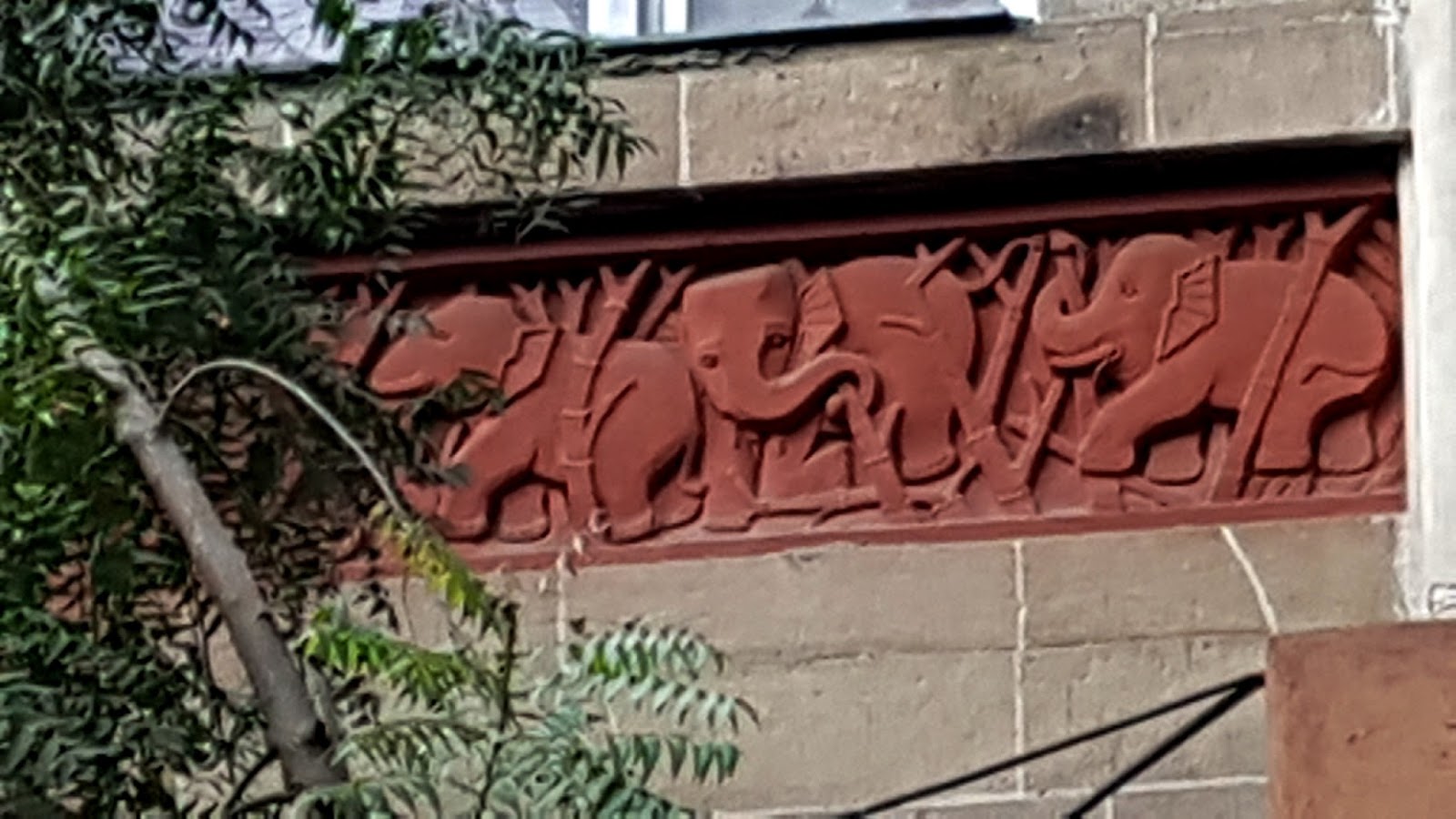
The cutest Art Deco Elephants in Mumbai