Monday, January 27, 2014

At the India NonFiction Festival - Crime and Politics, served up in a heady brew

- By Deepa Krishnan

Today I went with my cousin Lavanya to the India Non Fiction Festival.

I have been reading 'From Dongri to Dubai', the story of organised crime in Mumbai, so it was great to see and hear the author S Hussain Zaidi. We heard some amazing anecdotes, all the more impactful because they were couched in very no-nonsense terms.
Hussain Zaidi's book is very 'Bambaiya' in character. Only in Bombay would you have three underworld brothers from the Christian quarter of  Byculla called the Johnny Gang, with names like Bada Johnny, Chota Johnny and Chikna Johnny :) As you may have guessed, the youngest was very good-looking.

And only in Bombay would you read an anecdote like this one: Apart from the Johnny Gang, there was a rival gang from Byculla's Muslim area. Ibrahim Dada was the leader of the gang. He once went to the passport office where he met Maria, a receptionist from the Byculla Christian locality. When he and Maria started dating, Bada Johnny confronted him. "Why are you messing around with a girl from our area?" And in reply, Ibrahim Dada actually sang a movie song: Jab Pyaar Kiya to Darna Kya! Where else except in Bombay? :)

The crimelords of Mumbai operated from several areas: Byculla, Dagdi Chawl, Chinchpokli, etc. They were Hindu as well as Muslim. All came from humble beginnings.

Here are some photos, so you get a general sense of street scenes from the Muslim areas of Byculla / Bhendi Bazaar / Dongri:
Muslim tenement, Byculla
Street scene near Gol Deval
Roof of Minara Masjid, seen from JJ flyover
Hussain also spoke about his earlier book the Mafia Queens of Mumbai, a group of essays about some women who were an integral part of Bombay's crime scene. I think I'll buy the book. It sounds murky and fascinating, with a gritty street Bambaiya feel that I can't resist.

I also enjoyed listening to Vaibhav Purandare, author of 'Bal Thackeray - The rise and fall of the Shiv Sena'. The Sena's early years and the inter-linkages between politics, big business and trade unions were very interesting. I haven't read his book, have you?

Here is an aerial view of a section of the textile mill district in Parel. This is the setting for the Shiv Sena's meteoric rise. I clicked this photo in March 2008. Today the skyline of the area is dominated by high rise buildings.
Aerial view, Parel, 2008
I asked Vaibhav Purandare what he thought of the Sena's future strategy; specifically its approach towards violence. He seemed to feel there is no coherent strategy at the moment, given the factional in-fighting and split between the two cousins. He also feels that the Maharashtrian youth of today want jobs and education and to participate in the modern economy; not keep going back to a golden past or to keep throwing stones or damaging property.

Both authors served up a spicy cocktail of Mumbai's political and criminal landscape. The auditorium was completely full and there were lots of questions at the end.

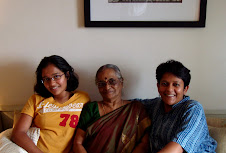
Nehru Centre is always a pleasure to visit. Alongside the festival there was also an exhibition of tribal art; I bought a beautiful large Gond painting. In the photo behind us is a small part of the extensive set of Saura paintings from Orissa. The art exhibition is there tomorrow as well.

Tuesday, January 14, 2014

David Sassoon - from Baghdad to Bombay

- By Deepa Krishnan

If you walk into the Bhau Daji Lad Museum at Byculla, you'll see a beautiful marble bust of David Sassoon, Mumbai's most famous Jewish businessman and philanthropist.
David Sassoon (1792 to 1864)
The Sassoon family history is a little fuzzy. One theory is that they originally came from the mountainous region of Sason in modern-day Turkey. The Sasoon surname is even today found among the Armenian and Kurd population of Sason. It is possible that some Sephardic (Spanish) ancestry existed among the Jews of Sason. In fact, according to Shaul Sapir, author of "Bombay - Exploring the Jewish Urban Heritage", the Sassoons trace their ancestry to Spain, to a family called the Ibn Shoshan (ibn Susan) who lived in the city of Toledo. Perhaps some branch of the Ibn Shoshan clan migrated to Turkey.
The city of Toledo, near Madrid, Spain
Whatever their history and origins, the earliest member of the Sassoon family to arrive in India was David Sassoon in 1832. He was born in Baghdad (present day Iraq) to a wealthy Jewish family who served as bankers and treasurers to the pasha. Fleeing political trouble, David Sassoon moved his wealth from Baghdad to Bushehr (Iran) in 1828. Four years later, he moved his wealth further east from Bushehr to Bombay.
In the early 19th century, Bushehr was the primary port in Iran. The East India company had a base at Bushehr and nearly 100 English and Arab ships came there each year from India and Muscat to trade. Goods from China and India were traded at Bushehr: cloth, metals, spices, indigo, tea, rice, sugar, pottery and porcelain, and wood for shipbuilding. Thus, it was possibly logical for David Sassoon to transition from Bushehr to Bombay, another British trading port. 

David Sassoon was 40 years old when he came to Bombay. Initially, he operated as a middleman for the British East India Company, using his contacts in the the middle-east. In 1842, ten years after David Sassoon arrived in Bombay, the British signed the Treaty of Nanking with the Chinese Emperor, opening up the Chinese market for trade in opium. Several Parsi merchants made the most of the opportunity; but David Sassoon was the first Jewish businessman to send his sons to open offices in Canton, Shanghai and Hong Kong to profit from the trade.
Opium export from Bombay and Calcutta 
A sort of three-way flow emerged: the Sassoons would export Indian yarn and opium to China; then from China, they would export tea and silk to Britain; and from Britain they exported textile goods into India. It's too complicated to draw, so I've only shown the first part of the transaction in the map above (the export from India to China). 

If you want to see what the opium factories and inland shipping looked like, click on the engraving below. You can see a larger image:
Apart from Bengal and Bihar (which the East India Company controlled), opium was also grown in the Malwa region; and indeed, it is Malwa opium where the Sassoons made a lot of their wealth. The Sassoon family acted as bankers to finance the Malwa opium crop, making advances to an already established group of dealers in Malwa opium. In effect, they purchased the crop before it was even planted.

David Sassoon with
three of his sons
According to Sir Jamsetjee Jeejeebhoy, a contemporary of David Sassoon in the opium business, "....the chief cause of David Sassoon's success was the use he made of his sons". And sons there were several: two from his first wife Hannah Joseph; and after her death, six from his second wife Farha Hyeem. Although David Sassoon spoke no English, his sons learnt the language and adopted Western modes of clothing as well.

As the Sassoon wealth grew, so did their munificence. They built synagogues, gardens, hospitals, schools and colleges in Mumbai. It looked as if David Sassoon decided that Bombay was a good place to settle down permanently. He built a palatial house in Byculla for himself and invested in improving facilities for Jewish people in Bombay.

The Sassoon mansion in Byculla was called 'Sans Souci'. In this photo, you can see the mansion decorated for a party in honour of Lord Monstuart Elphinstone, Governor of Bombay from 1853 to 1860. Check out the lettering on the arch which says 'God Save the Queen of India'
Clearly the Sassoons were keen to establish an excellent relationship with the British. They owned large tracts of land in Byculla, and from their holdings they donated a parcel of land to create the Victoria and Albert Museum (now called Bhau Daji Lad Museum). Here's the statue inside the Bhaudaji Lad Museum, containing the dedication to Prince Albert, by David Sassoon:
Statue of Prince Albert with David Sassoon's statue placed at the foot. The figures on the left and right are Science and Art
The dedication is in five languages: Hebrew, Marathi, Gujarati, Persian and English. It says:
Albert,
Prince Consort
Dear to Science, Dear to Art
Dear to Thy Land and Ours, A Prince Indeed
Dedicated by David Sassoon
1864
David Sassoon spent 32 fruitful years in Bombay, providing leadership (and employment) to the Jewish community of the city. When he died in 1864, his son Albert Abdallah Sassoon took over leadership of the vast Sassoon business interests. By this time, the Sassoons controlled almost 70% of all the Malwa and Patna opium traded from Bombay and Calcutta, according to an estimate I read in this book.

Albert Sassoon migrated to London, married into the very wealthy Rothschild family, and acquired a Baronetcy. Another son, Elias David Sassoon, set up his own independent firm in China, and thus left Bombay. In fact, six of David Sassoon's eight sons eventually migrated, leaving behind very few Sassoons in Mumbai.

I wonder if David Sassoon realised during his lifetime that his family's involvement with Bombay would be limited to 2 or 3 generations. Today there is no member of the family in Bombay. The Sassoon home Sans Souci is now a hospital. But the home and the beautiful monuments they have left behind are a lasting legacy.

Sunday, December 22, 2013

"Touched by Bhupen"

- By Deepa Krishnan

There's an exhibition currently going on at two art galleries, Max Mueller Bhavan and Mirchandani+Steinruecke. It's called "Touched by Bhupen", and it pays homage to the artist Bhupen Khakhar, who died in 2003. A group of 26 artists have come together to display art works and installations inspired by Khakhar.
Poster as soon as you enter Galerie Max Mueller
So why all the fuss about Bhupen Khakhar, you ask? Who was he, anyway?
Photos of Bhupen Khakhar, sourced from http://bhupenkhakharcollection.com
Bhupen Khakkar is considered to be one of most iconic, provocative and controversial artists of 20th century India. Born in Bombay in 1934, he moved to Baroda in the 60's. His paintings, with their street and daily life imagery, combined with some sardonic and playful twists, have been a major influence on Indian artists. He was among the earliest to portray the ordinary - the tailor, the rickshawalla, the barber - in ways that celebrated the mundane. He used historical and mythological references, as well as stylistic references to traditional painting techniques, to create a unique style of his own. Khakhar was the leading member of what is called the 'Baroda group', a set of artists who defined the art scene in the 70's. . 

In the 80's Khakhar created a sensation by becoming India's first openly gay artist to express his homosexuality on canvas. In a repressed era where such subjects were taboo, this made him iconic. 
"You can't please all", 1981, Bhupen Khakhar
In "You can't please all", Bhupen Khakkar references the Aesop's fable of the boy and his father taking a donkey to the market. The man on the balcony overlooking this street scene is himself. He painted this at his house in Baroda, at a point in time where he had not yet openly declared himself gay.

My introduction to Bhupen Khakhar came in Bangalore this September, where I attended a talk at the NGMA. I learnt that it was only after the death of his mother that he could bring himself to come out. "I can't do this to her", he told a friend. "She won't understand."

But after she died, he began expressing himself through his work. Here is one that moved me, because you can see he is not afraid to express his insecurity and need: 
"How many hands do I need
to declare my love to you?"
Watercolour, 1994
Since that talk at NGMA, I have looked up many of Bhupen Khakhar's works online, checked out photos and tidbits, trying to piece together who he was, and how this boy from a traditional Gujju family in Khetwadi could actually come out finally and declare his sexual orientation to the world. I've read what his friends have to say about him. What emerges from all the things written about him is that he was a unique man. Someone who was not afraid to paint his inner world, someone who appreciated the beauty within the mundane, who was not afraid of the grotesque. Above all, a man who was not afraid to declare his hurts and disappointments.

Anyway - I was quite intrigued by the concept of 26 artists doing tribute to Khakhar, and it so happened that I was passing by Max Mueller Bhavan, so I popped in to have a look:
Jogen Chowdhury's "His peaceful life in Heaven" on the left. I don't remember what the one on the right was called.
Karmakar's "Door" and "35 Views", two installations referencing how Khakhar shows both the inner and outer worlds. And also referencing the voyeurism in Khakhar's art
Of course, one of the problems with this kind of tribute/homage is that it tends to have all kinds of impossible-to-understand references, since each artist is influenced by Khakhar in different ways. But leaving that aside, there is some really good stuff to see. These 26 include some of the major contemporary artists in India today, so if you are anywhere near the Gateway of India, then you have until Jan 6th to check it out.

Like I said earlier, there are two venues; Max Mueller Bhavan and Mirchandani+Steinruecke.

I did not go to Mirchandani+Steinreucke, but I am very tempted to go, having seen all these interesting installations and exhibits on their website
Ram Rahman: Akhara Gate, Panchkuian Road, Delhi, 1980s. The photographer Ram Rahman shares Khakkar's interest in the depiction of street scenes, and finds some playful humor as well in this photograph.
Clockwise: Anju Dodiya, Sudhir Patwardhan and Gulammohammed Sheikh
In case you are planning to go, here is some practical information:

Exhibition details:
Dates: Friday, 29th November 2013 to Monday, 6th January 2014

Venues:
1) Galerie Mirchandani + Steinruecke
(Tuesday – Saturday 11 am to 7 pm)
2 Sunny House, 16/18 Mereweather Road, Behind Taj Mahal Hotel, Colaba, Mumbai 400 001 

2) Galerie Max Mueller, Max Mueller Bhavan, next to Jehangir Art Gallery - +91 22 2202 3030/ 3434 - Call and check opening days and hours before you go. I think they are closed Mondays.

Saturday, December 07, 2013

Santacruz Market Walk

- By Deepa Krishnan

A couple of days ago, I walked through Santacruz Market. It's great for photography, with lots of colour! There's a meat and fish market, a vegetable market, lots of spices and snacks, as well as fabrics and jewellery. I had only a camera-phone and I didn't really photograph everything in the market. But here are some photos of the food section.
Indoor market for vegetables
The fish market was nearby, with a busy looking kolin inviting me to check out the day's catch. There were a couple of men selling dried fish as well. 

Neatly slicing with her curved fish-knife
The meat market was gross as usual, dirty and bloody. I walked quickly past it. I think Mumbai customers should make more of a fuss about how the meat is displayed and sold. No wonder people are buying super-market meats! It was a relief to come out to the open street.
General street view: The awnings of the shops offer protection from sun and rain
Jalaram Stores, selling tea-time snacks
Pickle and spice shop
Leafy vegetables being arranged. The daily stock arrives in jute bags and is cleaned and presented on bamboo baskets.
Several spice shops sell fried stuff. This shop had a board advertising various types of fresh-ground flours. Looks like pasta is very popular in Santacruz!
As usual, the most fragrant thing was coriander.

The coriander stall also had fenugreek and mint, as well as chillies, garlic, lemongrass, fresh turmeric, ginger and amba-harad. I was very tempted to buy some amba-harad for pickling, but I had a deadline and lots of other work in the market, so I reluctantly walked away. 
The winter fruits were interesting too. They deserve a whole post of their own!

I'm definitely going back to Santacruz Market. Next time, I'll photograph the fabric markets and the little stalls that sell embellishments for sarees and salwar kameez.  And I'll see what else I can find. What a fabulous market it is. I think a new bazaar walk may be coming up!

Sunday, November 10, 2013

In which a little bit of Greece comes to Mumbai

- By Deepa Krishnan

In 2007, before the era where food shows took over Indian television, I went to a little village called Zaros in the island of Crete. 

We stayed at Studios Keramos, a small B&B, where our hostess Katerina was famous for her fantastic breakfasts. She made fresh bread for us every morning, and also all kinds of other Greek peasant-style baked treats. 

I peeped into her kitchen, saw her old oven, and fell in love with the idea of baking. 

It was alien to me, this whole thing about ovens. I had seen clay tandoors in India, with naans being stuck to the sides. But Katerina's kitchen was my first look at a 'proper' oven. 

It seemed like magic. Ordinary dough, transformed into pies with savoury and sweet fillings - how amazing it was! Sarikopita, spanakopita, kalitsounia...Katerina would pull all these Cretan specialties out of the oven, brown and delicious. To add to my delight, many were vegetarian, reflecting the abundant greens grown in the local farms. The typical breakfast table had some 15 baked goodies, absolutely stunning. 
But it was bread, plain bread, that caught my fancy. Fresh and warm, straight out of the oven, eaten with loads of butter, olive oil, feta and salad. 

I've been wanting to bake my own bread ever since I first ate Katerina's bread in 2007. But you know how it is. These thoughts are fleeting, and you rarely have time in your busy career to do anything about it.

The biggest problem was yeast, which is a smelly, ugly fungus, with a rotting odour that makes you wonder why you ever thought of baking anything. It's not something I am familiar with, and I didn't have the necessary initiative to go find it and tread into unfamiliar terrain. 

Then as luck would have it, I happened to find dried yeast at the food store at the Mumbai airport, when I went to pickup my in-laws who were visiting for Diwali. I plonked 350 rupees on the counter and brought it home. And finally this week, I took my first stab at baking. 

Here is the result - my first attempt at baking yesterday (which I converted into bruschetta), and my second one today (which is garnished with sesame and still whole). 
It's not as if this is a stupendous achievement, but after years of eating store-bought white bread, and having to depend on bakeries in Bandra and Colaba for better stuff, it is great to be able to bake my own bread.

More importantly, whenever I do something new, I feel good. Today it was the beauty of baking that gave me creative joy. But whether it is baking or snorkelling or climbing a mountain, I want my life to have a sense of newness and wonder all the time. I never want to be a bored, cranky, negative person who wonders how to get through the day.

In fact, I think the secret to happiness is always having many new "firsts", all through life. I hope I can keep myself open to new things, so that I never lose the joy of living. 

I think I will be baking some more. And I have Katerina to thank for it :) :)

By the way, she doesn't speak a word of English. It was all hand gestures and smiles. When we left the B&B, she gifted us her famous herbed tea, it was a bunch of wild herbs from the Cretan countryside. Aishwarya's journey into herbed tea began with Katerina's wild herbs :) And Katerina also gifted my husband a bottle of raki.

When people talk about travel and how it brings strangers closer, I always think about Katerina and how she introduced me to herbed tea and baking.

Sunday, October 27, 2013

Bhelwalla at Horniman Circle

- By Deepa Krishnan

Bhelpuri is a great leveller. I clicked this photo at Horniman Circle, at the heart of the financial district.
This bhelwalla has bankers and moneymakers queuing up for chana and bhel, alongside courier boys and labourers.
The new Starbucks is just across the street from the bhelwalla.
Inside Starbucks, it's a completely different world. I spotted SoBo teenagers doing a group-study thing, over expensive lattes, with fancy cell phones nearby. There were groups of foreigners with ipads and laptops. A security guard / doorman stood outside. It was a little upscale haven where the real world couldn't rudely intrude.

Sunday, October 20, 2013

Festival season at Kumbharwada, Dharavi

- by Deepa Krishnan

With Diwali around the corner, the kilns at Kumbharwada are going non-stop. If you go now, you will see women and men working round the clock, selling the diyas and decorative pots that have been made specially for the festive season. 

I went on Saturday. Here is what I found:
With every available open space taken up, these diyas were being dried on top of a taxi
Large quantities of standard type diyas were being filled
into gunny bags and loaded into trucks for
sending to other parts of the city
      
They were being given a last wash in geru (red colour) and dried before packing.
Decorative diyas had been made using fancy moulds.
Some of them were ceramic as well.
I found a girl deftly painting designs with acrylic paint.
She was super-quick and efficient.
Her mother sat nearby doing the base colours.
They made a pretty picture, lined up in a row
Women managing the shop.
Behind the shop is the home and the kitchen.
And behind that is the workshop and kiln.
Purchase transaction in progress
Every visit to Kumbharwada teaches me the importance of cottage industries. When work and home location are combined, women become active participants in production. The separation of work and home, aka "industrialisation" is simply not set up with women's inclusion in mind. If you want to read Gandhi's views on the subject, they are here.

This is what I bought for myself:
The larger diya will go in the centre of my Diwali rangoli
There is something special about going to the source of a product and buying it directly from the community. To be able to do that in an urban environment like Mumbai is something even more special. Go visit Kumbharwada, buy some stuff!

Kumbharwada is really easy to get to. With Sion railway station on your right, walk towards Bandra. The first big left you see is called 90-Feet Road. About 500 meters down this road is Kumbharwada (on your left). http://goo.gl/maps/rvQDm

Thursday, October 10, 2013

Why I love Navratri season

- By Janaki Krishnan

For youngsters, Navratri is a time of dance and merriment, through playing dandiya with friends and loved ones. It is said that at the end of the nine nights, young people end up finding the perfect life partner. For older people, Navratri is a time to show their devotion through prayer and fasting. I don't fall into either of these categories, because I can neither dance nor fast!

But I still love Navratri. When I was in school, our house would host Navratri celebrations. My sister and I would go round inviting other South Indian ladies in Matunga for vettalai pakku (pan supari). 
Navratri 'golu' display at 
Dr. Jayashree Rajagopalan's house
When we visited other houses to see their 'golu' displays, the lady of the house would ask us to sing a song for Devi before giving us prasad. My sister, a good Carnatic singer, would use every opportunity to show her skill, while I was more interested in the packets of prasad. 
My sister and I
(she is wearing blue, I am in red)
I would open the prasad eagerly as soon as we got home. Usually it would contain various types of chundal (boiled chickpeas and pulses of various types, sauteed and garnished in many ways). 

We would prefer to go visiting people on Tuesdays and Fridays, when the prasad would be sweet! Kozhakattai, shira, neiappam, these were all wonderful delights to look forward to.

Today at eighty years, I find that while my hearing, sense of smell and sight have deteriorated, my sense of taste has only become sharper! When I was working I never had any time to do anything; but retirement has given me all the time in the world. I intend to do full justice to it, and to my taste buds!
One of the many delights of Navratri: White chana chundal, with red chilli, mustard, curry leaves and fresh grated coconut
Kozhakattai, with jaggery and coconut stuffing
These days, apart from the prasad, I also enjoy the various gifts that I get during Navratri when I visit friends and family. I now have at least a dozen coconuts to last me for a whole month! And innumerable blouse-pieces to match all sorts of sarees. Here is a photo of all the things I got this season: steel dabbas of various sizes, plates, bowls, shopping bags, handbags, and sarees. 
Now do you see why I love this festival? 
Article by Janaki Krishnan; Photos by Deepa Krishnan; Inputs/edits by Aishwarya Pramod