Tuesday, May 26, 2009

Horsing around

- By Aishwarya Pramod

Last week, I went for a 5-day camp at a riding school called Japalouppe, two hours from our house, on the Mumbai-Pune highway. It was amazing.
.
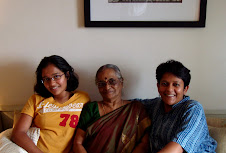
Right to left: Me in the blue T-shirt, Kim, Shamin and Prasamita.
We are standing outside the Japalouppe Office where we registered for the camp.

My friends were all first time riders but I had some experience with riding horses earlier. I stopped riding a few years back though, and I wanted to get back to it. Going to this camp was the best way to do that.
.

My first glimpse of horses at the camp

Japalouppe is a large and very beautiful farm. Apart from horses, they have dogs, cats, goats, and geese. Each day began at 6 am with the first batch of student riders (me included) having a one hour long riding session.

After our lesson we would have breakfast (sandwiches, sheera, pancakes, paratha and poha on different days). We learnt about the breeds of horses at Japalouppe, colours of horses, face markings of the horses, grooming, saddling and taking care of horses. We spent the afternoons lazing about in our dormitories or at the machan, and playing with the dogs.


Tyler, the basset hound

The evenings would see another round of riding lessons, followed by a cold water bath, dinner and finally, bed.

One morning, instead of riding we went on a trek through the path of a dried waterfall - it has water only in the monsoon - to the top of a hill. We were accompanied by some of the instructors and two of the camp dogs. At the top we had breakfast - chutney sandwiches.

Another day we went to a stud farm - a place where horses are bred. Every stall in this stable housed a mother and her foal. We saw a foal drinking its mo's milk, and another one following its mother around wherever the stablehand took her. We met a friendly stallion called Fact Finder - he seemed to love being petted and fussed over by all of us.

On the last day of the camp we had to demonstrate our riding skills to our parents who had come to take us back home. I was happy to see amma, appa and paati (my grandmom) at the show. Everyone showed off what they had learnt during these five days at camp. We got Japalouppe T-shirts to wear during the show.

I rode Little John, the same horse I'd been riding all through the camp. He is extremely calm and good-natured. Also tall and very goodlooking.

Me and Little John.

Isn't he amazing?

Riding demonstration.

All the students did walking and trotting, and some cantered. Two students with more experience did show-jumping.
.
It was an interesting yet peaceful week. Away from Mumbai, in a farm, I relaxed in the company of good friends and some very lovable animals.
.
I met a lot of great people at the camp and I'd love to keep in touch with them. I'm sure I'll meet some of them again at Amateur Riders Club in Mumbai, since they're also members there like me.
.
I also want to go back to Japalouppe as soon as possible! I can't go now in June, because I have to stay to see my college admissions through - but the very next chance I get, I'll be off!!

Monday, May 04, 2009

Agninakshatram

- by Janaki Krishnan
.
Today is Agninakshatram. From now on, for a month, the Sun is at his best, and it is the season for making papads, pickles and masalas for the year.
.
The terraces of Bombay's apartments are filled with papads drying in the sun. Housewives gather in the afternoons, and exchange recipes. They proudly declare how they got the best varieties of small green mangoes for pickling, at the cheapest price. I too enjoy the papad and picking season - especially after my retirement, when I feel the day has 48 hours.
.
This year after finishing my mango purchase (not proud, as I could get only second-grade ones!), I turned to vegetables for inspiration - beans, okra, lotus stem, and bitter gourd. When salted and dried, these make excellent fried snacks. They don't involve much labour, and they're tastier than the rice vadams and karuvadams. I made a batch of salted fritters, and sent them to my daughters.
.
Besides pickles and salted fritters, this is also the month when I buy my year's supply of tamarind. Tamarind is a must for all South Indians who cannot have a proper lunch without rasam or sambar. We buy the entire year's stock during summer when the prices are low and it is available in plenty. The tamarind is then de-seeded, dried, and stored in tight containers, along with salt.
.
This year, as I sat deseeding the tamarind, my mind wandered to a scene 60 years ago...and I had a flashback, like we see in the movies. My sister, my brothers and I are sitting around a big pile of tamarind, removing the seeds. My brother sneaks a piece of tamarind into his mouth...and the rest of us are quick to shout...."Amma!!" Of course, my brother too gets his chance to shout when someone else eats a piece. When it turns into a fight, my mother steps in. "Don't eat too much", she says, "Or it will weaken your bones".
.
These days, things have changed. With greater awareness about health, the consumption of pickles, fried items and tamarind comes with a warning. Cholestorol, blood pressure and diabetes have become familiar terms, frightening everyone. Besides, working women, whose tribe has increased since my childhood, hardly have time for such tasks. In their homes, readymade bottled pickles - Priya, Bedekar, and others - rule the roost. As bottled tamarind paste is available, nobody wants the headache of soaking, crushing and extracting tamarind essence for sambar. Women who balance career and home, and have to multi-task all the time, do need these conveniences.
.
But oh! The joys of retirement! With unlimited time at my disposal, I find a new interesting task every day. Buying the vegetable, cutting it, cooking it, and drying it, takes the better part of the day. Then comes the pleasure of frying and tasting the first batch...and the satisfaction of distributing it to family and friends. Their words of appreciation bring a warm glow to my heart. The next day, its is another vegetable's turn, and the process goes on all through summer! Silly, you may think...but perhaps when you retire, you will understand these slow pleasures. Until then, enjoy the readymade stuff!
.
(Posted by Deepa on behalf of Janaki)

Postcards from Kerala - Day 4

Lobby of The Brunton Boatyard, Cochin.
.
We had booked 1 night at this lovely hotel, but ended up staying 2 nights. The rooms are large, with interesting old furniture. Both our rooms had large sitting areas, old four-poster beds and great views of Cochin harbour.
.
On our very first lunch overlooking the sea, I spotted a pair of dolphins making their graceful way into the harbour. I was jumping up and down with excitement: "Look, Dolphins! Oh my god, Dolphins!!!". The two guys were more interested in the wine list.

I bought several spices for my kitchen at this co-operative store run by women. And I bought jewellery as well, an onyx necklace and a pearl necklace.
.
We watched an excellent Kathakali performance at the Cochin Cultural Centre. They enacted Putana Moksham (The Salvation of Putana), a story where the demoness Putana tries to kill the infant God Krishna by feeding him poisoned milk from her breasts. Instead, Krishna kills the demoness. The photo above is from the section where the demoness appears as a gentle-woman and deceives the household into letting her suckle the child.

Mandatory Chinese Fishing Nets photo. Our guide explained how they work. Simple but effective engineering!

Sunday, May 03, 2009

Postcards from Kerala - Day 3

We were still at Coconut Lagoon, Vembanad Lake. This is the 6:00 a.m. kalaripayattu practice session we watched. There was much groaning from Pramod and Marco at having to wake up early but they did it.
.
The martial arts performance was interesting. There were warm-up exercises first (a Japanese couple who were watching this with us participated in the warm-ups, but we didn't). After warm-ups, the two kalari practitioners demonstrated several fighting techniques and moves, using hands, sticks, knives, swords etc. Many of the moves are long intricate sequences - and several of them require very high jumps into the air.
.
I dragged Pramod and Marco to a 7:00 a.m. pre-breakfast birdwatching session. We saw 31 species of birds in an hour's time. I was very pleased because this is the breeding and nesting season, so I could see breeding plumages of several birds which I had not seen before. The two men suffered in stoic silence.
.
We took a smaller boat and went for an hour's cruise on the narrower lanes of the backwaters. It took us past small villages. Every house on the banks of the river had little steps leading to the water. Little kids were bathing in the river, their mothers were washing clothes or doing the dishes and keeping an eye on the kids. Many men, women and children were fishing with simple sticks for rods - we guessed the afternoon's catch would be cooked and eaten for dinner.
.

Private plunge pool at our villa. Perfect way to end the day.

Saturday, May 02, 2009

Postcards from Kerala - Day 2

Two days at Coconut Lagoon, on the banks of the glorious Vembanad Lake.

Our first sight of the lake - so big it looks like the sea! From this jetty, we took a boat to the resort.

Houseboat ride on the lake - the 'must do' Vembanad experience. As you cruise, the views are incredible - beautiful waterbirds fly past the boat, the water slaps against the wooden hull, and the breeze lulls you to sleep.

Lunch inside the houseboat - catch of the day (karimeen fry), sambar, poduthual, bitter-gourd fry, rice, yoghurt, papadam and pickle. A most delicious meal, cooked on board by the friendly crew. I fell asleep on the wooden bench, listening to the sound of the waves.

Friday, May 01, 2009

Postcards from Kerala - Day 1

Four magical days in Kerala. Deepa, Pramod and Marco.
Here's Day 1, at Marari Beach Resort, Alleppey.

The beach was private and very quiet. There was a security guard who walked the stretch - maybe because the sea was a little rough and they wanted to keep an eye on the few guests who were in the water.

The three of us spent some time sitting under the tree - but soon realised it was better to sleep! So we got ourselves some beach towels and spent a blissful 45 minutes snoozing under the tree. I saw a kite flying overhead.
.

Pramod and I wake up - and a classic Bollywood pose is born!

Sunday, April 26, 2009

My kitchen knives

- By Deepa Krishnan
.
When I first set up my kitchen, I bought a set of five steel knives from an upscale lifestyle store. There was a lovely chunky wooden holder (you know, the light coloured wood that you see in Scandinavian furniture?). The knives sat snugly in it. The darn thing caught my fancy.
.
I brought the knives and the holder home, and set it up on the kitchen counter. When the sun streamed through the window, the knife handles gleamed satisfactorily. Ah, Deepa, I told myself - you have quite the modern kitchen!
.
Five years have gone by now - and guess what - the knives are still sitting in the holder. We don't use them at all! Instead, my maids prefer these - the 10 rupee handmade knives from Zaveri Bazaar.

These knives are made by hand. A blade is inserted into a wooden holder, and bound with thin wire. The blade is then sharpened on a grinding stone. The nicer, bigger ones cost twenty rupees.
.
It's not just my maids who love these knives - I do too. They are excellent for slicing vegetables; and even the trickiest tomato is no trouble at all. I think it's because the blade is really thin and flexible. T-chak! T-chick! In minutes the carrots and beans are all neatly sliced!
.
My food-writer friend Rushina is a big fan of these knives too. I remember a couple of years ago, I was walking in Bhuleshwar with her and she said, "Deepa, you know, these are really great for vegetable carving." That's when I bought these for the first time, and now I'm hooked.
.
The knives are incredibly sharp when you buy them. But they lose the sharpness in a couple of months, because they're really thin knives and I don't think the metal is high quality. When we've used them for a couple of months, we take them back to the knife guy, and have him sharpen them again.

In spite of the need for sharpening, they're really lovely to use, and we've switched over completely to these. Next time you're in Zaveri Bazaar, or at your local market, buy yourself one of these. Oh, and if you need to see how sharp the knife is, ask them to demonstrate that neat paper-slicing thing they do! It's fun to watch!

Sunday, April 12, 2009

This khus thing

- by Deepa Krishnan
.
Just opposite Mangaldas Market, under the shadow of the Jama Masjid, there's a little attar shop. My friend Shoba wanted to buy sandal extract, so I went along with her to have a look.

I have never bought attar in my life - actually, I've never bought any perfume at all, apart from the mandatory deo - so I was a complete novice. Shoba seemed to know what she was doing though, so I stood quietly watching while she talked to the shop owner.

He was young and good looking - and with the kind of acquiline face and glossy black hair that belonged in the movies. Once he figured we were really going to buy something, he warmed to us and gave me a tiny smile for my camera.
.
While Shoba tried different extracts and essences, I tried to read the labels on the crystal decanters. What interesting names they had - Jannatul Firdose, Kasturi, Estanbul Gulab, Black Musk, Tea Rose, Mogra, Majmua, Ajab...
.
The one that interested me was a dark coloured liquid on the back row - Ruh Khus, or Soul of Vetiver.

I know what khus is - have you seen it? It is a sort of long aromatic grass. We've got khus incense sticks at home - the smell is woody and smoky. For those who are not big fans of floral essences (like me!), Indian vetiver or khus is a good alternative.

Khus is widely used in India, and not just in perfumes. In the summer months, it is woven into mats, and hung on the doorways of houses to keep the sun away. Water is sprinkled on the mats, and when the breeze blows through it, it keeps the house cool and fragrant.

The most interesting thing I've read recently about khus is how the Konkan Railway has used it to safeguard the rail track against soil erosion and mudslides.

The Konkan Railway runs between Bombay and Goa, on the foothills of the Western Ghats. Of the 740 kms they cover, one-third of the route has been either tunnelled or cut through the hills. There's also heavy rainfall here in the monsoons, so keeping the tracks clear of mudslides is critical.

On the Konkan Railway website, they've actually written two pages of stuff explaining why they picked vetiver for their embankments:

1) It is easily available all over India.

2) It is cheap and easy to establish as a hedge.

3) It can be easily maintained at little cost.

4) It withstands wide range of climates – from 300 - 6000 mm rainfall and from 15 - 55 degrees temperature. Moreover, it can withstand long and sustained drought for more than six months.

5) It is totally free of pests and disease, and does not serve as an intermediate host for pests or disease of other plants.

6) Its strong fibrous root system penetrates and binds the soil upto 3m depth.

7) It is perennial and requires minimal maintenance.

8) Over a period of time it helps in changing the PH of the soil from about 2 to 8 i.e. from acidic to alkaline.

OK, I'm thoroughly impressed! Not just with khus itself, but also with the Konkan Railway (just when you think everything is going downhill with the government, you find out they're doing some very cool stuff).

Anyway - I'm off now - I'm going to get some vetiver for my home garden!

Monday, March 30, 2009

Celebration

- by Deepa Krishnan
.
Today my daughter went out with friends, to celebrate the end of her 10th Standard CBSE Board exams. For a month now, the exams have ruled our household. But no more! As I write this, we are (...sigh of pleasure here...) reverting to the old ways.

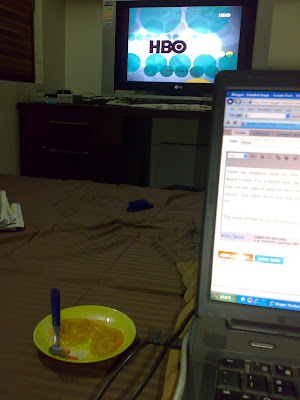
Right now for example, I'm watching television. It's not like we didn't watch TV this past month - but today I'm watching it in a happy mindless sort of way. I don't have to turn down the volume, I don't have to feel guilty about having a good time while my kid is slogging her butt off. Sigh. It's nice, even if there's only some really crappy stuff playing on HBO.
.

And you know what the other nice thing is? We can order in. Without thinking about upset tummies and food poisoning and missing exams! Yayy for the greasy little pleasures of life!

Friday, February 20, 2009

Nendrampazham - King of Bananas

- by Janaki Krishnan
.
Food is one area where my husband and I are poles apart (although our horoscopes show samasaptakam, or perfect agreement between our stars!).
.
While I am a foodie, my husband believes that one should eat only to live. Recently, he had a minor surgery, after which he was advised to eat a nutritious diet with plenty of milk, vegetables and fruits. This is where the Nendrampazham came to my rescue. The only fruit that my husband eats with delight is this king of bananas, a big yellow variety that is also called 'Rajali Kela' in Mumbai.

Rajalis from Vasai come into the city, but the Kerala variety is sweeter
.
Unlike the usual small sized bananas, this fruit can only be eaten plain if you have a strong digestive system. The popular method is to steam cook it, so that it becomes an ideal food for the sick, the elderly and for young children.
.
For my husband, I often cut the banana into 3-4 pieces and steam it with jaggery. It takes just ten minutes to cook, and everyone loves the taste. The pleasure of unwrapping the banana with your hands and tasting the caramelised jaggery is simply heavenly.
.
Bananas in a kadai with water and jaggery.
.

Ready to eat!

My younger granddaughter likes to have bananas sliced into thinnish circles, and stir fried in ghee. She eats it with a fork, Western style. But my older granddaughter loves banana chips. These are made using the raw version of these bananas, by slicing it very thin, and deep frying it in oil.

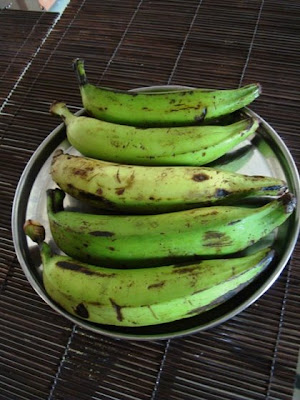
Nendrankkai - the raw version of Nendrampazham

My mother was an expert in making banana chips (and my father in distributing it among his office friends). As a young girl, whenever we heard a hissing sound coming from the kitchen, I was sure that my mother was busy making chips. The hissing sound comes at the last stage of making these chips, when salt water is poured on the chips before pulling them out of the oil.

That is what differentiates the traditional home-made chips from the ones we buy in Matunga market. In the market, the salt is added later, after the chips are taken out of the oil.

Home-made Nendrankkai chips
.
There are many more ways to enjoy this versatile banana. Sarkaraupperi is made by deep-frying raw bananas, dipping them in a jaggery syrup and then dusting it with dried ginger.
.
Sarkaraupperi is served at our weddings. After the first spoonful of payasam is served, this is the second favourite.
.
No food is wasted in India, even when it is available in plenty. Dried banana is powdered, stored, and later mixed with milk and water for use as baby food. My Christian friend makes sweet and salty bhajias using ripe bananas. Even overripe bananas, with the skin blackened, are turned into halwa using jaggery and ghee.
.

Banana varieties in Matunga Market

Nendrankkais are also used to make many Kerala specialities - erisseri and kaalan are my favourites. Even the skin is cut into tiny bits and converted into a tempting side-dish. No wonder this banana is called 'Rajali' - it is truly the King of Bananas!