Monday, September 29, 2008

An evening on Marine Drive

My friend Praveena just landed a new job, so we went out to celebrate. She bought tickets to a play, it was being staged at the National Centre for Performing Arts on Marine Drive, at 4 p.m.
.
'Chaos Theory' by Rahul da Cunha is the story of two people, starting from their college years in the sixties, to their present day life as academicians in New York. Reasonably good ingredients for a play, I guess, although this kind of storyline has been done to death already.
.
Here's a scene from the early part of the play. The two first meet at a college party in St. Stephen's, Delhi, where they discover they are both students of English literature. He is a pompous but funny wastrel who loves to drink; she is sharp and witty and destined to be top of her class.

There was a projection screen at the back, on which they used a montage of music and visuals from each decade to show the progression of time. The images and songs were right for the period, but it looked like the sort of thing an amateur would put together on Powerpoint. A little more attention to style and design would have helped. I felt like I was back in college, putting on a last-minute show for some college festival.

The play itself was pretty decent, some of the lines were really funny, although the conversations sounded like they were set in Eton rather than Delhi. I must confess, I'm not a big fan of the kind of Indian theatre where the script sounds like an Englishman wrote it. Granted, the main characters were students of literature, but they sounded so very unreal. There was also a lot of slap-stick by supporting characters, and a final emotional scene with so much gawky hamming by the drunk wastrel that both my husband and I couldn't bear to watch it. Overall, though, not a bad effort, 6 out of 10 on the Deepa Scale!

The play finished at 5:30, so we decided to wander down past Marine Drive to Chowpatty Beach. Everyone wanted to eat pav-bhaji.

At Chowpatty, the stalls were already beginning to see the first customers of the evening (peak time at the stalls is from 6:00 to 8:00 pm). We went looking for pav-bhaji, but got sidetracked by the Badshah panipuri stall.

.

Badshah has absolutely delightful panipuris. They're served by a guy wearing a pair of gloves, so of course, they lack that extra tang of sweaty hands! But it's lip-smackingly good, and you can ask for a filling of your choice (potatoes, sprouted moong, chole, or boondi). I had hot chole filling, with ice cold pani and an absolutely heavenly meetha chutney. After you're done eating, there's a guy who comes around handing out paper napkins.

After panipuri, I dragged everyone to my favourite pav-bhaji stand - Shetty's. They also do some really good sandwiches.

Pramod, me, Praveena and her husband Rajeev. Four very hungry people. I ordered a cheese pav-bhaji, while they stuck to the normal stuff. Pramod as usual, wanted his pav without maska.

Piping hot and mouth-wateringly tasty! It was spicy as well, the kind of spice that sets you thinking about ice-creams and golas for the next course.

Kulfi seemed like a better option than golas. There were lots of flavours to choose from; including some names that seemed inspired by Playboy. (I'm not kidding. I found a Kulfi called SANGAM 3-IN-1, and another one called MILAN 4-IN-1.) There was also a whole sub-section called Punjabi Special Item (are you thinking what I'm thinking?) - which included Punjabi Rabdi Kulfi, Kaju Draaksh Kulfi, Anjeer Kulfi, Sitaphal Kulfi, and a very, very modern-sounding 2000 MILLINIUM KULFI. Pramod ordered a Punjabi Rabdi, and it was outstanding. Praveena and Rajeev had Sitaphal.

By this time, the sun was setting over the Arabian Sea. The municipal van came around on its patrol, so the hawkers selling colourful paper fans and balloons disappeared. We decided to head out to Dragonfly at Express Towers for a drink. It's quite a swish lounge bar and restaurant, and some of the tables have really lovely views of the Arabian Sea.


We hung around near the bar. Drinks were ordered, and pronounced satisfactory. After all the stuff we'd eaten, none of us could bear the idea of more food. It was a quiet night, since we were there early, so we had our pick of tables.

I didn't want to sit anywhere near the big TV screen, so every now and then Rajeev would pop around the corner to watch the Singapore Grand Prix. We were discussing Lehman Brothers and bonuses - or the lack of them - when Rajeev suddenly piped up: "That's the Spanish national anthem!"

"Huh?" I said

"Must be Alonso!"

"Er...?"

"Alonso! He must've won!"

"Ah", I said, nodding like it all made sense.

At some point, we finally paid our tab (well, Praveena paid!) and left. Downstairs, the Victorias were doing their little pleasure rides on Marine Drive. I watched a young couple (honeymooners?) smiling and enjoying their ride on a jingling carriage.

By the time we got into our car, I had a beatific smile on my face. Good company, great food, good conversation...and great views of the Arabian Sea. I can't think of a better way to spend an evening on Marine Drive!

Sunday, September 14, 2008

The real Ganesh Chaturthi

As I sit at my desk and type this, I hear the noise of dancing and singing on the street. Big Ganesh processions make their way down the main road, heading towards the beach for immersion. The firecrackers are loud and almost endless. Some of the men are drunk. I am deafened by it all.
.
I think of this morning's drive with Alex, and our little walk on Chowpatty beach. It was not noisy then...there were no fireworks or cymbals or drums. Instead, there were small families and little groups of people, chanting and singing and clapping their hands as they said goodbye to their own little idols of the Elephant God.
.
What I saw gladdened me. It was a time for togetherness, for bonding with family and friends through the familiar rituals of prayer. Surely this is what this festival should be?
.
This family poses, their son clicks a photo so they can remember this year's idol.

Another family just starting to set out the idol in the sand for the last puja before immersion.


The sound of rthymic clapping, and the voices of children singing drew me to this little circle.

This man's voice rose strong and confident as he bid a personal goodbye to Ganesh.

I came away from Chowpatty refreshed by the sights we saw. After the ugly sponsored commercials and hoardings for paan-masala all along the Ganesh mandaps on the road, the sight of the festival's true spirit was very rewarding indeed.

Monday, September 08, 2008

Found Found Found - A Tree with acne?!

- By Aishwarya Pramod
.

We were on a nature trail at the Sanjay Gandhi National Park on Sunday morning, when I came across this wierd looking tree with knobbly protrusions all over the bark. What were they, an infestation? An infection? No, said our BNHS guide, they're insurance against dry days. This is the Red Silk Cotton tree and the spines/thorns are how the tree stores water.

We walked a little further, and found another individual of the same species. But I was more interested in the liana twirled next to it. These woody climbers are pretty strong, they grow straight up until they find a suitable host and then start to twine themselves around the host. But why do they do this when they aren't parasites?

Well, in a vine-eat-vine world, it's each vine for itself in the race to reach sunlight. Because in a tropical dry deciduous forest like this one, the tree cover is very thick, especially in the monsoon, and can completely block out the sunlight.

Lianas form bridges between the tree canopy, connecting the entire forest in an intricate network of entangled vines. Fully developed lianas are strong enough to take the weight of arboreal animals like macaques, hanuman langurs and the occasional flying fox. It's easy to figure out why lianas are also called Tarzan Vines!

The Park is very pretty, and we had a nice time there. Did you know that Sanjay Gandhi National Park is supposedly the largest national park in the world within the limits of a city? Check it out some time. BNHS organises great walks every now and then. We certainly enjoyed this one! :)

One morning in Dharavi

- by Deepa Krishnan
.
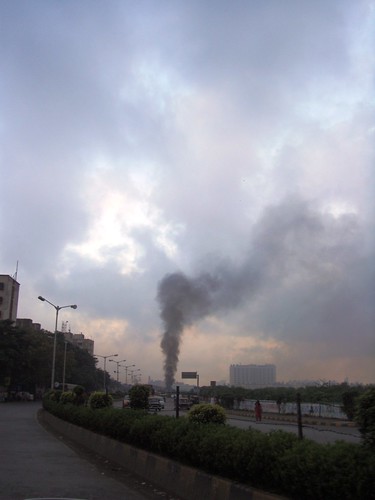
It was 7:00 a.m. I had dropped my daughter at school, and was driving home past Bandra Kurla Complex, when I saw a tower of thick smoke rising to my right.
.
"It's coming from Mahim", I said to my driver. "Do you think it's a fire?"
.
"No, it's from Dharavi", he said. "I've seen it before."
.
I had seen smoke at Dharavi earlier, but today it was exceptionally thick and dark. I thought we'd take a look. Sometimes early morning disasters don't get reported in time; perhaps I could stop for a quick check.
.
We drove closer. The smoke seemed to be coming from a residential area of Dharavi. I knew there were thickly populated bastis on the left on the road, where most of the recycling work gets done. We often take tourists to some of those places, and I thought to myself, what if it's one of the recycling compounds? They have enough inflammable things in there to start an inferno.

When we got closer, I realised it was coming from the opposite side of the road, from the marshy land opposite the hutments. It seemed to come from a line of trucks parked on the road. There was none of the panic and shouting associated with a fire.

We stopped for a closer look. Here's what we saw - in a clearing behind a low wall, a big rubbish heap was being burnt. Maybe they were burning the left-overs from the recycling factories - the thick smoke told me it was probably at least partly plastic. A young man was sitting there - he didn't move at all in the 10 minutes that I was there - I got the feeling he was watching over the fire. There were two bullock carts, transporting oil, the bullocks resting in preparation for the day ahead.

I realised it was just another day in Dharavi. Nobody gave a damn about the dense smoke, although my chest burned from just 10 minutes exposure. Just across the road from the burning, the daily routine had begun. The water tanker had arrived and big plastic drums were being filled for the day.

About 100 metres away, the shanties were already abuzz with activity. Little shops were open, and people were walking in the narrow lanes.

And naturally, since this was 7:00 a.m., every available inch of open space had been converted into a toilet. Little kids sat unmindful of passing traffic; while grown men found convenient bushes behind walls. The women, of course, had risen much earlier, while it was still dark, so they could have some desperately sought privacy.

My spirits sank at the sights I'd seen - pollution, dirt, stench...we're talking of Shanghai-like towers and skywalks and bridges, when we can't even get running water and toilets in place?

I was still thinking gloomy thoughts when we drove past a busy central thoroughfare and spotted several bright-eyed children going to school. Some of them were walking with siblings, others were riding pillion on their father's motorbikes. Many, especially the little ones, were walking with their mothers. I saw mothers carrying schoolbags and tiffin boxes and bright plastic water bottles, walking in that determined way that only mothers have, hustling their kids to school in time. After the depressing sights I had seen, the sight of these young kids was like a ray of sunshine. Here were children just like the ones I saw at my daughter's school; here were mothers with the same determination as me.

Still further down, I saw the Lijjat Papad van making its rounds, collecting papads and distributing fresh dough for making more. I thought of all the papad-makers I knew, women who supported their families through papad co-operatives. It lifted my spirits.

It's not all beyond repair, I told myself. There are good things too. Even among squalor and depressing conditions, Dharavi always manages to show a little bit of its bright side to anyone who cares to see it.

I remembered my first meeting with ragpickers from Dharavi a couple of years ago. They were sisters, giggling and collecting trash at Horniman Circle. I chatted with them only briefly; but talking to them changed me, transformed me from an outsider to an insider. As long as we don't turn our faces away from the reality of Dharavi, as long as we see commonality and shared humanity, there is hope yet - for the people of Dharavi, and for all of us in Mumbai who live side-by-side with it.

Wednesday, September 03, 2008

Thirty minutes in an imaginary world

- By Janaki Krishnan
.
Mumbai is a crowded city. Noise and air pollution are beyond acceptable limits. But I still enjoy my evening walk along its uneven roads and footpaths. This half-an-hour's exercise not only keeps me physically fit, but also stimulates me mentally. There are several regular faces that I encounter, and I enjoy labelling them with traits purely of my own imagination.
.
As soon as I set out from our building near Sion Circle, I see another walker, a very energetic young lady in her twenties. I call her my 'marching soldier'. Her erect posture, the sincerity of her face, and her steady yet energetic pace make me straighten up. I gather speed and try to keep pace with her.
.
Turning to the right, I reach the main road leading to King's Circle. Here I see a South Indian couple, senior citizens, the man walking ahead and the wife trailing two steps behind. Their slow leisurely walk, their conversation, and the occassional smile on the lady's face speak to me of the fourth stage of their life - vanaprastha - a period when ones duties towards children are over, with no worries about providing for financial security, and no waves of the 'samsara sagara' dashing against them. The peace and contentment on their face is contagious.
.
Walking a few steps ahead, I see a young couple walking hand-in-hand. Probably they are lovers, soon to be married. Their joyous faces reveal their dreams and aspirations for a happy life together.
.
I reach Muralidhar temple. Having expressed my gratitude to the Lord for his blessings, I come out, and trace my way back home. On the way, I often see a middle-aged lady walking with some difficulty, limping, supporting her knee with her hand. Watching her walk determinedly, I learn a lesson - that if you are mentally strong, then no physical disability can deter you from doing what you want.
.
As I near home, the last person I meet is my 'maalish bai', who I had employed to massage my grand-daughters when they were infants. I stop to exchange a few words with her. The renewed association brings back sweet memories of my experiences as a grandmother, and brings a smile to my face as I enter my house. Thirty minutes of walking along Mumbai roads has transported me into a wholly different world of imagination.

Saturday, August 30, 2008

A Brahmakamal blooms in Mumbai

- By A. Krishnan

Have you seen a Brahmakamal flower in full bloom? If you answered 'No' to that question, I wouldn't be surprised. When the Brahmakamal blooms each year, most Mumbaites are fast asleep!
.
This flower, named after Brahma, the God of Creation, blooms only for one night in the entire year, somewhere between July and September. The blooming lasts only for a few hours. This year, I was lucky - I had advance warning, and knew exactly when to show up with my camera for the blooming.

My interest in the Brahmakamal started in July, when I visited my aunt in Sion. She took me to her balcony, and showed me a plant with buds.

"This is the Brahmakamal", she said. "Don't you know the story of how Brahma emerged from Vishnu's navel in a lotus flower? We are lucky it is going to bloom in our house! See the buds?"

I peered over her shoulder, and saw a rather ordinary looking plant, about 4 feet tall. And yes, there were a few buds. I noticed one very strange thing - unlike other plants, these buds actually originated from the leaf of the plant.

Over coffee, I found out more about the Brahmakamal. She told me that the flower is considered sacred, and does not bloom in all homes. So people consider themselves lucky if they are able to witness this rare event, and perform pooja and aarti at the time of blooming. It is also considered to be a good omen and a sign of prosperity for the home.

I made up my mind to see this interesting flower. Over the next two weeks, I made several visits to her house, hoping that the buds would bloom...but they remained obstinately closed. Then one day, at 8:30 p.m., my aunt called me. "Come tonight, the buds have started to open!" I hurriedly finished my dinner and took my Canon Powershot A460 digital camera to catch a few pictures.

The bud beginning to open
,

Half-open phase - absolutely beautiful

Brahmakamal in full bloom

The whole room was filled with a lovely fragrance, and I was ecstatic to witness to this beautiful creation of the Almighty. If you look a little closer at the photo, you'll see the central white stamen. People believe that this stamen represents Lord Krishna, while the reddish brown stalks which you can see on the closed bud represent the 100 Kauravas from the Mahabharata.

The Brahmakamal is not a lotus at all, although its petals resemble a lotus. Lotuses grow in ponds, whereas the Brahmakamal grows on the slopes of the Himalayas (it is the state flower of Uttaranchal). The botanical name for this flower is Saussurea Obvallata. There is a belief that the Brahmakamal should be gifted, and not bought in the market. To grow the plant, a leaf is planted in the soil (and not a seedling or stem). This leaf then multiplies and becomes a plant to a height of about 4 to 5 feet. The flower itself is around 4-5 inches in diameter and has a lovely fragrance. But of course, you have to wait a whole year to smell that fragrance!

(Posted by Deepa on behalf of her uncle A. Krishnan. Edits by Deepa. Here's hoping the clan continues to produce more writers!)

Note (Oct 2): It turns out this flower is not the Brahmakamal but the Dutchman's Pipe. But Indians who worship it don't make these fine botanical differentiations! In the larger scheme of things, perhaps that is a better attitude?

Friday, August 15, 2008

A mysterious sort of grass

I see these little baskets of grass often in the market in Bhuleshwar. Do you know what this grass is, or how it is used? I've wondered about it so often that I decided to post a photo. I'm simply dying to know!
.
I have a pet theory, that these are herbs used to flavour drinking water. As a child, I remember drinking herb-flavoured water at my friend Sugatha's home. They are from Kerala, and her mom made herb-flavoured water at home every day. It looked like pale whisky, but smelled delicious and the taste? Well, it tasted like water, but you felt ever so virtuous drinking it!
.
Maybe the grass in these baskets is actually a herb that goes into tea? Or maybe it is some vile concoction that you drink first thing in the morning for arthritis or diabetes! Oh, someone please tell me, and put me out of my misery!

Saturday, August 02, 2008

A Welcome August

- By Janaki Krishnan

As the month of August arrives, I remember my childhood years and the pleasant memories of my student life at SIES High School, Matunga. As students, we always welcomed this month, which is full of festivals and holidays.

It usually began with Independence Day on 15th August. A week earlier, students of our class would collect money (4 annas per head!) to buy coloured paper and balloons to decorate our classroom. We celebrated the historic day by hoisiting the national flag, and singing patriotic songs. My favourite was Bharatiyaar's Viduthalai, Viduthalai (Freedom, Freedom!), a song proclaiming equality in Indian society. The other popular song was Muhammad Iqbal's Sare Jahan se Accha (Better than the whole world). But for us children, the highlight of the morning was the sweets distributed by the teachers at the end of the function.
.
Independence day of 1948 was special for us. That year, in the evening, my father took us by tram from King's Circle to VT to watch the city celebrating the first anniversary of India's freedom from British rule.
.
The tram fare was 1 rupee or so, but it was well worth it to see the grand illumination all over the city. All the big buildings were lit up - the black sooty mills at Parel, the railway yard, the Times of India building, Municipal Corporation and the grand Victoria Terminus. I remember seeing lights all along Hornby Road, and I think we rode right upto the last stop of the tram, the Prince of Wales Museum.
.
There were several other festival in Augusts that we celebrated. For Onam, the harvest festival of Kerala, we gathered at the school early in the morning, and decorated the portico with coloured flower petals. On Narali Poornima or Avani-Avattam, school was closed. On this day, menfolk went to the temple to purify themselves of sins committed through desire or anger. The old sacred thread was discarded, and a new one was worn, chanting kamokarsheet (It was desire that made me do it!). This ceremony was performed before the commencement of the study of the Vedas, after the monsoon break. We children enjoyed a grand feast.
.
By the end of the month, Gokulashtami would arrive, when we joyously celebrated the birth of Lord Krishna at midnight. The day was spent preparing prasad for offering to Krishna for his midnight visit. Four of us - my elder sister, myself, and two of our brothers - sat around a clean white dhoti to make cheedais. My mother gave us a big mound of rice dough, and we rolled it into little circular balls. My mother watched and admonished us if the balls were not uniform. Later the balls were deep fried into a delicious golden brown. We also enjoyed going from lane to lane, to watch the Govindas break the dahi-handi. In the evening, the house would be decorated with rangoli. Tiny feet of the Lord were drawn leading into the house, guiding Him to come in and partake of the offerings.
.
Even today at 73, I enjoy the arrival of August. I go to my school as an ex-student, to participate in the flag hoisting. My grandchildren join me at home in celebrating Onam, Avani Avattam and Gokulashtami.

Tuesday, July 29, 2008

Birthdays

- by Janaki Krishnan
The news in the morning paper caught my eye. It had a cheerful photograph of South Africa's first black president, with the caption "Mandela turns 90". On his birthday, he received goodwill messages from all over the world.

I was reminded of how birthdays are celebrated in my Tamil Brahmin community. There are three birthdays that are traditionally celebrated with pomp and splendour - the first birthday, the sixtieth birthday, and the eightieth birthday.

I still remember how joyously we celebrated our daughter Deepa's andu-niravu (first year-completion) with a visit to the temple, an ayush-homam (a prayer ritual for long life) and a grand feast for friends and relatives. A professional photographer was hired, the child was garlanded, and we all posed for photos.
.

My daughter Deepa's first birthday - outside our old Sion building

I remember my father's sixtieth birthday equally well. His sashti-abda-poorti (sixthieth year completion) was done the traditional way, by conducting a second marriage of him and my mother. My mother wore the traditional nine-yards saree, and amidst the chanting of mantras by the priests, my father tied the yellow thiru-mangalyam (wedding thread) around my mother's neck exactly as he had done on their wedding day.

My father's sixtieth birthday was celebrated along with another important event - my grandfather's eightieth birthday. For the eightieth birthday, children conduct a sadabhishekam (hundredth-year completion) ceremony. After the religious rites are over, everyone queues up with offerings of fruits and gifts to get the blessings of the Grand Old Man.

My father's sixtieth birthday at Matunga. He is standing next to my mother. My grandfather is seated in front.

Outside the sphere of religion, the birthdays that I really enjoy celebrating are those of my ex-colleagues. We are a gang of teachers (many of us 70 and above) who celebrate each others birthdays by organising get-togethers.

It is a day when we set aside our usual responsibilities and worries and live in a different world. We bring gifts and delicacies for the 'Birthday Baby'. We talk, laugh and eat, remniscing and reliving old incidents. We tell each other funny anecdotes, and enjoy the birthday to the fullest, singing 'Happy Birthday to You' as loudly as we can!

Saturday, July 19, 2008

Elephant Mania at Lalbaug

I was driving past Lalbaug today, and here's what I saw: Complete and Total Elephant Mania!
.
They were assembling several more elephants in the compound nearby (at least 7-8 more). I think they're going to place them all along the road. If you go over the Lalbaug flyover, you'll get a great view of all the elephants being lined up. So hurry! Find some excuse to drive on that route!
.
Looks like this year's Ganesh Chaturthi is going to be very grand indeed. Lalbaugcha Raja is truly going to be a raja!